The Rust Spray Named After the 39 Times It Didn't Work
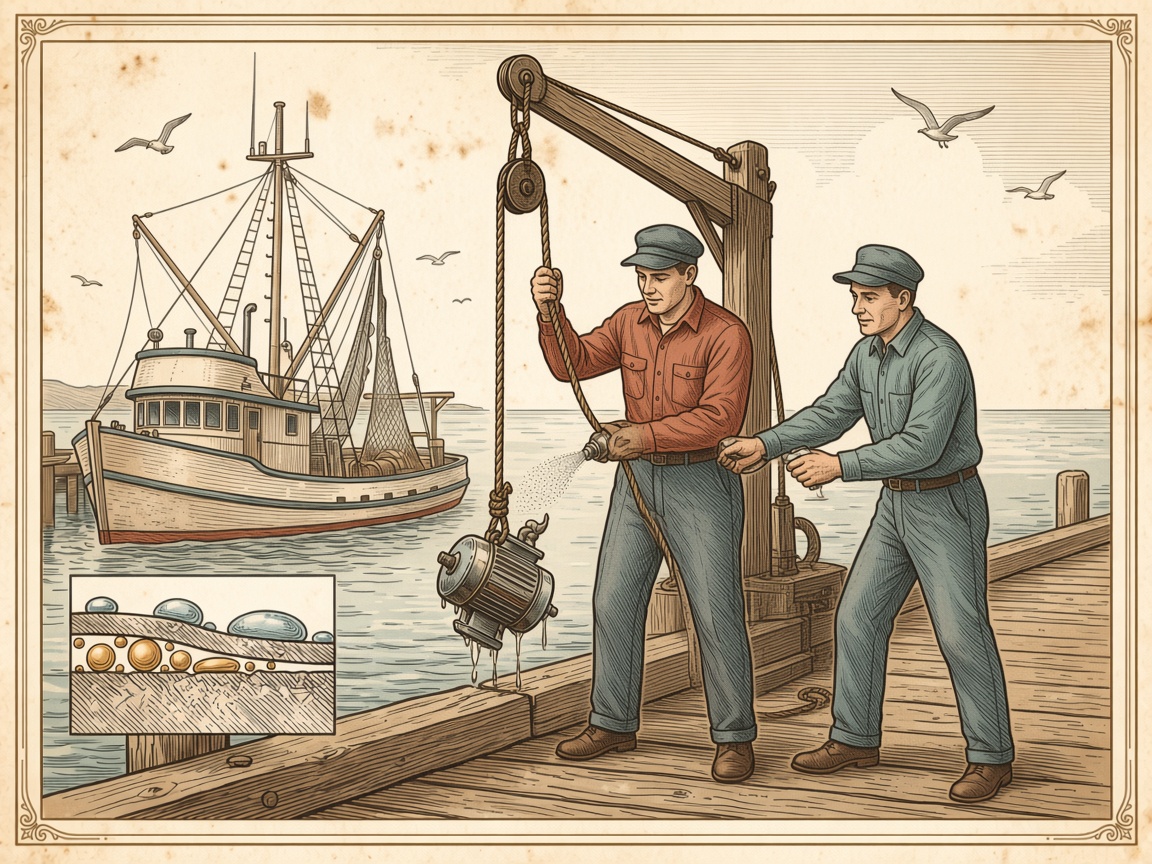
On a San Diego dock in the 1950s, two men lowered an electric motor into the salt water of the bay, left it there a while, hauled it back up dripping, sprayed it with an oily liquid from a new little chemical company — and, the way one witness's son told it decades later, it started right up. The liquid in the can had a name that was really a lab note: WD-40, for "water displacement," attempt number 40. The first thirty-nine hadn't worked.
By the Curiosities Desk · · 5 min read · Filed under Chemistry · Today’s round
What happened?
WD-40 Company’s official history says that in 1953 a three-person outfit called Rocket Chemical Company, working in a small San Diego lab, set out to make rust-prevention solvents and degreasers for the aerospace industry, and that it took 40 tries to get the water-displacing formula right. The company credits its founder, Norm Larsen.
The fuller story is a little more tangled. In 2014, historian Iris Engstrand of the University of San Diego published an account in The Journal of San Diego History, built partly on interviews with the family of a different man: Iver Norman Lawson, a Caltech-trained mechanical engineer who had once run a flying school at Lindbergh Field. According to Engstrand, a naval commander who was a family friend asked Lawson for something to keep ocean salt from corroding gears on Navy ships. Lawson worked on it in the evenings in a makeshift lab over his garage on Myrtle Way, in the Hillcrest neighborhood, mixing batch after batch “much to the dismay of his family,” until the 40th worked. His family said he handed the formula to his Rocket Chemical colleagues for a $500 bonus.
So why does nearly everyone say Larsen? Engstrand’s explanation is almost too neat: Norman B. Larsen was the company’s president in 1957 and 1958, the years the product took off, and over time the two Normans — both chemists, both, by her account, born in the Chicago area — blurred into one. She credits Larsen with putting the product in aerosol cans. The two versions still disagree on who mixed formula No. 40, and no single document settles it.
Its first big job is the part everyone agrees on. Convair, the San Diego aerospace contractor, used WD-40 to protect the outer skin of the Atlas missile from rust and corrosion. Atlas was built around “balloon tanks” — fuel tanks of extremely thin stainless steel that held their shape only because they were kept pressurized, like a soda can that’s rigid when sealed and crushable when open. A metal skin that thin has no rust to spare.
Meanwhile, the stuff kept walking out the door. WD-40 Company says it worked so well that some employees snuck cans home. Engstrand describes Rocket Chemical’s Cy Irving demonstrating it for tuna-boat owners at the Union Oil Dock — that’s the dunked motor from the Hook, a story Julius Zolezzi heard from his father, who was on the dock. One boat owner, Sam Crivello, was impressed enough to buy half the company.
By 1958 WD-40 was on San Diego store shelves in spray cans. That September, the company told The San Diego Union it was filling about 8,000 cans a day and selling through more than 500 county stores. In 1960, its staff of seven sold an average of 45 cases a day from the trunks of their cars. In 1961, after Hurricane Carla flooded the Texas Gulf Coast, employees came in on a Saturday to brew extra concentrate, and the company shipped 36,000 pounds of it to dry out drowned cars and machinery — its first full truckload order.
In 1969, a new president, John S. Barry, suggested renaming Rocket Chemical after its only product. His reasoning, according to his family: “We don’t make rockets.”
Why was it strange?
Most products get names from marketing departments. This one kept the label you’d scribble on a test beaker — and the label admits failure. “40” quietly tells every customer that 39 versions came first and didn’t do the job. It’s a rare brand that advertises its own trial and error.
It’s also strange how far the product traveled from its purpose. It was designed to protect missiles and ships’ gears, and it ended up in kitchen drawers. Engstrand’s list of reported uses includes squeaky fans, stuck zippers, crayon on walls, prosthetic limbs, and helping free a python that had coiled itself around the undercarriage of a bus. The company’s own list now runs past 2,000 uses.
Another ordinary thing with a strange past: The Minister Who Lived Next to a Brewery and Invented Soda Water to Cure Scurvy.
What did scientists learn?
Rust is what happens when iron reacts with oxygen and water. Take away the water, and the reaction slows to a crawl. That’s the whole idea behind water displacement.
A water-displacing liquid has to do two things. First, it has to “wet” metal better than water does — meaning it spreads out and clings to the surface instead of beading up. Second, it needs a lower surface tension (the pull that makes water molecules cling to each other and form droplets). Spray such a liquid on a wet part, and it creeps underneath the water droplets, gets between them and the metal, and lifts them off. What’s left behind is a thin film of oil that keeps new moisture and oxygen away.
The exact recipe is a trade secret — it was never patented, because a patent would have meant publishing the ingredients. The company says only that it is a blend of lubricants with anti-corrosion agents and ingredients for penetration, water displacement, and soil removal, and that about half of it is refined mineral spirits, a petroleum-based solvent that helps it flow into tight gaps and then evaporate. It also says, firmly, that there is no fish oil in it, a rumor apparently started by anglers who noticed fish seemed to like their sprayed lures.
Another object that did not start out as itself: The Secret Rubber Substitute That Became Silly Putty.
How does it affect us today?
In 1993, the company reported WD-40 was in four out of five American households. It’s a standard tool for drying out flooded equipment after storms, a role that began with Carla in 1961. And it has become an unusually well-known case study in trade secrets: the handwritten formula is kept in a bank vault. In 2018, for the company’s 65th anniversary, CEO Garry Ridge carried it to a new vault in a briefcase handcuffed to his wrist, escorted by armed guards and an armored truck.
A close cousin: The Billiard Ball Prize That Invented Plastic.
Fun fact
WD-40 Company keeps a myths page denying that its spray cures arthritis — a headline it says shows up in tabloids about once a year. It doesn’t, and the company advises against any medical use.
Sources
- Iris H. W. Engstrand, “WD-40: San Diego’s Marketing Miracle,” The Journal of San Diego History 60, no. 4 (2014) (strongest primary-based source, citing period San Diego Union coverage and family interviews)
- WD-40 Company — WD-40 History
- WD-40 Company — Myths, Legends & Fun Facts
- PR Newswire — “WD-40 Company Enlists Armored Security to Move Top-Secret Formula to New Location, Celebrates 65th Anniversary” (2018)
- Times of San Diego — “WD-40 Marks 65th Anniversary by Securing Iconic Product’s ‘Secret Formula’” (2018)