The Minister Who Lived Next to a Brewery and Invented Soda Water to Cure Scurvy
In 1767, a Unitarian minister named Joseph Priestley moved to Leeds, England, and found himself living next door to a brewery. Most neighbors would have noticed the smell. Priestley noticed the invisible gas rolling off the fermenting beer, and before long he was holding dishes of water over the vats to see what would happen. The water came back tasting faintly fizzy. Five years later, the Royal Navy was planning to test his bubbly water as a cure for scurvy on Captain Cook's next voyage around the world.
By the Curiosities Desk · · 5 min read · Filed under Chemistry · Today’s round
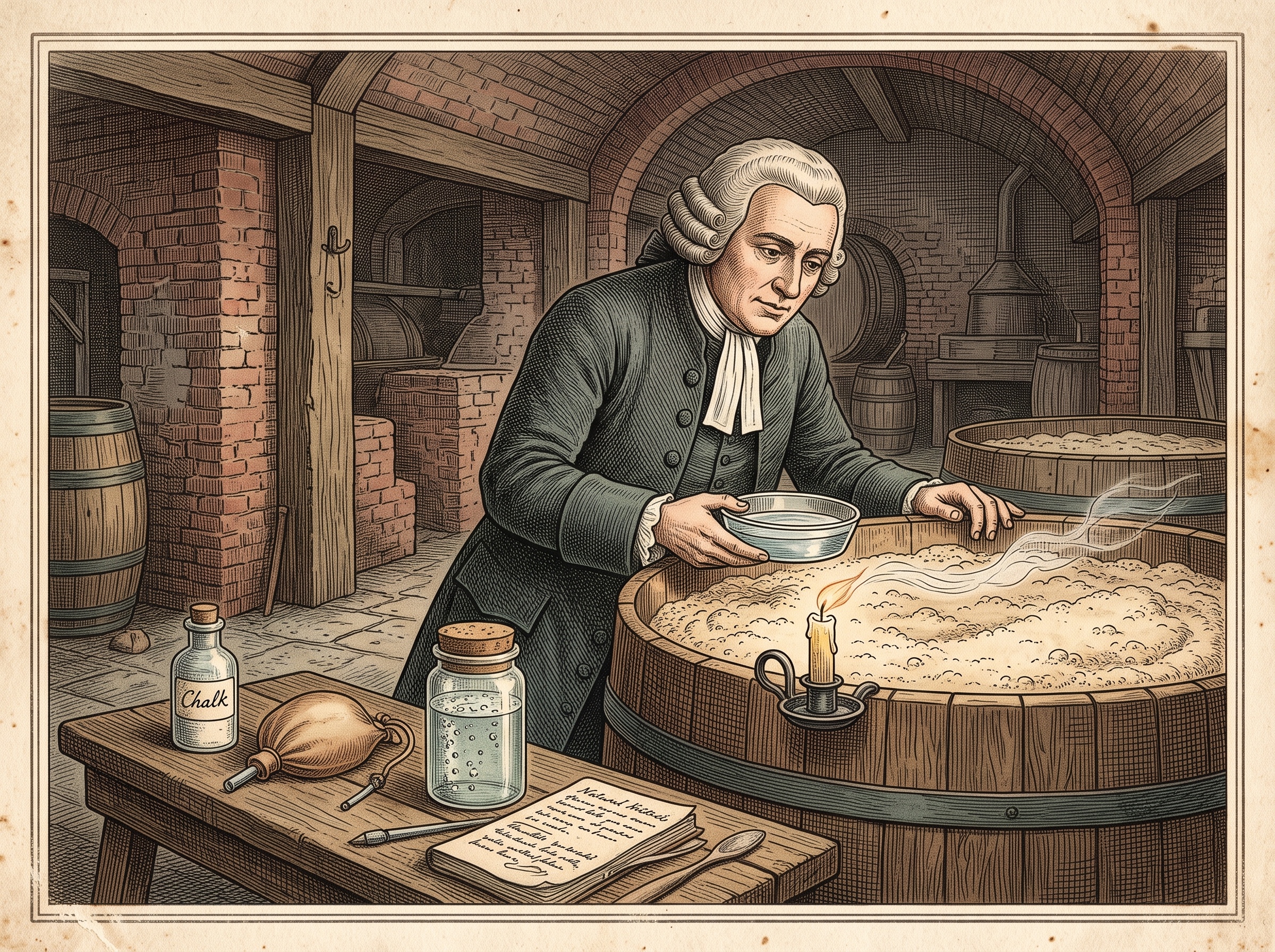
What happened?
Priestley was not a professional scientist. He was a minister at Mill Hill Chapel in Leeds, a teacher, and a prolific writer on religion, politics, and grammar. Science was his hobby, encouraged in part by his friendship with Benjamin Franklin. He later explained that he was led into the study of “airs,” as gases were then called, because he lived in a house next to a public brewery. A history of Leeds chemistry sites places that brewery on Meadow Lane, close to where Tetley’s Brewery later stood.
Fermenting beer gives off a heavy gas that collects in a layer just above the liquid. Chemists of the day called it “fixed air.” Today we call it carbon dioxide. Priestley experimented with that invisible layer. He wrote of lowering burning candles into it and watching them go out, and of smoke drifting along its surface as if it were floating on a pool.
Then he tried water. He found that water held just above the fermenting liquor for a few minutes picked up a pleasant, sharp taste. It reminded him of Pyrmont water, a famous and expensive German spring water whose natural sparkle came from the same gas.
The brewery method was messy and depended on the brewer’s schedule, so Priestley worked out a way to do it at home. He poured oil of vitriol (sulfuric acid) onto chalk in a small bottle, which releases carbon dioxide. The gas went into an animal bladder, and from there through a tube into a vessel of water. Shaking the vessel helped the water absorb the gas. According to his own instructions, a batch took about a quarter of an hour.
What made this more than a party trick was medicine. An Irish surgeon, David MacBride, had argued that fixed air might fight scurvy, the disease that killed huge numbers of sailors on long voyages. Priestley believed his fizzy water could deliver it. In the spring of 1772 he explained his method to Sir George Savile, a member of Parliament, who put him in touch with the Admiralty. The Royal College of Physicians approved the idea, and Priestley gave the details to ship commanders and surgeons. According to the editors of Franklin’s papers, the Admiralty hoped to use Cook’s second voyage, then about to set out, to test possible scurvy cures.
That same year Priestley published his method as a short pamphlet, Directions for Impregnating Water with Fixed Air, sold for one shilling. He signed the dedication at Leeds on 4 June 1772. In 1773 the Royal Society, Britain’s leading scientific body, awarded him its highest honor, the Copley Medal, for his paper on different kinds of air.
Why was it strange?
Soda water, one of the most ordinary drinks in the world, was not invented by a drinks maker, or even mainly as a drink. It was invented by a minister doing chemistry as a hobby, using his neighbor’s beer vats as free lab equipment, and he hoped it would be a medicine for sailors.
It was also a medicine that did not work. Scurvy is caused by a lack of vitamin C, and carbonated water contains none. MacBride’s theory was wrong, and Priestley’s water could not have helped. The world got a lasting everyday object out of a mistaken medical idea.
Another ordinary thing with a strange past: The Secret Rubber Substitute That Became Silly Putty.
What did scientists learn?
Priestley showed in a practical way that a gas could be dissolved into a liquid and stay there. Under pressure, or with patient shaking, carbon dioxide dissolves in water. A small part of it reacts with the water to form carbonic acid, a weak acid that gives soda water its slight tang. When the pressure drops, the gas comes back out as bubbles. That is why a bottle fizzes when you open it.
His work with fixed air was also the start of a much bigger project. He kept collecting and testing new gases, and on 1 August 1774 he produced the gas we now call oxygen. Priestley himself interpreted it through the older “phlogiston” theory, an idea that burning releases a substance called phlogiston, and he never gave that theory up. But his careful experiments helped other chemists, especially Antoine Lavoisier, build modern chemistry.
Another object that did not start out as itself: The Billiard Ball Prize That Invented Plastic.
How does it affect us today?
Other people turned Priestley’s idea into a business. In 1774 the Scottish physician John Nooth designed a glass apparatus for making carbonated water. In 1783 Johann Jacob Schweppe, a German-born watchmaker working in Geneva, began producing carbonated water commercially. The company that still bears his name calls Priestley “the father of our industry,” and he is often described as the father of the soft drinks industry.
Every can of soda, bottle of sparkling water, and home carbonation machine uses the same basic principle Priestley described: put carbon dioxide into water, and keep it there until someone opens the lid.
A close cousin: The Rust Spray Named After the 39 Times It Didn’t Work.
Fun fact
Priestley dedicated his soda water pamphlet to John Montagu, the Earl of Sandwich, who was then First Lord of the Admiralty. That is the same Earl of Sandwich whose name, according to a popular but loosely documented story, ended up on the sandwich.
Sources
- Joseph Priestley, Directions for Impregnating Water with Fixed Air (London: J. Johnson, 1772), full text via Today in Science History: https://todayinsci.com/P/Priestley_Joseph/PriestleyJoseph-MakingCarbonatedWater1772.htm
- Founders Online (U.S. National Archives), Benjamin Franklin to Joseph Priestley, 4 May 1772, with editorial notes on the Admiralty and Cook’s voyage: https://founders.archives.gov/documents/Franklin/01-19-02-0088
- James L. Marshall and Virginia R. Marshall, “Rediscovery of the Elements: Joseph Priestley,” The Hexagon, University of North Texas: https://cos.unt.edu/chemistry/system/files/james-l-marshall-pdfs/priestley.pdf
- McGill University Office for Science and Society, on Priestley, fixed air, and John Nooth’s apparatus: https://www.mcgill.ca/oss/node/7091
- Priestley International Centre for Climate, University of Leeds, “Joseph Priestley”: https://climate.leeds.ac.uk/about/joseph-priestley/