The Dentist Who Invented Cotton Candy — and Sold 68,655 Boxes of It
In the Palace of Electricity at the 1904 St. Louis World's Fair, a spinning metal bowl was throwing off threads of hot sugar into a catching pan, and a crowd was lining up to pay twenty-five cents for a wooden box of the stuff. Admission to the entire fair cost fifty cents. The man who had designed the machine — who had spent a decade of his career looking into other people's mouths — was a dentist.
By the Curiosities Desk · · 5 min read · Filed under Chemistry · Today’s round
What happened?
William James Morrison (1860–1926) practiced dentistry in Nashville, Tennessee, and by all accounts spent his spare hours inventing things. Sometime in 1897 he went into partnership with a local confectioner named John C. Wharton on an idea that sounds, in outline, like a joke at his own profession’s expense: a machine that would turn ordinary granulated sugar into edible fluff.
They filed on December 23, 1897, and were granted U.S. Patent No. 618,428 — titled simply “Candy-Machine” — on January 31, 1899. The document is charmingly literal about what the two men were after: “The object of our invention is to obtain an edible product consisting of the said filaments of melted and spun sugar or candy.”
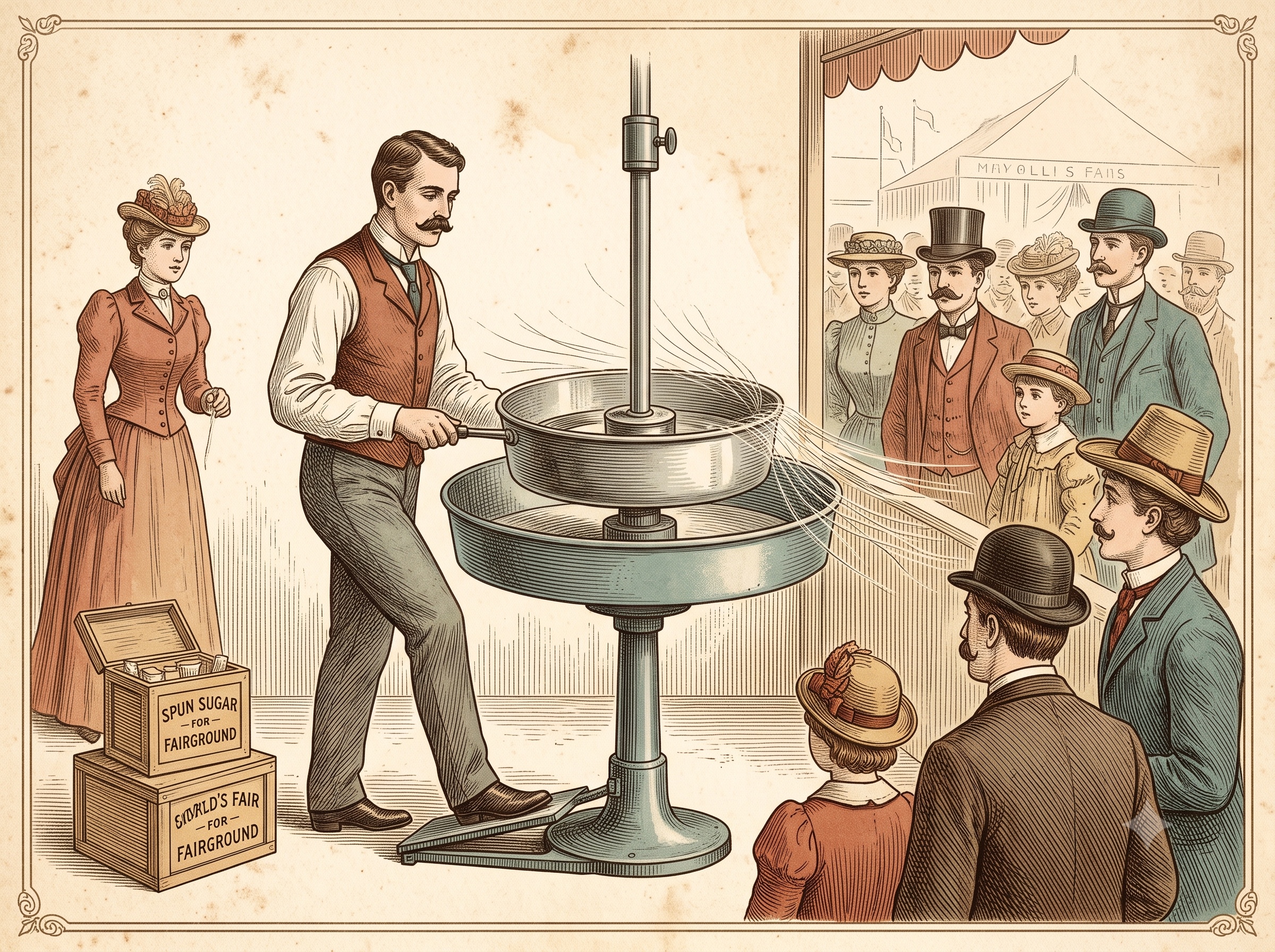
The mechanism is worth picturing, because it is not the tidy stainless-steel appliance you see at a county fair today. A shallow pan sits on a vertical shaft. Granulated sugar is poured in through an inverted funnel. Underneath is a ring of gas jets, fed by carbureted air from a tank of gasoline pumped through a bed of coke and pumice. A small taper lamp burns nearby to keep the jets lit. The whole assembly is driven by a foot treadle — “propelled by foot-power,” the patent says, “in the manner of a lathe.” Popular accounts often call this an “electric candy machine,” but the primary document describes a pedal, an open flame, and a gasoline tank sitting beneath a bowl of molten sugar.
It worked. As the pan spins, centrifugal force drives the liquefied sugar out through a ring of tiny gaps at the rim, where it emerges as what the patent calls “silk-like filaments.”
Morrison and Wharton sold the rights to the Electric Candy Machine Company of Nashville, and the invention debuted at the Louisiana Purchase Exposition — the 1904 World’s Fair in St. Louis. They called the product fairy floss and sold it in small wooden boxes decorated with scenes from the fair, at twenty-five cents apiece: half the price of a ticket to get through the gate, for a confection made of sugar and air.
People bought it anyway. Over the run of the fair, 68,655 boxes sold, for receipts of $17,163.75, and the machine took a prize for “novelty of invention.” Afterward the company began selling machines across the country, and fairy floss became a fixture of the American midway.
The name changed later. In the 1920s a Louisiana dentist — a second dentist — named Josef Lascaux began calling it “cotton candy,” and in the United States that name stuck. It is still fairy floss in Australia and candy floss in Britain and India.
Why was it strange?
The obvious strangeness is the job title. But the deeper oddity is what the machine is actually selling, which is mostly nothing: a box of cotton candy is overwhelmingly air, held open by a sparse web of sugar.
The stranger thing is that Morrison and Wharton had built, by trial and error and foot power, a device that produces a form of matter chemists were still arguing about a century later. Their patent says the sugar is “melted.” That turns out to be a much more complicated claim than it looks.
The same thread — Food Science — continues in The Chemist Who Asked to Be Buried in the Pringles Can He Invented.
What did scientists learn?
Ordinary table sugar is sucrose in a crystal — molecules stacked in a repeating three-dimensional lattice. Heat it, and the lattice comes apart. Spin the resulting liquid out through a small hole and it stretches into a thread so thin that it loses its heat almost instantly, in far less time than the molecules would need to find their way back into an orderly crystal. What you get is an amorphous solid: a material that is rigid like a solid but arranged at random like a liquid, frozen mid-shuffle. Glass is the classic example. Cotton candy is sugar glass, drawn into fibers.
That much has been understood for a long time. The surprise came in 2011, when Joo Won Lee and Shelly J. Schmidt at the University of Illinois looked hard at the first step — the melting — and found that sucrose does not appear to melt at all in the ordinary thermodynamic sense. Using high-performance liquid chromatography to check whether the sugar coming out was still sugar, they found decomposition products showing up the moment “melting” was detected. What the textbooks list as sucrose’s melting point (around 186 °C) behaves instead like a rate-dependent chemical breakdown: heat it faster or slower and the number moves. They coined the term apparent melting for it.
This is not settled — the finding drew a published comment and a response in the Journal of Agricultural and Food Chemistry, and the behavior of sugars under heat is still being worked out. But it means that pan of hot syrup was doing chemistry nobody had fully described in 1897, or for a very long time after.
Another ordinary thing with a strange past: The Billiard Ball Prize That Invented Plastic.
How does it affect us today?
Most directly: the machine is still with us, essentially unchanged in principle, at every fair and ballpark. Understanding sugar as a glass rather than a liquid or a crystal is routine food science now — it governs why hard candy is clear, why caramel behaves the way it does, and why some powdered products go sticky in humid air. The same physics is used deliberately in pharmaceuticals, where drugs are sometimes locked in a glassy state to control how fast they dissolve.
The most unexpected descendant is in a laboratory. At Vanderbilt University, engineer Leon Bellan’s group bought a cotton candy machine and spun fibers of a temperature-sensitive polymer instead of sugar. Embedded in a gelatin hydrogel and then dissolved away, the fibers left behind a three-dimensional network of channels roughly the size and density of capillaries — one of the hardest problems standing between us and lab-grown organs. In a 2016 paper in Advanced Healthcare Materials, the team reported keeping living cells viable and functional in such a network for more than a week.
Another object that did not start out as itself: The Rust Spray Named After the 39 Times It Didn’t Work.
Fun fact
Cotton candy’s name is unusually poetic around the world. In France it is barbe à papa — “daddy’s beard.” In Greece it is μαλλί της γριάς, “old lady’s hair.” In much of the English-speaking world outside the United States, it is still the name Morrison and Wharton chose in 1904: fairy floss.
Sources
- U.S. Patent No. 618,428 — W. J. Morrison and J. C. Wharton, “Candy-Machine,” filed December 23, 1897, granted January 31, 1899 (primary source)
- Tennessee State Museum — “Meet Me at the Fairy Floss Stand! Tennessee’s Sweet History of Cotton Candy”
- Encyclopædia Britannica — “How Was Cotton Candy Invented?”
- Lee, J. W. & Schmidt, S. J., “Investigation of Thermal Decomposition as the Kinetic Process That Causes the Loss of Crystalline Structure in Sucrose,” Journal of Agricultural and Food Chemistry (2011)
- Vanderbilt University — “Cotton candy machines may hold key for making artificial organs” (on Lee et al., Advanced Healthcare Materials, 2016)