Everyday Objects · Engineering
The Chemist Who Asked to Be Buried in the Pringles Can He Invented
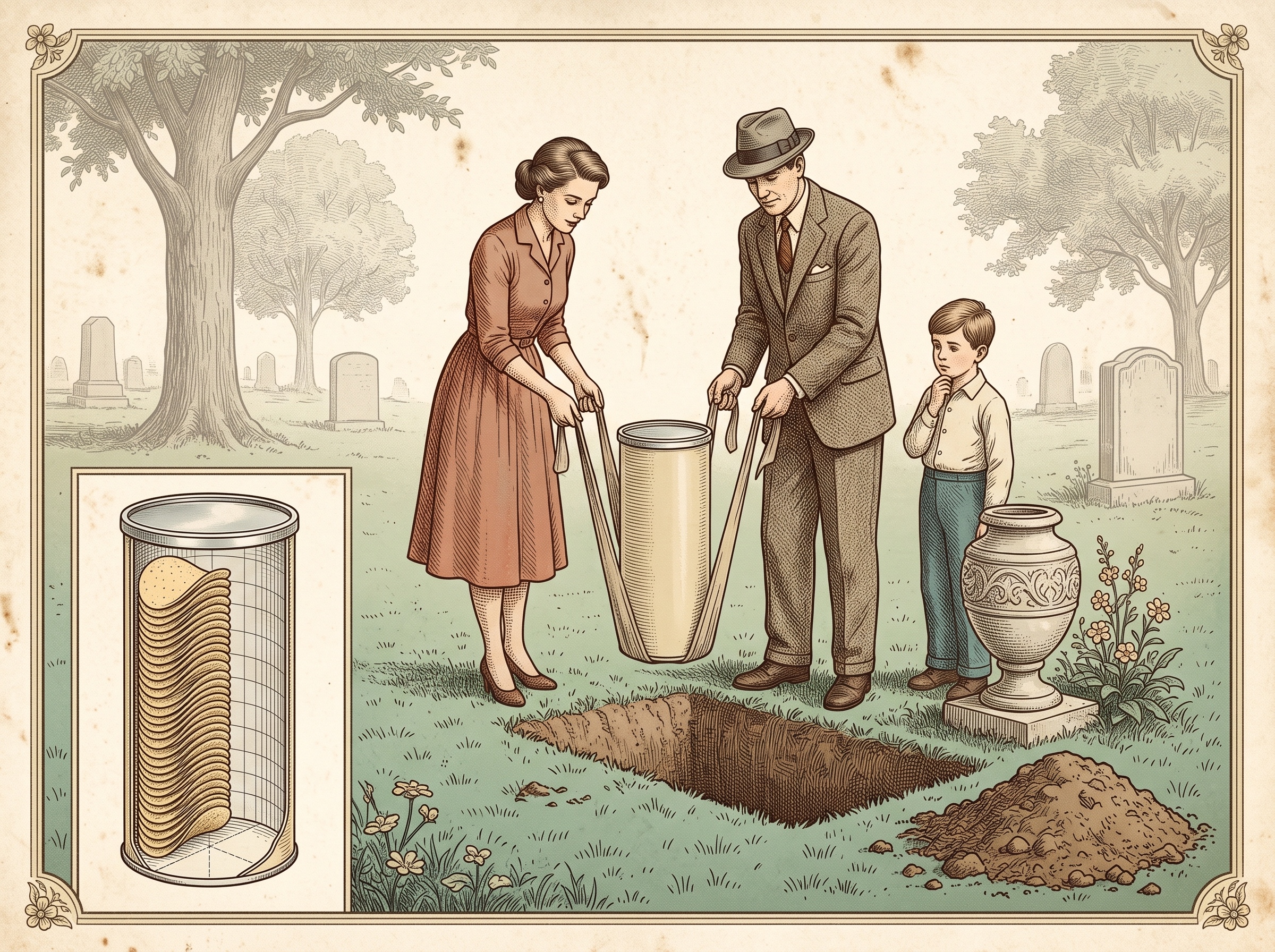
In 2008, on the way to the funeral home, Fredric Baur's grown children pulled into a Walgreens to buy a can of chips. Standing in the snack aisle, they had a question few families ever have to settle: which flavor should hold Dad? Sour cream and onion? Barbecue? His eldest son, Larry, made the call. It had to be the original. Their father had designed that tube, he was proud of it, and he had asked to be buried in one.
By the Curiosities Desk · · 5 min read · Filed under Engineering · Today’s round
What happened?
Fredric John Baur Jr. was born in Toledo, Ohio, in 1918. He earned a master’s degree and a PhD in organic chemistry at Ohio State University, served in the U.S. Navy as an aviation physiologist, and spent his career at Procter & Gamble in Cincinnati. His specialty was unglamorous but important: food storage, frying oils, and quality control. In other words, he spent his working life figuring out why food goes bad and how to stop it.
In 1956, according to P&G’s own corporate history, the company handed Baur a problem that shoppers complained about constantly. Potato chips came in bags that were half air. The chips broke into crumbs. They were greasy. And once opened, they went stale fast.
Baur attacked the problem from both ends: the chip and the package. On the chip side, he worked out a way to make a snack from fried potato dough instead of slices of whole potato, which meant every piece could be exactly the same size and shape. He chose a curved, saddle-like shape so the chips would nest neatly on top of each other. On the package side, he chose a tall tube that the stack would fit into snugly, with no room to rattle around and shatter.
There was just one snag. Baur couldn’t make the chips taste good. He was eventually moved to another project. In the mid-1960s, a different P&G researcher, Alexander Liepa, picked the work back up and improved the flavor, and his name went on the patent for the chip itself. The machinery that cooked the chips was developed with help from Gene Wolfe, a P&G engineer who later became a celebrated science fiction author.
Baur’s contribution was locked in on paper, though. On July 29, 1966, he and P&G colleague Harold Kenneth Hawley filed a patent titled “Packaging of chip-type snack food products.” It was granted on March 3, 1970, as U.S. Patent 3,498,798. It describes chips “of uniform size and shape” stacked into a rigid tube made from materials that keep out oxygen and water vapor.
P&G began selling “Pringle’s Newfangled Potato Chips” in Indiana in 1968. There are several competing stories about the name. One says it came from Pringle Drive in Finneytown, a Cincinnati suburb; another says it was pulled from a phone book. Nobody has settled which is true.
Baur retired from P&G in the early 1980s. He died on May 4, 2008, at age 89. As the Associated Press reported, his children honored his wish. Part of his ashes went into an Original flavor Pringles can in his grave in suburban Springfield Township, near Cincinnati. The rest went into an urn buried alongside it, and a third portion went to a grandson.
Why was it strange?
Inventors are often proud of their work. Very few want to spend eternity inside it.
But the request makes a certain sense. The can was the part of Pringles that was unmistakably Baur’s. The flavor had been fixed by someone else. The cooking machine had been built by someone else. The tube was his idea, his patent, and the thing everyone recognized. As his son Lawrence told reporters, his father asked for the burial because he was proud of the design.
The chips themselves also had an identity crisis. Rival snack makers argued that a chip made from potato dough wasn’t really a “potato chip.” In 1975, the U.S. Food and Drug Administration ruled that Pringles could use the word “chip” only as part of the phrase “potato chips made from dried potatoes.” That was a mouthful, so Pringles eventually started calling them “crisps.” Decades later, in the United Kingdom, P&G argued the opposite way in a tax case. Its lawyers said Pringles, at about 42 percent potato, weren’t “potato crisps” for tax purposes. The High Court agreed in 2008, but the Court of Appeal reversed that ruling in 2009. Pringles were crisps after all, at least in the eyes of British tax law.
The same thread — Packaging — continues in The Wallpaper That Failed and Became Bubble Wrap.
What did scientists learn?
The Pringle is a small lesson in geometry. Its saddle shape is what mathematicians call a hyperbolic paraboloid: a surface that curves up in one direction and down in the other, like a riding saddle. That double curve makes a thin chip much stiffer than a flat one of the same thickness, for the same reason a curved sheet of paper holds its shape better than a flat one. Identical curved chips also stack like spoons, which is what makes the tube work.
The tube carries a chemistry lesson, too, and it was Baur’s field. Frying fats react with oxygen from the air, a process called oxidation, which breaks them down into compounds that taste stale or rancid. Moisture turns crisp snacks soft. A tightly packed tube lined with barrier materials leaves far less trapped air around each chip than a puffy bag does. That’s why the patent stresses packaging that keeps out oxygen and water vapor.
Another ordinary thing with a strange past: The Dentist Who Invented Cotton Candy — and Sold 68,655 Boxes of It.
How does it affect us today?
Pringles went from a slow start to one of the world’s biggest snack brands. In 2012, Kellogg’s bought the brand for about $2.7 billion, and in 2024 its parent company agreed to be bought by Mars.
The can has a less flattering modern legacy. Its mix of cardboard, foil lining, metal base, and plastic lid makes it hard to recycle, and in 2017 a UK recycling group singled it out for criticism. The same layered design that kept chips fresh for decades is now a design problem in its own right.
Another object that did not start out as itself: The Canned Food That Arrived 48 Years Before the Can Opener.
Fun fact
The Pringles mascot had no official first name for decades. The name “Julius” started as a prank edit on Wikipedia in 2006, spread through the media, and was eventually adopted by the company as real.
If you’re going through a loss of your own, a small, personal ritual like the Baurs’ can be one meaningful way to remember someone. Reaching out to people you trust, or to a grief support service, can help too.
Sources
- U.S. Patent 3,498,798, “Packaging of chip-type snack food products,” F. J. Baur and H. K. Hawley, Procter & Gamble (filed 1966, granted 1970): https://patents.google.com/patent/US3498798A/en
- Associated Press via CBS News, “Man’s Final Resting Place: A Pringles Can” (June 2, 2008): https://www.cbsnews.com/news/mans-final-resting-place-a-pringles-can/
- Time, “The Man Buried in a Pringles Can” (June 4, 2008): https://time.com/archive/6904379/the-man-buried-in-a-pringles-can/
- NPR, “Inventor’s Ashes Buried in His Creation: Pringles Can” (June 3, 2008): https://www.npr.org/2008/06/03/91098067/inventors-ashes-buried-in-his-creation-pringles-can
- Court of Appeal of England and Wales, Revenue & Customs v Procter & Gamble UK [2009] EWCA Civ 407: https://caselaw.nationalarchives.gov.uk/ewca/civ/2009/407