Everyday Objects · Engineering
The Wallpaper That Failed and Became Bubble Wrap
In 1957, two engineers in New Jersey ran two plastic shower curtains through a machine, hoping to invent a stylish new wallpaper. What came out instead was a sheet studded with trapped air bubbles. Nobody wanted it on their walls. Nobody wanted it on their greenhouse, either. It would take a third idea — and a brand-new IBM computer — before anyone realized they had accidentally made one of the most satisfying objects on the planet.
By the Curiosities Desk · · 5 min read · Filed under Engineering · Today’s round
What happened: Bubble Wrap? It Was Wallpaper
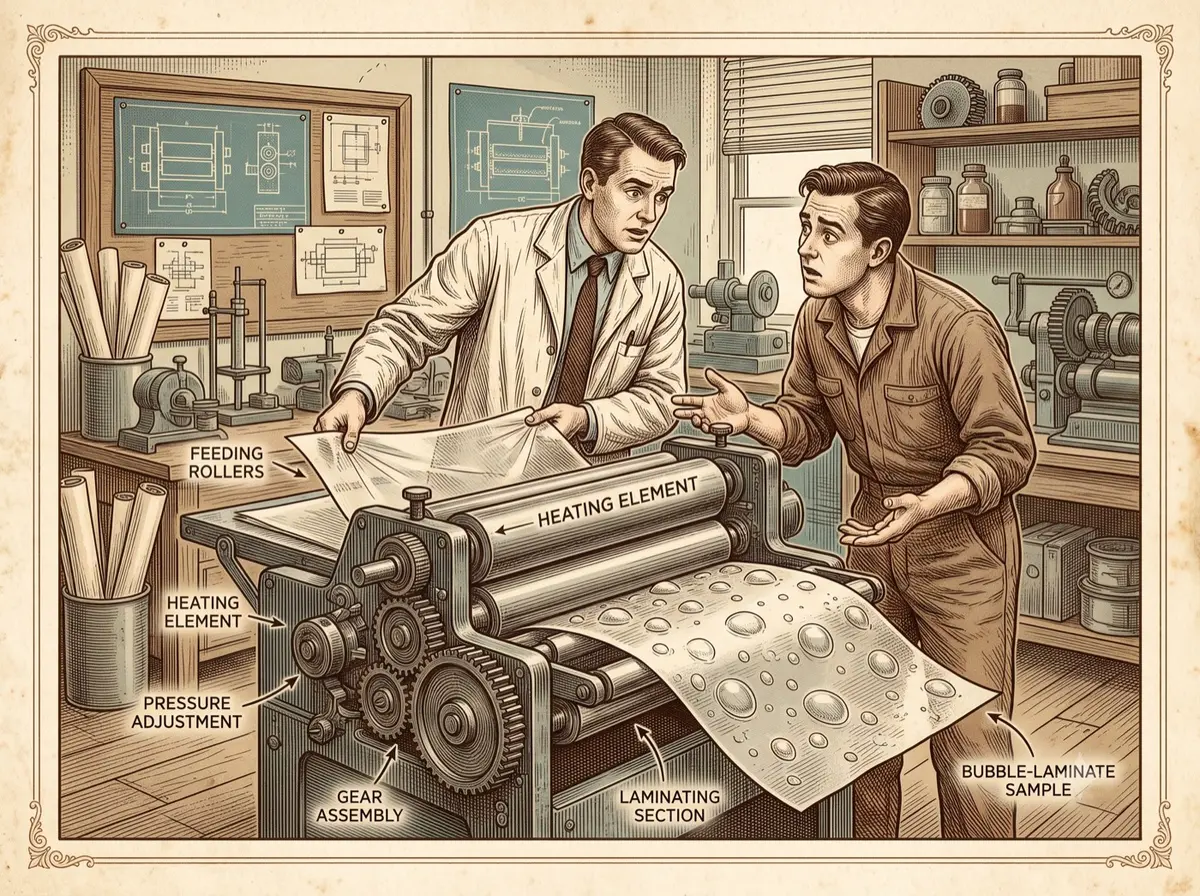
The inventors were Alfred W. Fielding and Marc Chavannes, working in Hawthorne, New Jersey. As the story is usually told, they were trying to create a textured, three-dimensional plastic wallpaper that could be wiped clean. Their method was to seal two flexible plastic sheets together — in some accounts, shower curtains — so that pockets of air were trapped between them. The result was a bumpy, bubble-covered plastic.
As wallpaper, it was a flop. Almost no one wanted walls covered in plastic blisters.
Rather than give up, the two men looked for another use for their bubbly material. Their second pitch was greenhouse insulation: the trapped air, they reasoned, could hold heat the way a double-paned window does. That idea didn’t take off commercially either. By most measures, the invention had failed twice.
The turning point came at the company the pair founded to sell the material, Sealed Air Corporation, established in 1960. A Sealed Air marketer named Frederick W. Bowers was looking for customers when he noticed that IBM had just announced the 1401, a new transistor-based business computer, in 1959. Delicate, expensive electronics like that had to survive shipping. Bowers pitched the bubbly plastic not as décor or insulation but as protective packaging — a cushion that wrapped fragile cargo in a layer of air. IBM bit. The product finally had a purpose, and that purpose was protection.
From there it became ubiquitous. Sealed Air’s original product was branded “Air Cap,” but the name that stuck with the public was Bubble Wrap, a trademark the company still holds. Fielding and Chavannes secured patents for their process of making “laminated cushioning material,” and Sealed Air grew over the following decades into a multibillion-dollar packaging company. The accidental wallpaper had become an industry.
Why it was strange: Bubble Wrap? It Was Wallpaper
The strangeness here isn’t a freak of nature — it’s a freak of purpose. The physical object barely changed from the failed wallpaper to the hit packaging product. What changed was the question the inventors were asking. The same trapped-air bubbles that made lousy wall covering and unconvincing insulation turned out to be near-perfect shock absorbers. The invention didn’t need to be fixed; it needed to be aimed at a different problem.
It’s also strange how completely the original intent was forgotten. Generations of people have wrapped dishes, popped bubbles to kill time, and never suspected the material was born as a decorating idea. We treat Bubble Wrap as if it were obviously, inevitably a packaging product — but it was the third guess, not the first.
The same thread — Packaging — continues in The Chemist Who Asked to Be Buried in the Pringles Can He Invented.
What scientists learned: Bubble Wrap? It Was Wallpaper
The science underneath Bubble Wrap is the physics of cushioning. When a package gets jostled or dropped, the danger is the sudden spike of force as it stops. A good cushion spreads that force out over a longer time and a wider area, lowering the peak the contents have to absorb. Sealed pockets of air do this efficiently: each bubble compresses, the gas inside resists, and the energy of an impact gets soaked up and redistributed across many bubbles instead of slamming into the object all at once. Air is also nearly free and weighs almost nothing, so you can ship protection without shipping much mass.
The deeper lesson is one product designers repeat to this day: a material’s value lives in its application, not just its chemistry. The bubbles were always good at trapping and releasing air. Whether that made them wallpaper, insulation, or packaging depended entirely on what someone needed at the time.
Another ordinary thing with a strange past: The Canned Food That Arrived 48 Years Before the Can Opener.
How it reaches us today: Bubble Wrap? It Was Wallpaper
Bubble Wrap helped make modern shipping — and, eventually, e-commerce — possible. The ability to send fragile goods across the country and trust they’ll arrive intact is something we now take completely for granted, and air-cushion packaging is a big part of why. Sealed Air remains a major packaging firm, and bubble cushioning in countless forms protects everything from electronics to glassware in transit.
The material has even tried to evolve. In 2015, Sealed Air introduced a redesigned version — sometimes called iBubble Wrap — that ships flat and is inflated on demand, saving storage and transport space. The catch: because the bubbles connect and stay sealed by the roll, you can’t pop them one at a time. The change provoked genuine public mourning, a reminder that for most of us Bubble Wrap stopped being mere packaging long ago. Its second life as a stress-relief toy may be the most beloved accident of all.
Another object that did not start out as itself: The Grocer Who Hired Fake Shoppers to Push His Invention Around the Store.
Fun fact: Bubble Wrap? It Was Wallpaper
There is an unofficial Bubble Wrap Appreciation Day, observed on the last Monday of January. It traces back to a radio station in Bloomington, Indiana, around 2001, and it celebrates exactly what you’d hope: the small, irresistible joy of popping the bubbles. A product invented to hang quietly on a wall is now honored, once a year, for the noise it makes.
Sources: Bubble Wrap? It Was Wallpaper
- “Bubble wrap,” Wikipedia — https://en.wikipedia.org/wiki/Bubble_wrap
- “Sealed Air,” Wikipedia — https://en.wikipedia.org/wiki/Sealed_Air
- “The Accidental Invention of Bubble Wrap,” Smithsonian Magazine — https://www.smithsonianmag.com/innovation/accidental-invention-bubble-wrap-180961537/
- “IBM 1401,” Wikipedia — https://en.wikipedia.org/wiki/IBM_1401
Related stories: Bubble Wrap? It Was Wallpaper
- The Weak Glue That Took Six Years to Find a Job — and Became the Post-it Note — A glue that would not stick properly took six years to find a job
- The Crash-Test Foam That Invented Your Mattress — Aircraft crash-test foam ended up in your mattress
- The Strange History of the Ballpoint Pen — The pen that took decades and a patent war to work properly