The Crash-Test Foam That Invented Your Mattress
Press your hand into a pillow and watch it slowly fill back in, like the material is thinking it over. That lazy, deliberate un-squish was not designed for comfort. It was designed so that if your airplane seat crumpled around you in a crash, the cushion would spread the impact evenly across your body instead of letting your spine take the hit. The foam under your head tonight has a résumé that starts with airline disaster testing, not bedtime.
By the Curiosities Desk · · 5 min read · Filed under Space · Today’s round
What happened: Memory Foam
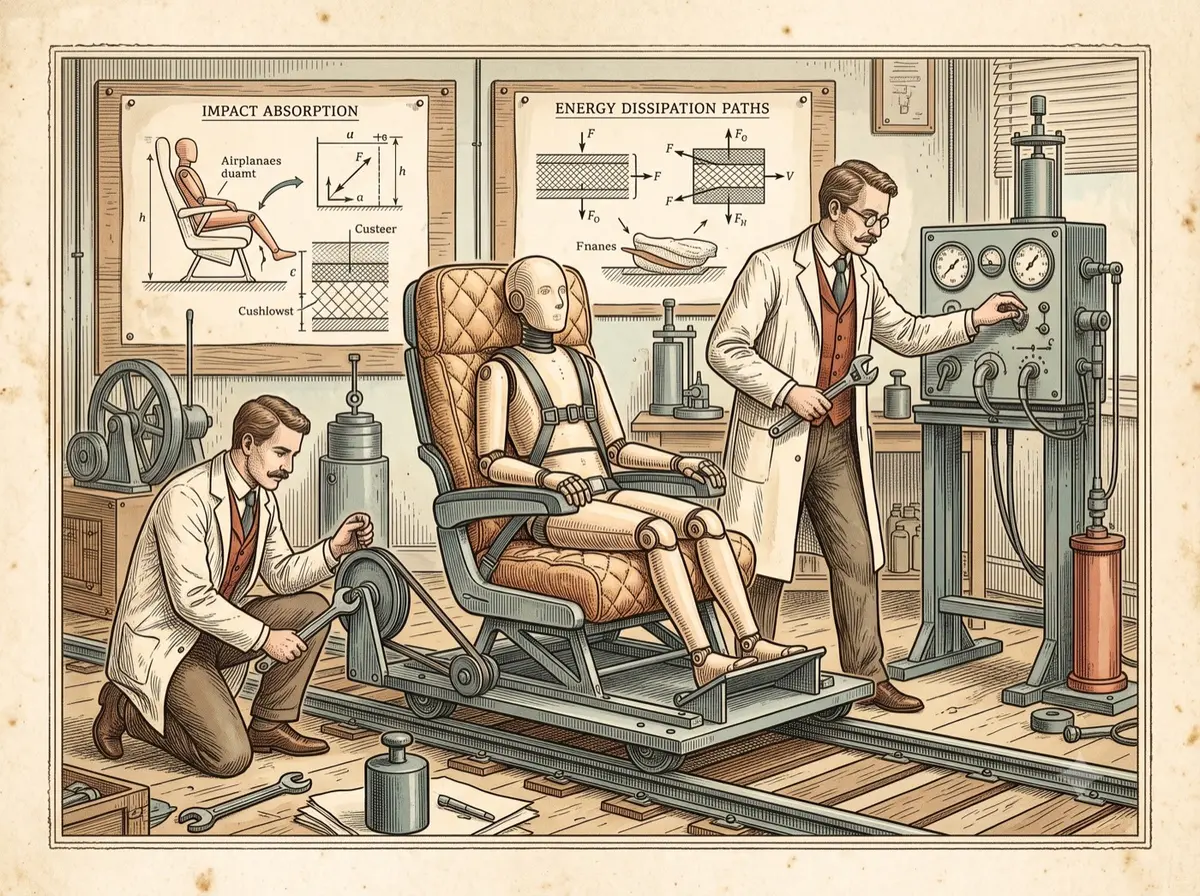
In 1966, an aeronautical engineer named Charles Yost was hired on contract to NASA’s Ames Research Center, working through Stencel Aero Engineering Corporation, to solve a grim, practical problem: how to keep airline passengers alive and unbroken during a crash. Yost was not new to survival engineering — four years earlier he had helped build the recovery system that let the Apollo command module parachute safely back to Earth. Now NASA wanted him to study “human survival in aircraft emergencies,” the title of the report his work eventually fed into.
Standard seat cushions of the era were built for comfort, not physics. In a hard landing or crash, a passenger’s body doesn’t decelerate evenly — bony areas like hips and shoulders punch through soft padding and take the full force, while the rest of the body barely compresses the material at all. Yost set out to build a cushion that would spread that force across the entire body at once, the same way a mattress of nails works safer than a single spike: distribute the load, and no single point gets overwhelmed.
What he came up with was an open-cell polymer foam with an unusual property called viscoelasticity — meaning it behaves partly like a viscous liquid and partly like an elastic solid. Push on it, and instead of springing back instantly like ordinary foam rubber, it flows slowly to match the exact contour of whatever is pressing into it, spreading out to touch as much surface area as possible before gradually returning to its original shape once the pressure lifts. Engineers at the time nicknamed it “slow spring back foam,” which is a far less catchy but more honest description than what it would later be sold as.
Ames Research Center built the material into a redesigned airplane seat that improved crash protection and, as a side effect nobody was chasing, made long flights noticeably more comfortable. In 1969, Yost formed his own company, Dynamic Systems, Inc., based in Leicester, North Carolina, to sell the technology commercially under the name “Temper Foam.” The company sold the rights to the material in 1974, and Temper Foam went on to be manufactured under license by chemical and medical-supply companies, eventually reaching hospitals, wheelchairs, and — much later — bedrooms.
Why it was strange: Memory Foam
The foam that ended up soothing sore backs and cradling heads at night was never meant to feel good. Comfort was the byproduct of a much colder design goal: minimizing tissue damage during violent deceleration. It’s a strange inversion — one of the most relaxing materials in the average household began life as safety equipment engineered around the mechanics of a body slamming into a seatback.
It’s also strange how long the gap was between invention and household name. “Memory foam” as a consumer mattress category didn’t take off until the late 1980s and 1990s, more than two decades after Yost’s original work — and even then, most shoppers had no idea the material had a NASA pedigree at all. The foam sat quietly in aircraft seats, prosthetics, and hospital wards for years before anyone thought to put it under a pillow.
Another ordinary thing with a strange past: The Astronaut Ice Cream That Astronauts (Probably) Never Ate.
What scientists learned: Memory Foam
The core insight was about how force and materials interact over time, not just at a single moment. Ordinary foam responds to pressure almost instantly — push it, it pushes back. Viscoelastic foam responds on a delay, because its open-cell structure lets air flow slowly through and around the polymer as it compresses. That lag is exactly what makes it good at absorbing energy: instead of bouncing the force of an impact back into the body, the foam spreads that energy out over a longer stretch of time and a wider area of contact, lowering the peak force any one point of the body experiences.
This is the same underlying principle used in modern crash padding, sports equipment, and protective gear generally: it’s not just how much force you absorb, but how quickly you’re forced to absorb it. Spread an impact over more time and more surface area, and the same total energy does far less damage. NASA Spinoff reports have noted a three-inch pad of the foam can absorb the shock of a 10-foot fall by an adult.
Another object that did not start out as itself: The Kitchen Microwave That Impersonated a Signal From Deep Space.
How it reaches us today: Memory Foam
Temper Foam’s descendants are everywhere. Mattress and pillow companies built entire product lines on the technology starting in the 1990s. Hospitals use it for wheelchair cushions, bedsore-prevention pads, and prosthetic limb sockets, where the same load-spreading property protects fragile or pressure-sensitive tissue. Motorsports teams — NASCAR, Formula 1, and others — adopted foam seat inserts to reduce driver fatigue and injury risk, and it padded football helmets for teams including the Dallas Cowboys through the 1970s and '80s. It’s even shown up in archery targets, whose self-healing foam lets arrows pull free with barely a mark.
And the material eventually came full circle: aircraft and helicopter seating still uses viscoelastic foam for the exact crash-protection purpose Yost originally designed it for, more than half a century after his contract with NASA began.
A close cousin: The ‘Astronaut Drink’ NASA Never Invented — and the Moonwalker Who Said It Sucks.
Fun fact: Memory Foam
NASA never patented memory foam, which is part of why it spread so widely into so many unrelated industries — from mattresses to prosthetic legs to horse saddles — without a single company controlling the license.
Sources: Memory Foam
- NASA Spinoff, “Forty-Year-Old Foam Springs Back With New Benefits” (2005): https://spinoff.nasa.gov/Spinoff2005/ch_6.html
- NASA Spinoff, “Temper Foam” technology record: https://spinoff.nasa.gov/node/9021
- NASA, “Memory Foam” (image/article): https://www.nasa.gov/image-article/memory-foam/
- Space.com, “Everyday Tech From Space: ‘Memory Foam’ for the Masses”: https://www.space.com/10783-space-spinoff-technology-memory-foam.html
Related stories: Memory Foam
- The Wallpaper That Failed and Became Bubble Wrap — Textured wallpaper flopped and became bubble wrap
- The Weak Glue That Took Six Years to Find a Job — and Became the Post-it Note — A glue that would not stick properly took six years to find a job
- The Cylinder That Weighed Too Much and Became Teflon — A gas cylinder that weighed too much held the first Teflon