The Astronaut Ice Cream That Astronauts (Probably) Never Ate
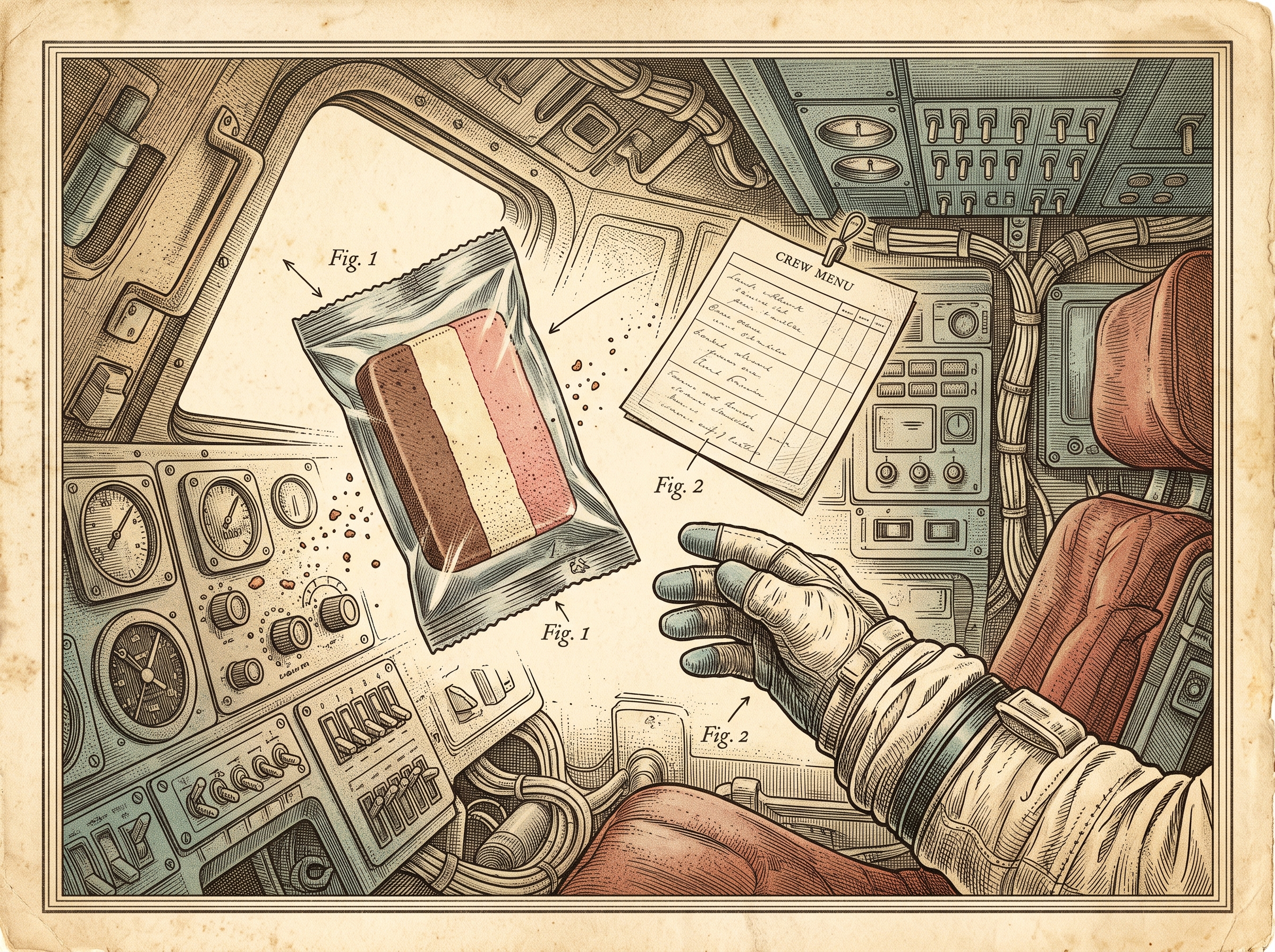
In 1968, a NASA press kit for Apollo 7 listed a surprising dessert on one of the crew's menus: vanilla ice cream. Half a century later, a chalky, crumbly brick of freeze-dried Neapolitan, sealed in a silver pouch, is a fixture of science-museum gift shops everywhere, sold on the promise that this is what astronauts eat. There's just one problem. When people asked the last surviving member of the Apollo 7 crew about the ice cream, he said he didn't remember any.
By the Curiosities Desk · · 5 read · Filed under Space · Today’s round
What happened?
Space food started out grim. On the Mercury flights of the early 1960s, astronauts squeezed purées out of aluminum tubes and nibbled bite-size cubes; John Glenn’s applesauce in 1962 made him the first American to eat in orbit. NASA’s own retelling notes that the early food was unappealing, hard to rehydrate, and prone to shedding crumbs that could drift into the instruments. For the Gemini and Apollo programs, NASA funded better ways to remove water from food so it would be light, keep without a refrigerator, and come back to life with a squirt of water.
The key technique was freeze-drying. By the Apollo era, astronauts had dozens of freeze-dried items to choose from, from shrimp cocktail to the famous bacon squares.
Somewhere in that push, someone tried ice cream. Freeze-dried ice cream is usually credited to the Whirlpool Corporation, which worked on space food under contract to NASA in the 1960s. And in NASA’s 1968 press kit for Apollo 7, the first crewed Apollo flight, “vanilla ice cream” appears on one of the three crew menus. According to collectSPACE, a space-history news site, it’s the only known time the dessert made it onto a NASA-prepared menu.
Whether it actually flew is another matter. Apollo 7’s crew was Wally Schirra, Donn Eisele, and Walt Cunningham. Schirra and Eisele never spoke publicly about it before they died. Cunningham, asked in interviews decades later, said he didn’t recall any ice cream on the 11-day mission. He did remember pudding, and he cheerfully named the bacon squares as a favorite. Even reputable sources disagree: a Smithsonian magazine article states flatly that the ice cream appeared on Apollo 7, while others call the whole story a myth. The honest answer is that a menu said it was planned, and nobody who was there remembers eating it.
The treat’s real launch came on the ground. In the early 1970s, NASA wanted visitors to be able to taste “astronaut food.” According to NASA’s Spinoff publication, in 1973 the visitor center at NASA’s Ames Research Center contacted American Outdoor Products, a Boulder, Colorado, company that made freeze-dried meals for backpackers, and asked whether it could make freeze-dried ice cream. (The company’s founder has also told the story with a different museum, the Goddard Air and Space Museum, making the call — accounts vary.) Nobody had sold such a thing before. In the founder’s telling, the first batches were made by freezing tubs of store-bought Neapolitan ice cream, slicing them with a bandsaw, then freeze-drying and wrapping the slices.
It went on sale in 1974. The company expected a passing fad. Instead, “Astronaut Ice Cream” became a gift-shop staple, and in the 1990s it was even a mail-away prize with Kellogg’s Raisin Bran.
Why was it strange?
Most space spinoffs follow a tidy path: NASA needs something, engineers build it, it flies, and later it shows up in your kitchen. Astronaut ice cream skipped the middle step. It’s a souvenir of a mission it may never have joined, and it is sold on the strength of a menu line, not a flight record.
The irony runs deeper. The very property that makes freeze-dried ice cream fun to eat in a parking lot (it crumbles) is the property that makes it a bad idea in a spacecraft. In weightlessness, crumbs don’t fall; they float, and can end up in eyes, air filters, or electronics. That’s why so much Apollo food was compressed into bite-size cubes or coated to hold together.
The same thread — Space Food — continues in The ‘Astronaut Drink’ NASA Never Invented — and the Moonwalker Who Said It Sucks.
What did scientists learn?
Freeze-drying relies on a neat bit of physics called sublimation, when a solid turns straight into a gas without melting first. According to NASA Spinoff, food is frozen to around 40 degrees below zero, placed in a vacuum chamber, and gently warmed. With the air pressure that low, the ice can’t melt into liquid; it vaporizes directly and is pulled away. Repeated over many hours (about a day for ice cream), the process removes more than 99 percent of the water while leaving the food’s structure mostly intact.
That’s why astronaut ice cream holds its shape at room temperature: the water that would melt is gone. It’s also why it tastes so different. Real ice cream gets its creamy texture from tiny ice crystals and trapped air. Take away the ice and you’re left with a dry, airy foam of sugar, fat, and milk solids that softens on your tongue instead of melting.
The lesson NASA took away was practical: food in space has to be safe, light, and tidy, and astronauts eat better when it also tastes like food. Once spacecraft had freezers, crews could have the real thing. Skylab carried a freezer in the 1970s, and space shuttle and International Space Station crews have occasionally enjoyed ordinary frozen ice cream, often riding up in freezers meant for science samples.
Elsewhere in the space stories: The Corned Beef Sandwich That Got NASA Hauled Before Congress.
How does it affect us today?
Freeze-drying itself is everywhere: in instant coffee, backpacking meals, emergency food kits, and many medicines and vaccines that need to survive without refrigeration. NASA’s push to make that technology lighter and faster during the space race helped it spread.
And astronaut ice cream is still with us, sold under the Astronaut Foods brand at more than 1,000 retailers, according to NASA Spinoff, now in flavors like mint chocolate chip and cookies and cream. It has become something better than a space food: an object that gets kids asking how astronauts eat, what a vacuum does to water, and why crumbs matter in orbit. Not bad for a dessert with a shaky flight record.
Another ordinary thing with a strange past: The Crash-Test Foam That Invented Your Mattress.
Fun fact
According to an Astronaut Foods sales executive quoted by NASA, the top-selling item in the gift shop at the Smithsonian’s National Air and Space Museum, home to real Apollo flight food, is astronaut ice cream.
Sources
- “Freeze-Dried Foods Nourish Adventurers and the Imagination,” NASA Spinoff 2020 (strongest primary source: NASA’s own account of the 1973 Ames request and the freeze-drying process)
- “Astronaut ice cream turns 50,” collectSPACE (2024)
- “Sorry, astronaut ice cream never went to space,” As It Happens, CBC Radio
- “Astronaut ice cream turns 50: freeze-dried treat still popular (even if it never flew),” Space.com
- “Unpack a Meal of Astronaut Space Food,” Smithsonian magazine