The Corned Beef Sandwich That Got NASA Hauled Before Congress
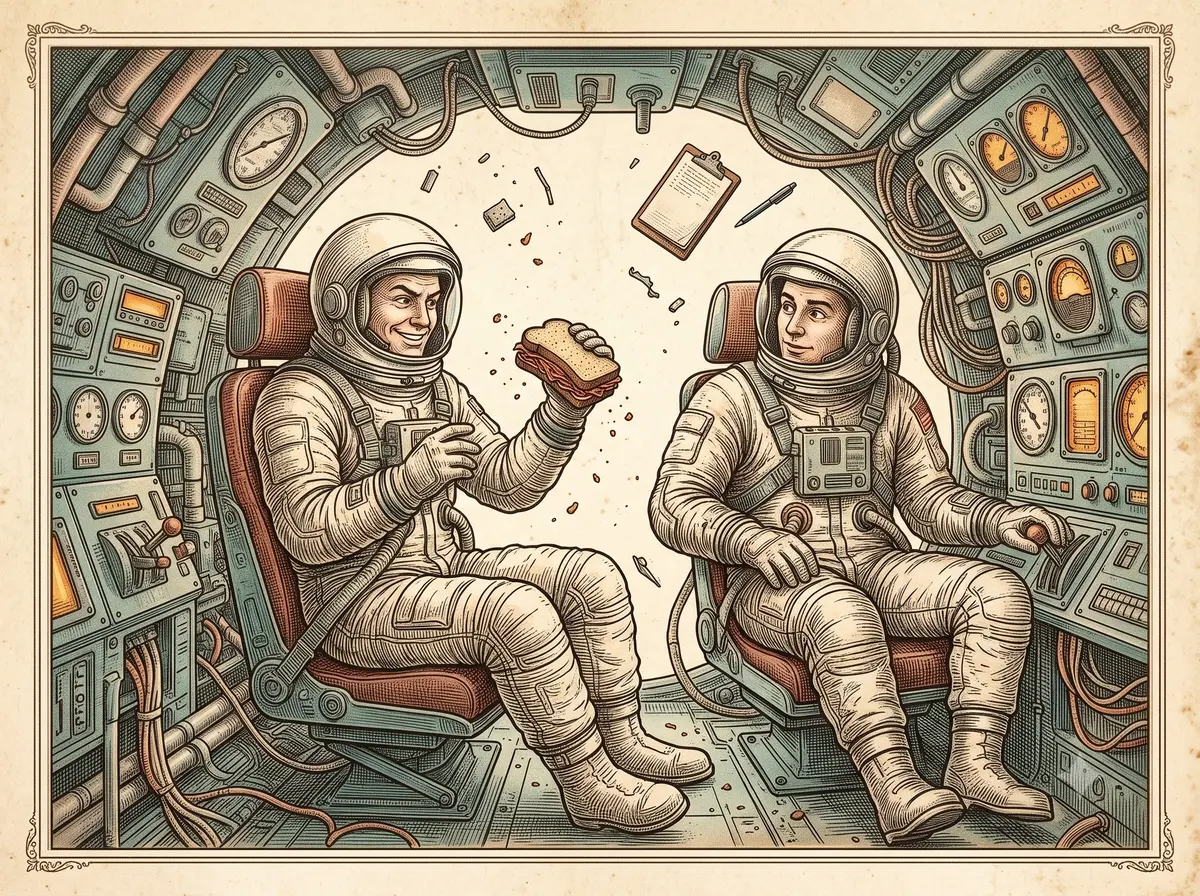
About two hours into America's first two-man spaceflight, John Young reached into the pocket of his pressure suit and pulled out a corned beef sandwich on rye. His commander, Gus Grissom, asked where it had come from. "I brought it with me," Young said. "Let's see how it tastes." Then, after a beat: "Smells, doesn't it?"
By the Curiosities Desk · · 5 min read · Filed under Space · Today’s round
What happened: The Corned Beef Sandwich That Got NASA Hauled Before Congress
Gemini III lifted off from Cape Kennedy at 9:24 a.m. Eastern on March 23, 1965. It was the first crewed flight of Project Gemini, the first time two Americans flew to orbit together, and the first time a crew fired thrusters to change the shape of their own orbit — a maneuver NASA needed to master before it could think about the Moon. The mission lasted three orbits and just under five hours. Grissom, who had nearly drowned when his Mercury capsule sank in 1961, named the spacecraft Molly Brown, after the Broadway musical about a Titanic survivor.
One of Young’s assigned jobs on the flight was to evaluate the food system: whether the packaging leaked when the freeze-dried meals were reconstituted, and whether the leftovers could be stowed properly. The Gemini menu was not beloved. Everything had to be rehydrated with a water gun, and only cold water was available. Young himself later described the chicken bites in his post-flight debriefing as “barely edible.”
So during training, when Grissom grew bored with the practice meals, Young had an idea. He asked Wally Schirra — the backup command pilot, and the astronaut corps’ most committed practical joker — to pick up a corned beef sandwich from a restaurant in Cocoa Beach. On launch morning, Young slipped it into his suit pocket and carried it to the pad. It “seemed like a fun idea at the time,” he said afterward.
In orbit, it was a fun idea for roughly thirty seconds. Grissom took a bite, and the rye bread began coming apart. Crumbs drifted loose in the cabin. Grissom stuffed the sandwich into his own suit pocket to contain the damage. Young’s assessment, recorded on the air-to-ground loop: “It was a thought anyway. Not a very good one.”
Two days later, at the post-flight press conference in Cocoa Beach, a reporter asked about it. Young looked startled — “How did you find out about that?” — and laughed. He also told Life magazine, in the April 2, 1965 issue, “I hid a sandwich in my spacesuit,” which is not a sentence that stays quiet for long.
Congress was not charmed. At hearings on NASA’s 1966 budget, Representative George E. Shipley of Illinois compared the Gemini cabin to a surgeon’s operating room and called Young’s stunt foolish. Press accounts and later retellings dubbed it the “$30 million sandwich,” a figure aimed at the mission’s cost rather than the deli’s price. George Mueller, NASA’s associate administrator for manned spaceflight, told the committee the agency had “taken steps, obviously, to prevent recurrence of corned beef sandwiches in future flights.”
Not everyone at NASA agreed. Manned Spacecraft Center director Robert Gilruth defended the crew, saying such antics helped astronauts “break up the strain,” and that he was reluctant to impose a lot of new rules on men who had done such good jobs. Administrator James Webb overruled him: “this is the United States of America’s space program,” he said, and individuals would not be substituting their own judgment about what flew.
Why it was strange: The Corned Beef Sandwich That Got NASA Hauled Before Congress
The strangeness isn’t that an astronaut broke a rule. It’s that there wasn’t one. Nobody at NASA had thought to write down “do not bring a sandwich,” because nobody had imagined needing to. Gemini gave crews far more autonomy than Mercury had — they could fly the ship, maneuver it, work independently of Mission Control — and that freedom quietly extended to their pockets. The sandwich exposed a gap between a spacecraft engineered to microscopic tolerances and a checklist that never asked what was in the suit.
Another ambitious failure: The Mars Lander That Carried a Blur Ringtone and a Damien Hirst Painting — and Then Went Quiet for 11 Years.
What scientists learned: The Corned Beef Sandwich That Got NASA Hauled Before Congress
Crumbs are a real hazard, not a punchline. In microgravity, nothing settles. A particle that would fall to the floor on Earth instead drifts on air currents until something catches it — a ventilation intake, an instrument panel gap, an eye. Bread crumbs are dry, abrasive, and numerous, and in a cabin with no gravity to sort them out, they go everywhere and stay there. Nothing went wrong on Gemini III; the flight completed all its objectives, and Mueller confirmed to Congress that the sandwich caused no detriment to the mission. But the failure mode was easy to picture, and that was enough.
The fix was procedural. Starting with Gemini IV, crews had to submit a list of everything they intended to carry. Sandwiches were explicitly out, along with bulky items and loose metal. Personal items — wedding rings, coins for family — were still permitted, through what NASA formalized as the personal preference kit.
Another experiment that taught more by not working: The Venus Lander That Tested the Hardness of Its Own Lens Cap.
How it reaches us today: The Corned Beef Sandwich That Got NASA Hauled Before Congress
The crumb problem never went away; it just got engineered around. This is why astronauts on the International Space Station eat tortillas instead of sliced bread — a flatbread holds together, sheds almost nothing, and needs no crumb-catching. It’s a small design decision, made because of physics that a corned beef sandwich demonstrated first.
The manifest rules stuck too. Every crewed spacecraft flying today launches with a documented inventory of what’s aboard, down to the personal effects. And space food kept improving in the direction Young was reaching for: ISS crews now get fresh fruit and vegetables on resupply flights, and there’s a functioning food warmer, both of which would have solved his problem without the paperwork.
The same thread — Space Food — continues in The ‘Astronaut Drink’ NASA Never Invented — and the Moonwalker Who Said It Sucks.
Fun fact: The Corned Beef Sandwich That Got NASA Hauled Before Congress
The incident cost Young nothing. He never received a formal reprimand, went on to become the first person to fly in space six times, walked on the Moon on Apollo 16, commanded the first Space Shuttle flight, and led the Astronaut Office for 13 years. Meanwhile, the sandwich got its own museum display: the Grissom Memorial in Mitchell, Indiana, exhibits a corned beef sandwich preserved in resin — a replica, the Smithsonian notes, not the original.
Sources: The Corned Beef Sandwich That Got NASA Hauled Before Congress
- Fallout from the Unauthorized Gemini III Space Sandwich — Jennifer Ross-Nazzal, NASA Human Spaceflight Historian, drawing on the House Appropriations hearing testimony and air-to-ground transcripts.
- How an Astronaut Smuggled a Sandwich Into Space — Smithsonian National Air and Space Museum.
- Gemini III mission page — NASA.
- Contraband Corned Beef and the Early Days of Space Biology: the Gemini III Mission — NASA Ames Research Center.
- How John Young Smuggled a Corned-Beef Sandwich into Space — Space.com.
Related stories: The Corned Beef Sandwich That Got NASA Hauled Before Congress
- The Million-Dollar Space Pen Myth — and the $128.89 Pencils NASA Actually Bought — NASA never spent millions on a zero-gravity pen
- The Time a Falling Space Station Got a $400 Littering Ticket — Skylab fell on Australia and got a $400 littering ticket
- The Moon Rocket Struck by Lightning Twice — and the Switch Nobody in Mission Control Had Heard Of — Lightning hit Apollo 12 twice, and one obscure switch saved it