The Mars Lander That Carried a Blur Ringtone and a Damien Hirst Painting — and Then Went Quiet for 11 Years
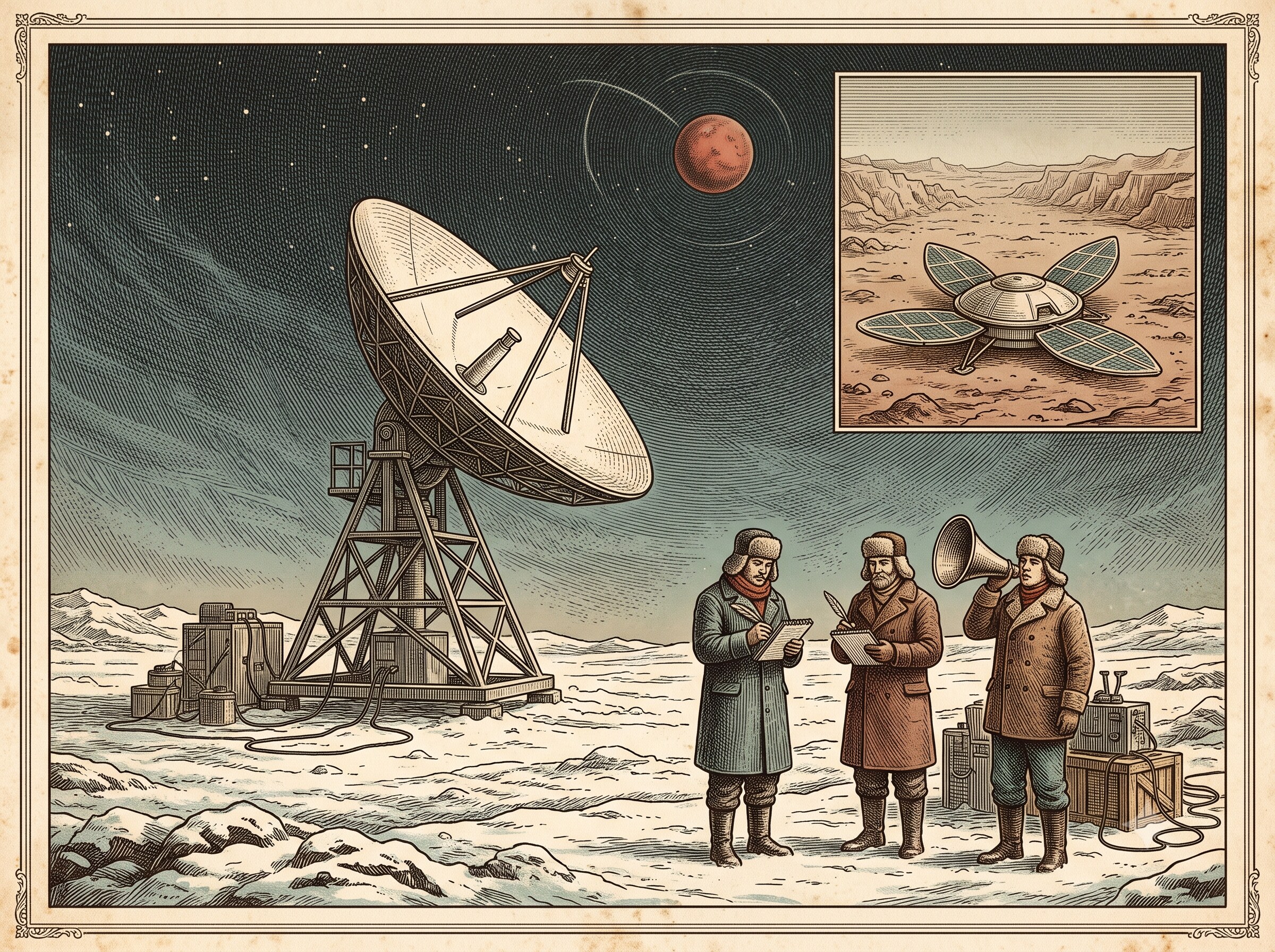
On Christmas morning 2003, a 76-metre radio dish in the English countryside was pointed at Mars, waiting for a piece of Britpop. Britain's first Mars lander was supposed to announce its safe arrival by beaming home a short tune written by the band Blur. The dish listened on the 25th. It listened again on the 26th, and the 27th. Nothing came. Nothing came for eleven years.
By the Curiosities Desk · · 6 min read · Filed under Space · Today’s round
What happened?
The lander was Beagle 2, named after HMS Beagle, the ship that carried Charles Darwin around the world. It was the work of a consortium of British scientists led by Colin Pillinger, a planetary scientist at the Open University who had cut his teeth analysing Apollo Moon rocks at NASA. Pillinger wanted to send something to Mars that would sniff for signs of life — and he wanted to do it on a budget that most space agencies would have laughed at.
The whole spacecraft weighed about 33 kilograms and folded up like a pocket watch. Into that saucer the team crammed a stereo camera, a microscope, a mass spectrometer, a rock grinder, and a mole-like burrowing device for fetching soil. The project cost roughly £50 million — small change by interplanetary standards, and Pillinger had to hustle for a good chunk of it himself.
That hustling is how a Mars probe ended up with celebrity credits. Pillinger recruited Damien Hirst to produce the lander’s calibration target — the small painted chart a spacecraft photographs to check that its cameras and spectrometers are reading colours correctly. Hirst supplied one of his signature spot paintings, which did the job perfectly well and looked considerably better than a standard test card. Blur, meanwhile, composed the call sign: the little melody Beagle 2 would transmit once it was safely down, so the world would know it had made it.
Beagle 2 rode to Mars strapped to Europe’s Mars Express orbiter, launching on 2 June 2003. On 19 December, Mars Express spat the lander free on its final coast. Touchdown was set for the early hours of 25 December 2003, in Isidis Planitia, a broad, flat impact basin near the Martian equator. The plan was a parachute, then gas bags to cushion the impact, then a bounce, then a slow unfolding of four solar panels like the petals of a flower.
Then: silence. NASA’s Mars Odyssey orbiter listened for the call sign and heard nothing. The Lovell Telescope at Jodrell Bank tried on three consecutive days and heard nothing. Mars Express arrived in orbit and tried too. By February 2004 the lander was declared lost. The joint ESA/UK inquiry that followed could not say what had gone wrong, concluding that no definitive cause could be identified for lack of data — no radio, no telemetry, no pictures. Theories piled up anyway: a crash, a tangled parachute, a thinner-than-expected atmosphere on landing day.
Pillinger spent the next decade defending the mission and pushing for another go. He was diagnosed with multiple sclerosis in 2005. He died on 7 May 2014, aged 70, after a brain haemorrhage.
Eight months later, on 16 January 2015, Beagle 2 was found — sitting on the surface of Mars, in one piece.
Why was it strange?
The find came from NASA’s Mars Reconnaissance Orbiter and its HiRISE camera, which photographs the surface at roughly 30 centimetres per pixel — enough to resolve objects a bit under a metre across. Beagle 2, fully unfolded, is only a couple of metres wide, and the target landing area was about 170 by 100 kilometres.
The crucial tip came from Michael Croon, a former member of the Mars Express operations team, who submitted a request through HiWish — the public programme that lets anyone on Earth suggest a HiRISE target. Croon spotted a faint candidate at the edge of a 2013 frame. More images followed, and a bright spot appeared to shift position between them. That was the giveaway: petal-shaped solar panels catching sunlight at different angles on sloping ground.
So the strangeness is this. For eleven years the story was that Britain’s Mars lander had crashed. It hadn’t. Every hard part had worked — the release, the entry, the parachute, the cushioned landing, the lid, the panels beginning to unfold — and then it stopped one step short of being able to speak.
The same thread — Spacecraft Failure — continues in The Genesis Capsule That Crashed Because a Switch Was Installed Backward.
What did scientists learn?
The images showed a partially deployed lander. Beagle 2’s radio antenna sat underneath the solar panels, so the panels had to open fully before the antenna could see the sky. If even one stayed stuck, the spacecraft was mute — awake, powered, possibly running its programme, and unable to say a word.
A 2017 study in Royal Society Open Science narrowed it down. A team led by Nick Higgett built a detailed 3D model of the lander and simulated how sunlight would glint off its panels and insulation under Martian conditions, then matched those simulations against the HiRISE images — a method called reflection analysis. Two configurations fit: three panels deployed, or all four. The authors could not tell which. If it really was all four, something else in the final sequence let it down, and the exact culprit is still unknown.
The confirmed lesson is more useful than a culprit anyway. Beagle 2 proved that its low-cost entry, descent and landing design actually worked at Mars — a result everyone had written off. It also showed that burying a communications antenna under deployable hardware is a single point of failure worth designing out.
Elsewhere in the space stories: The Astronomer Who Saw Canals on Mars That Weren’t Real.
How does it affect us today?
Roughly half of all missions sent to Mars have failed, and Beagle 2 quietly moved from the crash column into a much stranger one: landed, never heard from. The European Mars landing work that followed, including ESA’s ExoMars programme, drew on Beagle 2’s people and hardware experience. The discovery is also a quiet advertisement for public participation in planetary science — the sighting that ended an eleven-year mystery started with a HiWish request from a former operations engineer.
And Hirst’s spot painting is still bolted to a lander in Isidis Planitia, which makes it the only artwork known to be sitting on the surface of another planet.
Another ambitious failure: The Corned Beef Sandwich That Got NASA Hauled Before Congress.
Fun fact
The Hirst commission began with Pillinger watching television. In spring 1999 he caught a programme featuring Damien Hirst, saw one of the spot paintings, and realised that the dull colour chart his instruments needed could be a piece of art instead — as long as the spots were painted in pigments of precisely known colour. They were. The painting is a real calibration target, and the calibration target is a real Hirst.
Sources
- HiRISE / University of Arizona, “Finding Beagle 2” (ESP_039308_1915), 16 January 2015 — https://www.uahirise.org/ESP_039308_1915
- N. Higgett et al., “Identification of the Beagle 2 lander on Mars,” Royal Society Open Science 4:170785 (2017) — https://royalsocietypublishing.org/doi/10.1098/rsos.170785
- NASA/JPL, “Beagle 2 Lander on Mars, With Panels Deployed” (PIA19107) — https://www.jpl.nasa.gov/images/pia19107-beagle-2-lander-on-mars-with-panels-deployed/
- Doug Millard, “Obituary: Colin Pillinger (1943–2014),” Science Museum Blog, 8 May 2014 — https://blog.sciencemuseum.org.uk/obituary-colin-pillinger-1943-2014/
- Maggie Aderin-Pocock, “What happened to Beagle 2?”, BBC Sky at Night Magazine — https://www.skyatnightmagazine.com/space-missions/beagle-2
Related stories
- The Venus Lander That Tested the Hardness of Its Own Lens Cap — A lens cap that landed exactly where the instrument needed to work
- The Unit Mix-Up That Doomed a Mars Probe — Pounds, newtons, and a probe lost at Mars
- The Genesis Capsule That Crashed Because a Switch Was Installed Backward — One small component, oriented the wrong way