Failed Experiments · Archaeology
The 3,000-Year-Old Trumpet That Shattered in Rehearsal for Its Worldwide Radio Debut
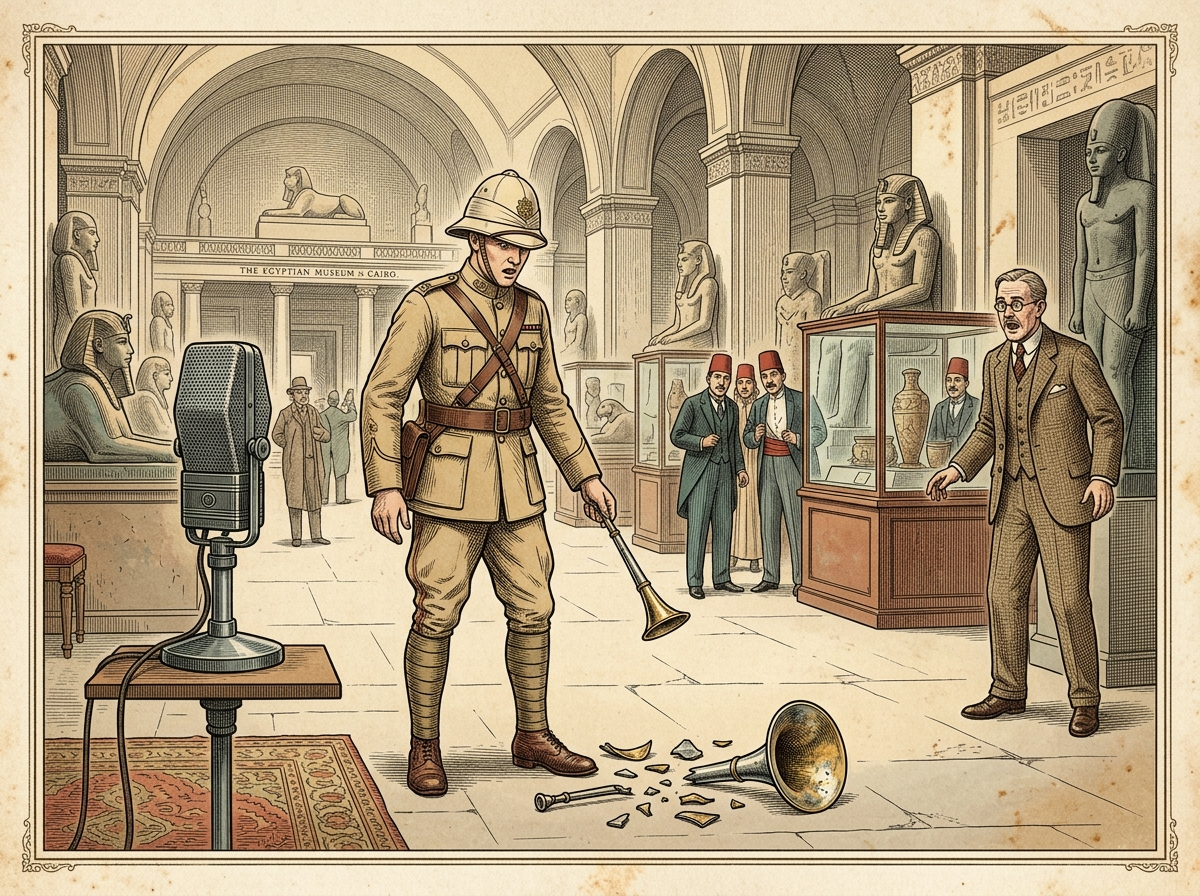
In 1939, inside the Egyptian Museum in Cairo, a British Army bandsman pressed a modern bugle mouthpiece into a silver trumpet that had been buried with Tutankhamun more than 3,000 years earlier. He took a breath and blew. The bell of the trumpet broke apart, and, as the broadcaster in charge later told it, the soldier was left holding only the stem, while Egypt's King Farouk looked on.
By the Curiosities Desk · · 5 min read · Filed under Archaeology · Today’s round
What happened?
When Howard Carter’s team opened Tutankhamun’s tomb in the 1920s, they found two trumpets among the king’s treasures. One, made of copper alloy (often called the bronze trumpet), turned up in the antechamber in a chest of military objects and walking sticks. The other was silver, decorated with gold. Carter’s own excavation card, now in the Griffith Institute archive at Oxford, records that it lay in the south-east corner of the burial chamber, under a calcite lamp, “wrapped in reeds.” It is 58 centimeters long, its bell engraved with a lotus flower, the king’s names, and three gods. Each trumpet came with a painted wooden core that slid inside the tube, probably to protect its thin metal walls from denting.
The musicologist Percival Kirby examined them in Cairo in 1933 and concluded that, played as the Egyptians probably played them, with lips pressed straight to the metal, they could manage only one good note.
Then radio arrived. Rex Keating, a broadcaster based in Cairo, wanted to put the trumpets on the air. In his words, he hoped listeners might “cross the gulf dividing us from ancient Egypt, and for a few seconds breathe life into her dead bones.” Museum officials agreed. Keating had a problem, though: he wanted a simple tune of three or four notes, and he had been told the trumpets would give one note, two at most.
A bandsman from a Hussar regiment stationed in Egypt was given the job. According to Keating’s own later account, the rehearsals did not go well. At the second one, while the soldier struggled to coax anything out of the copper trumpet, King Farouk and his entourage arrived to watch. The bandsman switched to the silver trumpet and fitted a modern mouthpiece. When he blew, the bell shattered. Keating’s explanation was that the silver had become brittle over three millennia. He also claimed that Alfred Lucas, the chemist who had spent years conserving Tutankhamun’s treasures for Carter, was so upset that he needed hospital treatment. These details come from Keating’s memoir, written long afterward, and historians treat them as his telling of events rather than a documented record. What isn’t in doubt is that the silver trumpet was damaged and had to be repaired.
The broadcast went ahead anyway. On 16 April 1939, with an estimated 150 million people listening around the world, a different bandsman, James Tappern of Prince Albert’s Own 11th Royal Hussars, played both instruments live from the museum. Alfred Lucas was there too; Keating interviewed him to set the scene before counting down to the moment. Tappern also used a modern mouthpiece, packed to fit, and this time nothing broke. He played short fanfares, and listeners heard sounds that had last been made, at least in public, when a pharaoh was alive.
Why was it strange?
The whole point of the event was to hear the authentic voice of ancient Egypt. But to get a “proper” tune out of the trumpets, the performers changed the very thing they were trying to hear. A modern mouthpiece alters how a player’s lips vibrate against the instrument, which lets a skilled trumpeter force out notes the original design probably never made. Kirby, who had studied the trumpets carefully, was unhappy with the broadcast for exactly this reason: he felt it misrepresented how they would have sounded.
So the most famous experiment ever performed on these trumpets nearly destroyed one of them in rehearsal, then delivered a sound shaped as much by 1939 as by 1323 BCE. The trumpet survived its first brush with a microphone; another Tutankhamun treasure later had its own close call, told in The 3,300-Year-Old Golden Beard That Got Glued Back On With Epoxy.
What did scientists learn?
Later studies were gentler. In the 1970s the instrument specialist Jeremy Montagu examined the copper trumpet in detail and published his findings in the Journal of Egyptian Archaeology in 1978. He found its body was made of rolled copper alloy only about a quarter of a millimeter thick, brazed (joined with melted metal) along its length, with a bell of an even thinner gold alloy. With walls that thin, it is no wonder the silver one cracked.
Montagu reported that modern players could get three notes: a weak low one, a usable middle one, and a high one that stressed the metal badly enough to risk destroying it. His conclusion was that ancient players most likely used just the middle note, sounding it in rhythms, rather like a bugle call. Wall paintings show Egyptian trumpeters blowing straight into the tube with no mouthpiece, and experts think the instruments were used for military signals or to direct groups of workers. Testing sound, it turns out, is a tricky science; a 19th-century team learned that too in The Trumpeters Who Rode a Steam Train Back and Forth to Test a Theory About Stars.
How does it affect us today?
The trumpets are now treated as far too fragile to play in official reconstructions. Researchers who want to hear ancient instruments increasingly build replicas, or use measurements and acoustic modeling, instead of putting breath through the originals. As the BBC’s Christine Finn wrote in 2011, the idea of playing a 3,000-year-old trumpet “wouldn’t be entertained today.”
The 1939 broadcast also left a strange legacy of folklore. World War II broke out a few months after it, and stories grew that blowing the trumpets summons war. In 2011, a Cairo museum curator was quoted saying the copper trumpet had “magical powers,” and that same year it was stolen during the unrest in Egypt, only to be returned weeks later. There is no evidence for any curse, as the record of supposed pharaonic curses shows in The Mummy’s Curse That Missed Its Main Target. Still, the legend has kept the trumpets in the news for more than eighty years.
Fun fact
James Tappern’s family once owned a 78 rpm record of his famous performance, but it broke during a house move. Decades later his son Peter, also a trumpeter, heard the BBC’s original recording and said he was “astonished with the quality of it.”
Sources
- Griffith Institute, University of Oxford, “Carter No. 175: Silver trumpet” — Howard Carter’s original excavation record of the silver trumpet’s find spot, size, and decoration.
- Jeremy Montagu, “One of Tut’ankhamūn’s Trumpets”, Journal of Egyptian Archaeology 64 (1978): 133–134 — measurements of the copper trumpet and the three notes it can produce.
- Christine Finn, “Recreating the sound of Tutankhamun’s trumpets”, BBC News, 17 April 2011 — the 1939 broadcast, Keating’s account of the shattering, and the Tappern family’s recording.
- Iwan Fox, “The Pharaoh’s Curse? — The tale of Tutankhamun’s trumpets”, 4barsrest, 21 June 2020 — the rehearsal with King Farouk, Tappern’s regiment, and the notes the trumpets produce.
- Ted Gioia, “Why was King Tut buried with a trumpet?”, The Honest Broker — Percival Kirby’s 1933 study and his objections to the broadcast.
#Tutankhamun #ancient Egypt #Egyptian Museum #experimental archaeology