Failed Experiments · Archaeology
The Bronze Age Shield Sliced in Two in Front of Britain's Top Archaeologists
In 1961, in a lecture room at the Society of Antiquaries in London, a young archaeologist named John Coles held up a gleaming replica of a 3,000-year-old shield while a colleague swung a bronze sword at it in front of a crowd of Britain's leading professors. One slashing blow cut the shield straight through. The only thing keeping the two halves together was the wire coiled inside its rim.
By the Curiosities Desk · · 5 min read · Filed under Archaeology · Today’s round
What happened?
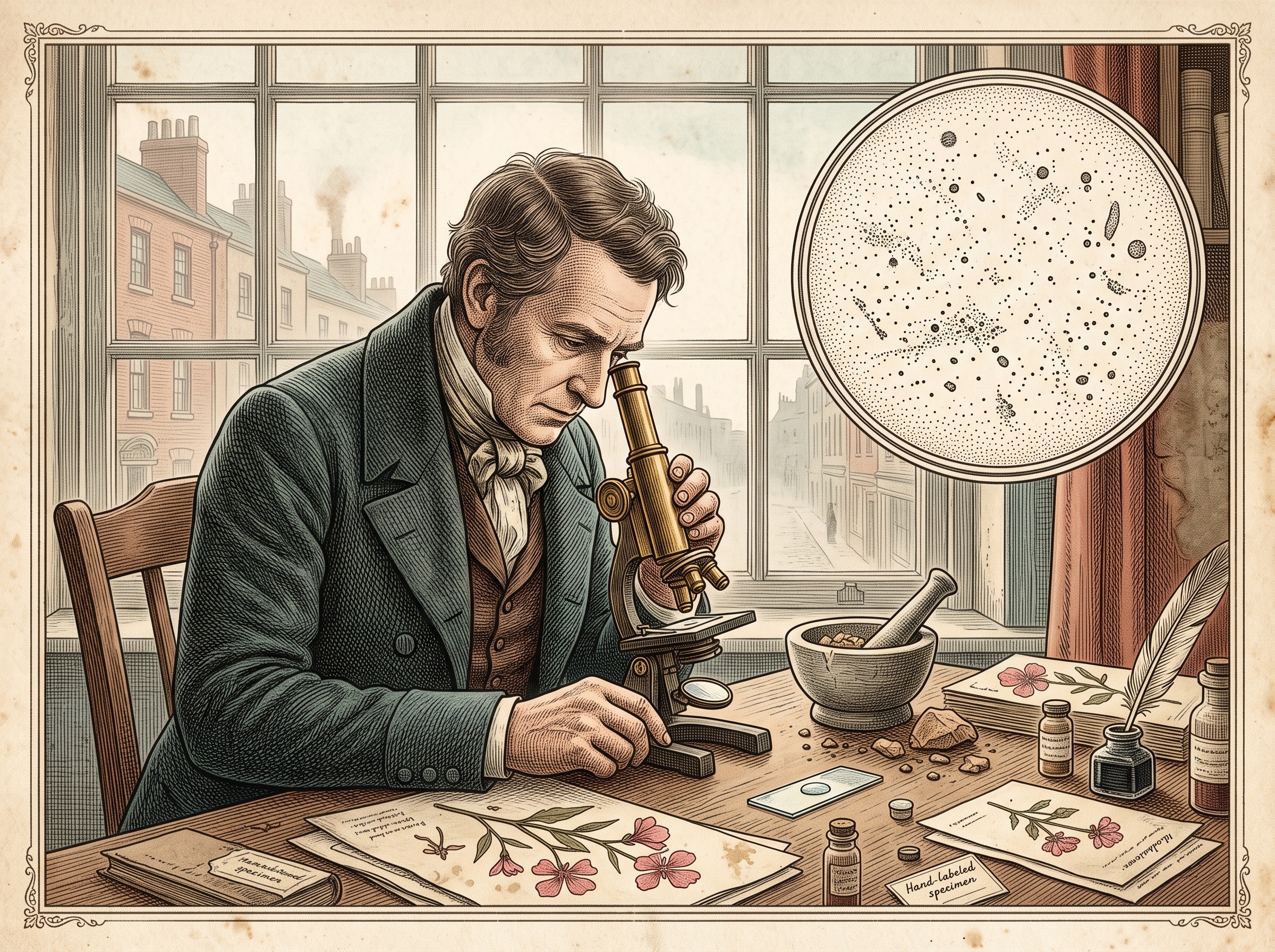
John Morton Coles was born in Woodstock, Ontario, in 1930, and found his way into British archaeology through Cambridge and Edinburgh, where he finished a PhD on Scottish Late Bronze Age metalwork in 1959. By 1960 he was back in Cambridge as an assistant lecturer, and he had a puzzle on his hands.
Across Britain and Ireland, peat bogs and riverbeds had been giving up beautiful sheet-metal shields: round, covered in rings of tiny raised bumps, with a central boss, or dome, over the handgrip. Archaeologists call the commonest British kind the Yetholm type, after a bog in southern Scotland that produced three of them. Today about 22 are known. They date to roughly the late second millennium BC, and they are thin, about six-tenths of a millimeter of bronze, thinner than many modern coins.
So were they for fighting? Coles decided to find out the most direct way available: make some and hit them.
For his metal shield, he hammered out a ribbed copper replica about 0.3 millimeters thick, modeled on a shield found at Coveney Fen in Cambridgeshire. For comparison, he also made leather shields. Ireland had preserved a real Bronze Age leather shield in a bog at Cloonbrin, County Longford, so leather was known to be an option. Coles tried three ways of making leather tough, and the winner was soaking the hide in cold water, beating it into shape, and sealing it with wax.
Then came the public test, during his lecture to the Society of Antiquaries. The two surviving accounts disagree on one detail. In a 2009 interview, Coles remembered holding the metal shield himself while a colleague attacked it, adding that he was glad his hand escaped the blow. A 2022 British Academy memoir by archaeologist Anthony Harding says Coles swung the sword and a departmental technician held the shield. Either way, the results were the same.
The point of a leaf-shaped bronze sword went into the metal shield easily. Then a slashing cut went through it, leaving two slices held together only by the wired rim. The leather shield took the same treatment and, by Coles’s account, resisted every blow, flexing a little but never letting the sword through.
Coles wrote up the work in 1962 as “European Bronze Age Shields” in the Proceedings of the Prehistoric Society. His conclusion was neat and memorable: the shining metal shields were for show — ceremony, display, offerings to the bog — while the plain leather ones were what you actually carried into a fight.
Why was it strange?
Most archaeology works by looking very carefully at things that cannot be touched. Coles’s demonstration did the opposite. It turned a museum question into a live, slightly dangerous performance, and it let a room full of experts watch an answer happen in a split second.
The surprise was the result itself. A metal shield sounds like it should beat a leather one. Coles’s test suggested that the Bronze Age had flipped that expectation, and that some of its most impressive war gear may never have been meant for war at all.
That is also why, decades later, the experiment ended up in the “failed” column. In 2009, archaeologist Barry Molloy of University College Dublin pointed out a problem in Antiquity: Coles’s replica was two to three times thinner than a typical Yetholm shield, and it was made of copper, which is softer than the tin-rich bronze of the originals. The shield in the lecture room wasn’t a fair stand-in for the real thing.
The same thread — Bronze Age — continues in The 3,000-Year-Old Pants That Were Invented for Horseback Riding.
What did scientists learn?
Molloy reran the test with copper replicas averaging 0.9 millimeters thick. Struck repeatedly with replica bronze swords, all three survived extensive punishment without becoming useless. Rolled edges dented and spread the force of a blow instead of splitting. Spear thrusts sometimes punched into the face but never went all the way through, and arrows tipped with bronze or flint, shot from a 35-pound bow at 10 meters, didn’t get through at all. The weak spot was the boss, which dented badly.
Leather turned out to be good, but not invincible. Molloy’s 3.5–4 mm leather replica degraded after about 25 strikes and began to bend back onto the holder’s arm.
Most tellingly, Molloy looked at the originals. The Cloonbrin leather shield carries the same kinds of damage seen in the tests, including an edge cut consistent with a right-handed attacker. A bronze shield from Barry Beg in Ireland shows marks that “may be combat related,” in his careful words. His overall view is that the line between ceremonial object and working weapon was rarely sharp: the same shield might be both.
The deeper lesson is about method. An experiment is only as good as its replica. Change the thickness or the metal, and you can change the answer.
Another ambitious failure: Kon-Tiki: The Raft That Crossed an Ocean to Prove a Theory That Was Wrong.
How does it affect us today?
Coles didn’t stop at shields. He became one of the people who turned “let’s try it and see” into a real discipline, and his 1973 book Archaeology by Experiment helped set out rules for doing it carefully. Today experimental archaeology is a field of its own, with open-air museums, research networks such as EXARC, and journals devoted to rebuilding houses, boats, tools, and weapons to test how they worked.
The shield story is now a standard teaching example in that field, precisely because it was persuasive, public, and partly wrong. It shows students why replicas need to match the originals’ materials and dimensions, and why wear marks on real objects are worth checking before a dramatic demonstration settles the matter.
Another experiment that taught more by not working: The Bluestone Bound for Stonehenge That Sank 17 Miles Into a 240-Mile Trip.
Fun fact
Coles later remembered that when the leather shield shrugged off the attack, the room full of professors broke into applause. He also remembered being relieved that his hand had stayed out of the sword’s way.
Sources
- Coles, J. M. “European Bronze Age Shields.” Proceedings of the Prehistoric Society 28 (1962): 156–190. (Primary source: Coles’s original publication of the experiment.)
- Paardekooper, Roeland. “John Coles Reflecting on Experimental Archaeology.” euroREA 6 (2009). (Coles’s own recollection of the lecture-room test.)
- Harding, Anthony. “John Morton Coles, 1930–2020.” Biographical Memoirs of Fellows of the British Academy 20 (2022): 111–137.
- Molloy, Barry. “For Gods or Men? A Reappraisal of the Function of European Bronze Age Shields.” Antiquity 83, no. 322 (2009): 1052–1064.
- Wikipedia. “Yetholm-type shield.” (Starting point for the shield type, find spots, and later critiques.)