Failed Experiments · Archaeology
The Obelisk That Took Three Attempts, Two Countries, and 120 Men to Stand Up
On the morning of March 24, 1999, in a granite quarry outside Aswan, eight people walked over to a two-ton obelisk, pulled on a rope, and stood it upright. It took minutes. Twenty yards away, a documentary crew, a British structural engineer, an Egyptologist, a stonemason and 120 hired laborers spent the rest of the day failing to do the same thing to a bigger one. Ropes snapped. A counterweight fell. By sunset they had called in a crane — a leftover from the building of the Aswan High Dam — to lift their 25-ton obelisk back down flat, while the little obelisk stood beside them, perfectly vertical, in the setting sun.
By the Curiosities Desk · · 5 min read · Filed under Archaeology · Today’s round
What happened?
Ancient Egyptians raised hundreds of obelisks: single shafts of granite, quarried whole, hauled overland, floated down the Nile, and then somehow tipped upright onto a pedestal without shattering. The largest still standing, the Lateran obelisk in Rome, weighs several hundred tons. Not one Egyptian text or tomb painting explains how the raising was done. It is one of the great open questions of ancient engineering, and in the 1990s the PBS science series NOVA decided to answer it the direct way: by trying.
The first attempt came in 1995 at Aswan, the quarry that supplied the originals. Egyptologist Mark Lehner led the scholarship. Roger Hopkins, an American stonemason, supplied the optimism. Aly el Gasab, one of Egypt’s foremost specialists in moving heavy statues, directed the crews. Sculptor Martin Isler pushed his own levering theory.
The first problem was getting an obelisk at all. Ancient workers shaped granite by pounding it with hammers of dolerite — a volcanic rock hard enough to bruise granite without shattering — a process that would have taken months. The team gave up and brought in bulldozers, which produced a 35-foot shaft of roughly 40 tons.
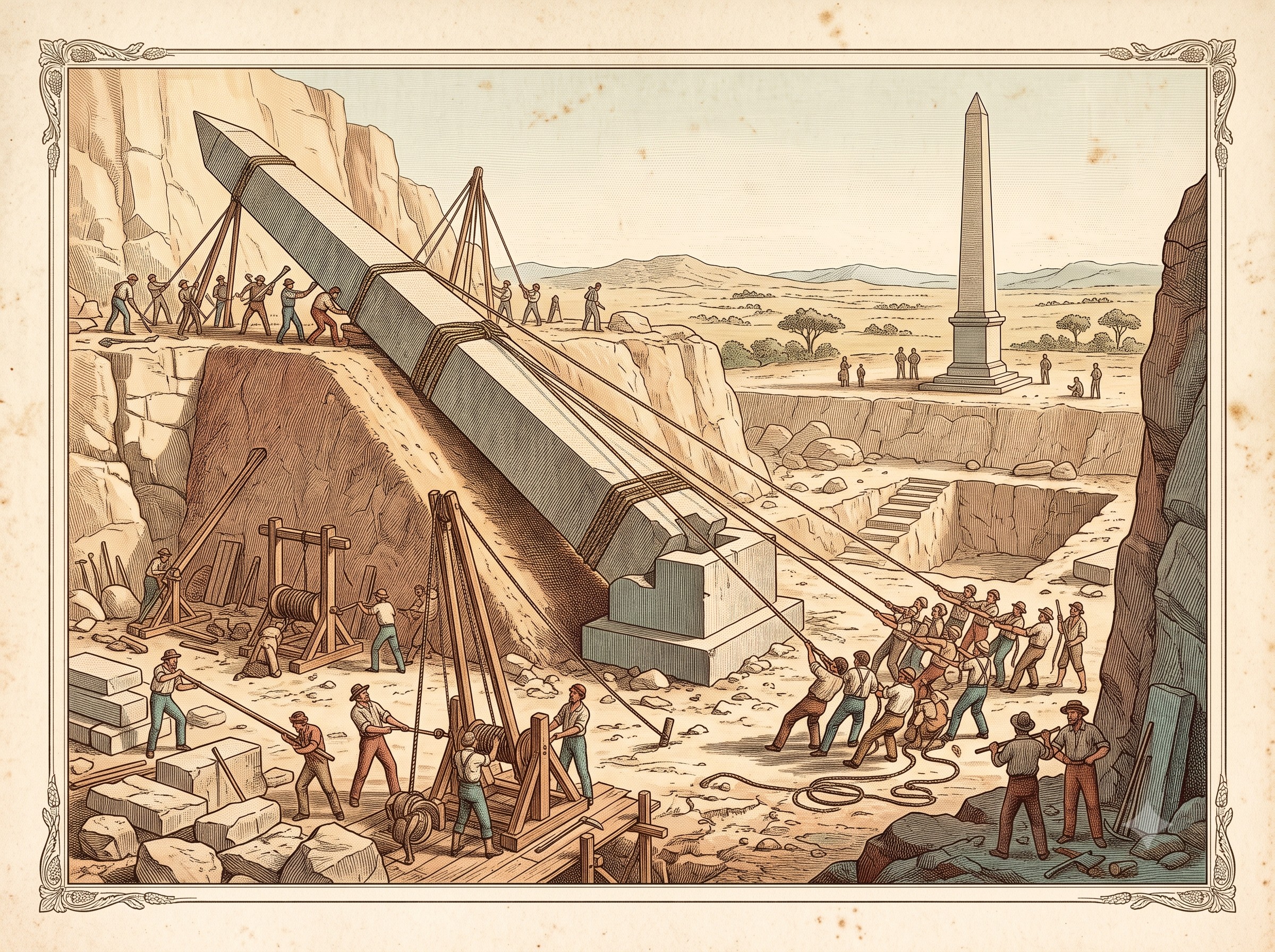
Raising it went well right up until it didn’t. The obelisk was dragged on a sled up an earthen ramp, tipped over the lip, and lowered into a “turning groove” — a notch cut into the pedestal that holds the butt end in place while the shaft swings up. It settled at 32 degrees. Levers pushed it to about 40. And there it stopped. Pulling harder on the rope tied to the tip only wedged the butt end deeper into the groove. Hopkins rigged an A-frame overnight to redirect the pull upward; by morning the rope ran down at so steep an angle that not enough workers could reach it. The obelisk never passed 42 degrees. Isler, meanwhile, levered a two-ton obelisk upright without much trouble.
The second attempt, in March 1999, was better funded, better staffed, and worse. British engineer Mark Whitby designed a system using a suspended stone counterweight. The ropes stretched overnight, so the counterweight sagged to the ground before the day began. It was hoisted, retied, and dropped again. At 11:25 a.m. the counterweight rope broke. At 12:30 p.m. two of the main ropes snapped, sending the crane holding the counterweight bouncing on its frame; no one was hurt, and no one could say why the ropes had parted. In the afternoon 120 men on six ropes heaved in unison to the call of “Hela hop!” The obelisk rose — and started rocking side to side, which walked the pivot timber toward the edge of the ramp. Asked whether the timber might go over, Whitby said: “It’s not a danger, it’s a real reality.” That was the end of it. Hopkins’s little two-ton obelisk had gone up at 8 a.m. that same morning.
The third attempt moved the whole operation to a granite quarry in Chelmsford, Massachusetts, in the late summer of 1999 — closer to NOVA’s Boston base, and with months rather than days to prepare. The design was simpler: Hopkins’s sand-pit idea, scaled up. A 49,000-pound obelisk lay on a gravel ramp with its butt end over a container packed with dry sand. Crews drained the sand slowly through doors at the base, and the obelisk sank into the turning groove at 75 degrees. On September 11 and 12, four teams of 28 pullers took it the last 15 degrees. It stood.
Why was it strange?
The strange part isn’t that it took three tries. It’s what kept beating them. Nobody ran out of stone, or muscle, or money. They ran out of rope.
Every failure traced back to the soft, stretchy, fraying parts of the system — knots that slipped, hemp that lengthened overnight, lines that abraded on a 90-degree edge. The granite behaved perfectly. The physics behaved perfectly. It was the humble consumables that made a monolith unmovable, which is presumably also why no ancient rope-master left us a manual.
Another experiment that taught more by not working: The Bronze Age Shield Sliced in Two in Front of Britain’s Top Archaeologists.
What did scientists learn?
This is experimental archaeology: testing a theory about the past by physically doing it, and treating the failures as data. The failures here were unusually informative. They established that pulling on an obelisk’s tip is close to useless past a certain angle — the force vector points into the turning groove rather than around it, so the harder you haul, the more firmly you jam the stone. They established that the sand-pit method, which lowers the stone by removing support beneath it rather than lifting it, works at 25 tons. And they established, painfully, that rope management is not a detail. The winning team spent months testing lines, eliminated sharp edges, and calculated that the obelisk becomes self-righting at 86.5 degrees, past which it will “want to go kerplunk.”
None of this proves the Egyptians used sand. It proves the method is physically sufficient with Bronze Age materials — which is a smaller claim, and the honest one.
Another ambitious failure: Kon-Tiki: The Raft That Crossed an Ocean to Prove a Theory That Was Wrong.
How does it affect us today?
The obelisk trials are now a teaching case for why reconstruction beats speculation. Armchair theories about ancient monuments are cheap; a theory that survives 49,000 pounds of granite and a hundred pairs of hands is not. The same approach has since been turned on Stonehenge lintels, Roman concrete, and Polynesian voyaging canoes.
There’s a quieter lesson too, for anyone who builds things. Three capable teams were stopped, repeatedly, by the least glamorous component in the system. The rope was never the interesting part of the plan. It was the part that decided the outcome.
A close cousin: The Bluestone Bound for Stonehenge That Sank 17 Miles Into a 240-Mile Trip.
Fun fact
The largest obelisk the Egyptians ever attempted is still lying in the Aswan quarry, three sides carved, one side never freed from the bedrock. Masons found a crack in the granite and walked away. Had they finished it, it would have weighed somewhere near 1,000 tons — and the NOVA teams, who could not raise 25, would have had a considerably longer television series.
Sources
- NOVA Online, “Mysteries of the Nile: First Attempt” — NOVA’s own account of the 1995 Aswan attempt, including the 42-degree stall and the A-frame failure.
- NOVA Online, Dispatch: “A Tale of Two Obelisks,” March 24, 1999 — Peter Tyson’s hour-by-hour primary account of the second failure.
- NOVA Online, Dispatch: “The Third Attempt,” August 27, 1999 — the redesign and the 49,000-pound Massachusetts obelisk.
- NOVA Online, Dispatch: “Obelisk Raised!,” September 12, 1999 — the successful raising, with the engineering numbers.
- Evan Hadingham, “A NOVA Crew Strains, and Chants, to Solve the Obelisk Mystery,” Smithsonian, January 1997 — contemporary coverage of the first expedition.