Failed Experiments · Archaeology
The Bluestone Bound for Stonehenge That Sank 17 Miles Into a 240-Mile Trip
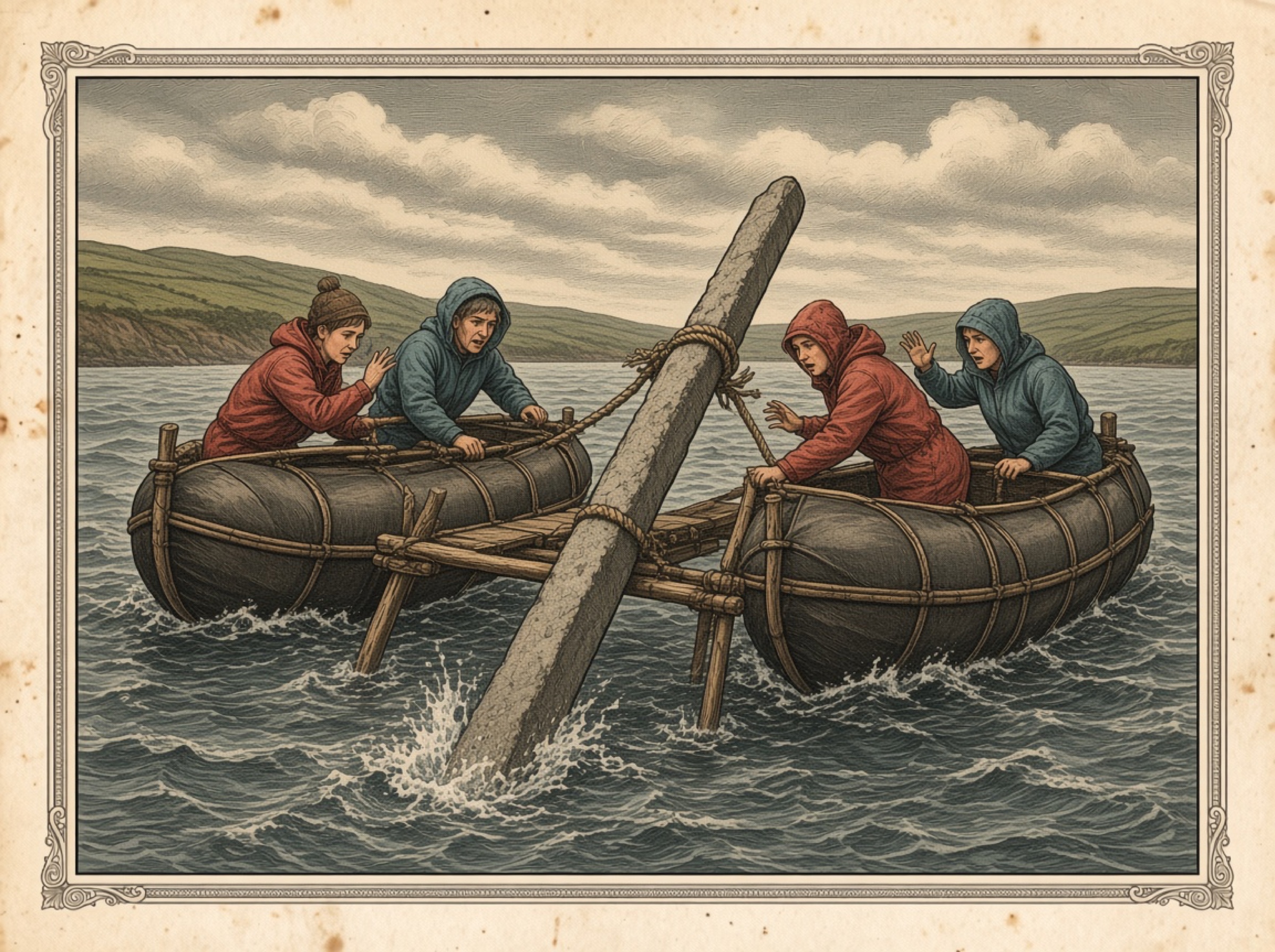
In the summer of 2000, a crew of volunteers in Wales watched a pillar of ancient rock — dragged for weeks across the Pembrokeshire countryside by hand — slip out of its rope sling between two replica Stone Age boats, dangle beneath the waves for a moment, and then drop to the bottom of Milford Haven. It was supposed to be going to Stonehenge.
By the Curiosities Desk · · 5 min read · Filed under Archaeology · Today’s round
What happened?
Stonehenge, on Salisbury Plain in southern England, is built from two kinds of stone. The giant sarsens came from roughly 15 to 20 miles away. The smaller “bluestones” are the puzzle: they come from the Preseli Hills in west Wales, roughly 140 miles away as the crow flies. For more than a century, people have argued about how Neolithic builders (people of the New Stone Age, the first farmers) got them there.
In 2000, a Pembrokeshire community group called Menter Preseli decided to stop arguing and try it. Backed by a £100,000 grant from the UK’s Millennium lottery fund, the “Millennium Stone” project would move one bluestone — reported at around three tonnes, though some accounts say four — from the Preseli Hills to Stonehenge using only muscle, rope, wood, and boats of a prehistoric style. The planned route, by land and sea along the Welsh coast and up the Bristol Channel, came to about 240 miles.
The overland leg began in April. Teams of volunteers hauled the stone on a wooden sledge, and it went badly from the start. Dragging turned out to be much harder than expected; the crews managed about one mile a day instead of the three they had hoped for. Tired volunteers didn’t always turn up for towing duty. And near the end of the roughly 20-mile overland stretch, according to reports at the time, pranksters towed the sledge away in the night. (It was recovered.)
At Milford Haven, the stone was slung on a platform between two currachs — light boats made of hide stretched over a wooden frame, a traditional design used as a stand-in for prehistoric craft. Then the sea got rough. The securing ropes gave way, and the stone sank into about 60 feet of water. By the BBC’s count, it was only around 17 miles into its 240-mile journey.
It stayed on the seabed for roughly ten days before Royal Navy reservists located it and winched it back up with salvage vessels. The voyage was never completed. A Welsh historian who had long opposed the project called it “a complete fiasco” and “a total waste of money,” and other critics pointed out that the modern landscape — with its roads, hedges, and fences — was so different from prehistoric Britain that even success wouldn’t have proved much.
The stone itself sat on the quayside at Milford Haven for more than two years. In 2003 it was moved to the National Botanic Garden of Wales in Carmarthenshire, where it rests on its side on a plinth, next to an information panel describing how its trip ended.
Why was it strange?
Experimental archaeology — testing theories about the past by actually rebuilding the tools, boats, or methods — usually ends one of two ways: “yes, that works” or “no, it doesn’t.” The Millennium Stone managed to say neither.
Sinking a stone in a modern harbor doesn’t prove Neolithic people couldn’t move bluestones by sea; the original builders had generations of seafaring know-how, could pick their weather, and weren’t working to a lottery-funded schedule. But it didn’t prove they could, either. If anything, the project’s clearest result was a lesson in how much hidden skill a “simple” prehistoric task requires: lashing a heavy, top-heavy load between two small boats so it survives open water is a craft, and that craft has been lost for about 5,000 years.
There’s also a lovely irony. The project set out to settle a debate and instead gave both sides fresh ammunition. Supporters of human transport said the stone had been moved overland just fine; skeptics — including geologists who argue that Ice Age glaciers carried some bluestones most of the way east — said the fiasco showed how implausible the whole effort was.
Another experiment that taught more by not working: Kon-Tiki: The Raft That Crossed an Ocean to Prove a Theory That Was Wrong.
What did scientists learn?
Later research changed the question in two big ways.
First, archaeologists found where the bluestones actually came from. Excavations led by Mike Parker Pearson at outcrops in the Preseli Hills, including Craig Rhos-y-felin and Carn Goedog, uncovered what the team interprets as Neolithic quarries: stone wedges, worked platforms, and dated hearths from around the time the bluestones were extracted. That work, published in the journal Antiquity, also pushed the team toward an overland route rather than a sea voyage — partly because the quarries sit on the north side of the hills, away from the southern harbor at Milford Haven. The glacial-transport camp still disputes the quarry interpretation, and the debate is not fully settled.
Second, better experiments showed that technique matters more than headcount. In 2016, UCL archaeology student Barney Harris had volunteers pull a roughly one-tonne stone strapped to a sycamore sledge running over a track of logs. He expected to need at least 15 people. Ten could move it about ten feet every five seconds — a pace that suggests a few dozen people could have managed a full-size bluestone.
The same thread — Neolithic — continues in The 5,700-Year-Old Chewing Gum That Held an Entire Human Genome.
How does it affect us today?
The Millennium Stone became a kind of cautionary tale in experimental archaeology: test one variable at a time, in conditions as close to the original as you can get, and be honest about what a result can and can’t show. Later projects tended to focus on smaller, controlled questions — how much friction a sledge creates, how many people a load really needs — instead of one heroic re-enactment.
The bigger mystery keeps expanding, too. In 2024, a study in Nature traced Stonehenge’s six-tonne Altar Stone not to Wales but to northeast Scotland, more than 400 miles away. Whatever method Neolithic Britons used to move big stones long distances, they were evidently better at it than anyone in 2000.
Another ambitious failure: The Obelisk That Took Three Attempts, Two Countries, and 120 Men to Stand Up.
Fun fact
The Millennium Stone never reached Stonehenge, but it did eventually make a much shorter trip — to a botanic garden in Carmarthenshire, a few dozen miles east of where it started, where it is displayed lying down so visitors know it’s “the one that made the journey.”
Sources
- Parker Pearson, M. et al. (2015). “Craig Rhos-y-felin: a Welsh bluestone megalith quarry for Stonehenge.” Antiquity 89(348). Cambridge Core (PDF)
- Stone Pages Archaeo News (2 July 2000), compiling BBC News and The Times reports. “Unforeseen obstacles for the Millennium Stone project”
- The Megalithic Portal, “The Millenium Stone,” quoting BBC News Wales (2003) on the stone’s move to the National Botanic Garden of Wales. megalithic.co.uk
- Archaeology magazine (Archaeological Institute of America), “People Could Have Pulled Bluestones to Stonehenge” (2016). archaeology.org
- New Civil Engineer (8 June 2000), “Team to rethink plans as Millennium Stone sinks.” newcivilengineer.com