Failed Experiments · Archaeology
Kon-Tiki: The Raft That Crossed an Ocean to Prove a Theory That Was Wrong
On August 7, 1947, a balsa-log raft named Kon-Tiki slammed into a coral reef in the middle of the Pacific, ending a 101-day, 4,300-mile drift from Peru. The six men aboard had just done something no one thought possible: crossed the world's largest ocean on a vessel built with Stone Age technology. They'd set out to prove that ancient South Americans could have settled Polynesia. They'd actually just proved that Thor Heyerdahl, the raft's captain, was a man who could survive nearly anything the ocean threw at him — except being right.
By the Curiosities Desk · · 6 min read · Filed under Archaeology · Today’s round
What happened: The Kon-Tiki Expedition
Thor Heyerdahl was a young Norwegian zoologist who, in the late 1930s, spent a year with his first wife on the Marquesas Islands in French Polynesia studying local wildlife. There he became fascinated by island legends about a god-chief named Tiki, who was said to have led the first people to the islands from a “great country” to the east. Heyerdahl noticed that some Polynesian stone statues resembled South American ones, and that the Pacific’s currents and trade winds — the same Humboldt Current that sweeps up the coast of Peru — flow steadily westward toward Polynesia. He developed a theory: Polynesia’s first settlers hadn’t sailed in from Asia, as most anthropologists believed, but had drifted over from South America on rafts.
Academic Polynesia experts dismissed the idea outright — ancient South Americans, they said, had no oceangoing craft capable of the trip. Heyerdahl decided to settle the argument the only way he could think of: by building one and sailing it himself.
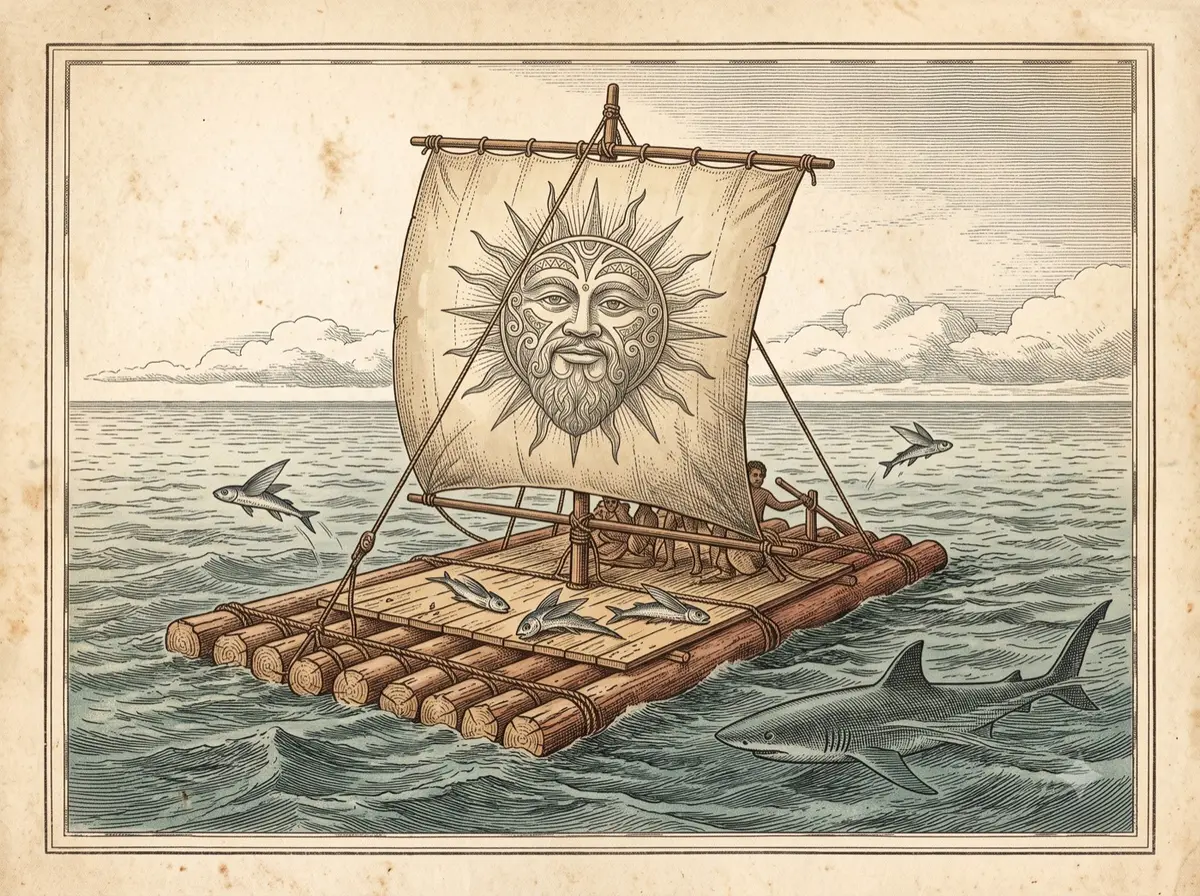
In 1947 he assembled a five-man crew — fellow Norwegians Erik Hesselberg, Knut Haugland, Torstein Raaby, and Herman Watzinger, plus Swedish sociologist Bengt Danielsson — and, with help from the Peruvian navy, built a raft from nine balsa logs lashed together with hemp rope, using only materials and techniques available to pre-Columbian South Americans (they allowed themselves a radio, for safety). They named it Kon-Tiki, an old name Heyerdahl believed had been used for the Inca sun god Viracocha, and painted a bearded face on its sail.
The raft left the port of Callao, Peru, on April 28, 1947, towed out to open water, then set loose to drift with the current. For over three months the crew ate fish, plankton, and canned rations, fought off curious sharks, watched flying fish land on deck, and radioed updates to ham operators around the world through Haugland and Raaby’s equipment. On August 7, after 101 days at sea, Kon-Tiki struck a reef at Raroia, in French Polynesia’s Tuamotu Islands, and the crew waded ashore. No one had died. The voyage became a sensation: Heyerdahl’s book about it was translated into some 70 languages, and the 1950 documentary film of the expedition won the Academy Award for Best Documentary.
Why it was strange: The Kon-Tiki Expedition
The expedition worked exactly as advertised — the raft floated, the crew survived, the voyage proved a Stone Age craft could drift from South America to Polynesia. But proving something is possible isn’t the same as proving it happened. Heyerdahl treated a successful demonstration of feasibility as if it were evidence for actual history, and the public — dazzled by the adventure — mostly went along with him. For decades, “Kon-Tiki” made Heyerdahl’s South American settlement theory feel like established fact in popular culture, even as the scientists who actually study Polynesian origins kept saying otherwise.
The same thread — Thor Heyerdahl — continues in The Easter Island Statues That ‘Walked’ to Work — and the 18 People Who Took One for a Stroll.
What scientists learned: The Kon-Tiki Expedition
Later research — linguistics, archaeology, and eventually genetics — built an overwhelming case against Heyerdahl’s core claim. Polynesian languages belong to the Austronesian language family, whose roots trace back to Taiwan; the pottery styles, tools, and settlement patterns found across the Pacific match a migration that began in Southeast Asia roughly 5,000 years ago and spread east through Melanesia into Polynesia, not one that began in South America. DNA studies of Polynesian populations, starting in the 1990s and confirmed repeatedly since, show that their genetic ancestry is overwhelmingly Southeast Asian, not South American.
That doesn’t mean Heyerdahl invented the South America connection out of nothing. A 2020 genetic study led by researchers at Stanford, published in Nature, found real evidence of contact between Polynesians and Native Americans — most likely people related to the Indigenous Zenú of present-day Colombia — with the two populations interbreeding around 1200 CE, centuries after Polynesia was first settled. And the sweet potato, a crop native to South America, was already growing across Polynesia before European contact, with remains in the Cook Islands radiocarbon-dated to around 1000 CE. The best current explanation is that Polynesians, who were the more accomplished long-distance sailors of the two groups, made the crossing to South America and back — the reverse of the direction Heyerdahl proposed, and centuries after his settlement timeline, not the founding voyage itself.
Another experiment that taught more by not working: The Bluestone Bound for Stonehenge That Sank 17 Miles Into a 240-Mile Trip.
How it reaches us today: The Kon-Tiki Expedition
Kon-Tiki remains a landmark case study in the difference between demonstrating that something could have happened and proving that it did — a distinction taught in archaeology and philosophy-of-science courses alongside the expedition’s own dramatic story. The original raft is preserved at the Kon-Tiki Museum in Oslo, one of Norway’s most-visited museums, where it still draws visitors curious about the voyage. And the genuine, if much smaller and later, contact between Polynesia and the Americas that genetics has since uncovered shows that ambitious, “wrong” theories can still point toward real discoveries — just not the ones their authors expected.
Another ambitious failure: The Bronze Age Shield Sliced in Two in Front of Britain’s Top Archaeologists.
Fun fact: The Kon-Tiki Expedition
Heyerdahl nearly drowned twice as a child in Norway and grew up genuinely afraid of water; he didn’t learn to swim confidently until his twenties. The man who would go on to spend 101 days adrift on a raft in the open Pacific once said that as a teenager, he would have “absolutely denied” that he’d ever go to sea on one.
Sources: The Kon-Tiki Expedition
- Kon-Tiki Museum, Oslo — official history of the expedition: https://kon-tiki.no/en/thor-heyerdahl/the-kon-tiki-expedition/
- Ioannidis, A.G., et al., “Native American gene flow into Polynesia predating Easter Island settlement,” Nature, vol. 583 (2020): https://www.nature.com/articles/s41586-020-2487-2
- “Kon-Tiki expedition,” Wikipedia: https://en.wikipedia.org/wiki/Kon-Tiki_expedition
- Smithsonian Magazine, “Native Americans and Polynesians Met Around 1200 A.D., DNA Shows” (2020): https://www.smithsonianmag.com/science-nature/native-americans-polynesians-meet-180975269/
- Britannica, “Thor Heyerdahl”: https://www.britannica.com/biography/Thor-Heyerdahl
Related stories: The Kon-Tiki Expedition
- The Man Who Found Troy — and Dug Straight Through It — The man who found Troy dug straight through it
- The Astronomer Who Saw Canals on Mars That Weren’t Real — An astronomer mapped canals on Mars that were never there
- Göbekli Tepe: The Temple Built Before Farming, Writing, or the Wheel — A temple complex built before farming, writing, or the wheel