Science Gone Wrong · Archaeology
The 3,300-Year-Old Golden Beard That Got Glued Back On With Epoxy
In January 2015, visitors to the Egyptian Museum in Cairo began noticing something odd about the most famous face in archaeology. Tutankhamun's golden burial mask, a 3,300-year-old masterpiece, now had a thin, transparent yellowish line running between its chin and its long braided beard. The beard looked very slightly off-center. Within days the world learned why: months earlier, the beard had come off, and it had been put back with a quick-drying epoxy.
By the Curiosities Desk · · 5 min read · Filed under Archaeology · Today’s round
What happened?
The mask was found by Howard Carter’s team, who discovered Tutankhamun’s tomb in the Valley of the Kings in 1922 and revealed the mask on 28 October 1925 when they opened the innermost of the king’s three coffins. It weighs a little over 10 kilograms (about 22 pounds) and is made of two sheets of gold, inlaid with lapis lazuli, quartz, obsidian, carnelian, turquoise, and colored glass. The beard alone is a narrow strip of gold and blue glass weighing roughly 2.5 kilograms.
Even then, the beard was not firmly attached. According to the German conservator Christian Eckmann, who later led its restoration, the mask was found in two pieces, face and beard, lying on the mummy’s face. For almost two decades the two were displayed separately. In 1946 they were fixed together as a single object. (Some accounts give 1944; Eckmann’s team, which studied the museum’s archives, gives 1946.)
The trouble came in August 2014. Exactly what happened is still disputed. Conservators who spoke anonymously to the Associated Press gave differing accounts: in one, the beard was knocked off while the display case was being worked on; in another, it was removed on purpose because it was already loose. Government investigators later concluded the mask had been carried improperly. What everyone agreed on was the repair. Under pressure to get the museum’s biggest attraction back on display quickly, staff reattached the beard with epoxy, a strong two-part glue that sets fast and cannot be dissolved afterward.
One conservator told the AP that epoxy dripped onto the face and dried there, and that a colleague scraped it off with a spatula, leaving scratches on the gold. The museum’s director at first denied any damage, though he later acknowledged that the epoxy layer was “very visible.”
Once photos spread in January 2015, Egypt’s Ministry of Antiquities called in Eckmann, a specialist in metal and glass, who had restored ancient Egyptian copper statues of King Pepi I. Germany’s Foreign Ministry provided 50,000 euros. After months of study, a German-Egyptian team began work in October 2015.
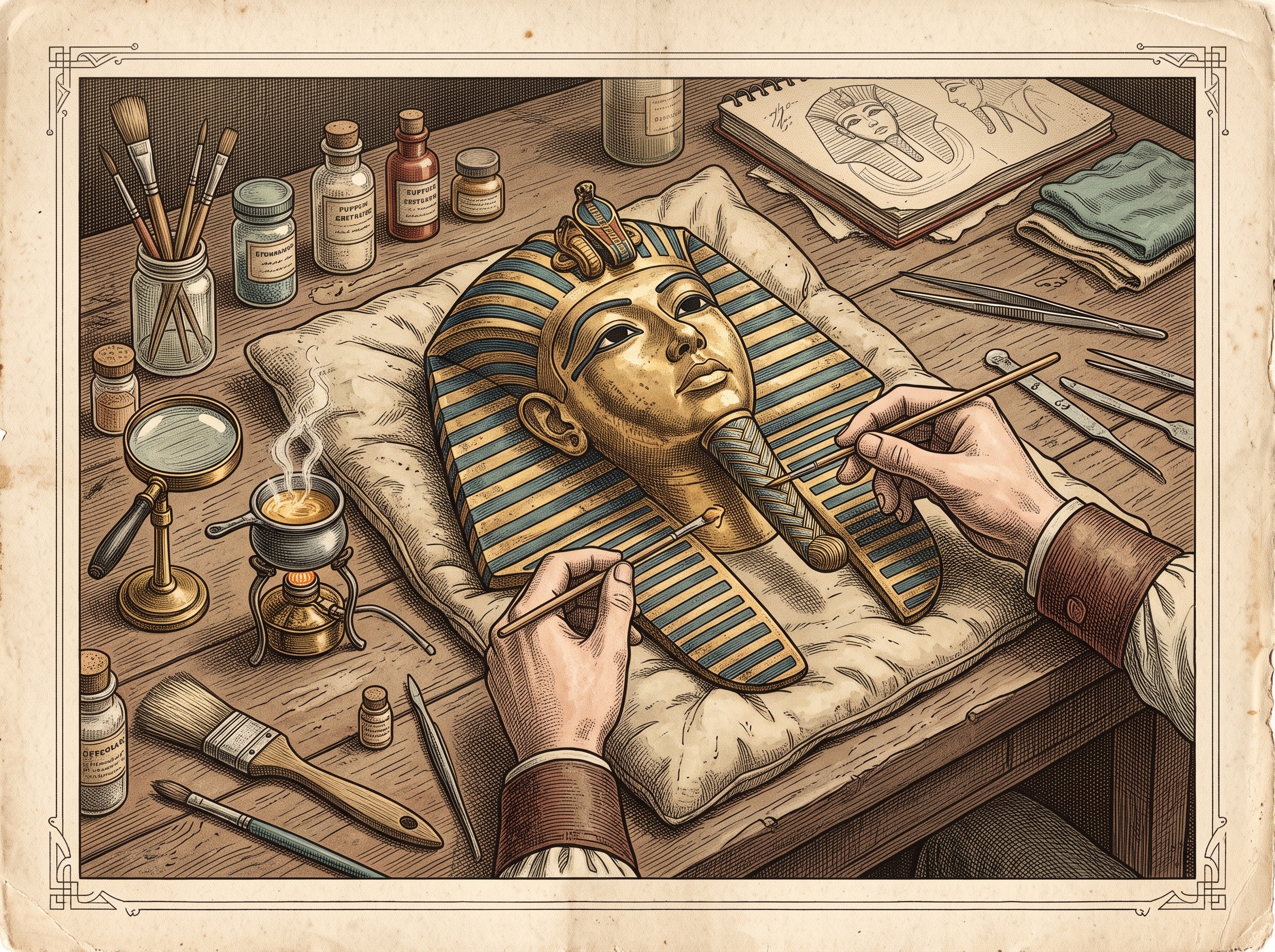
Getting the glue off was slow. Epoxy, Eckmann told Ahram Online, is “not soluble in anything.” So the team did it by hand. They warmed the mask slightly to soften the adhesive, then pried and scraped it away using wooden sticks and spatulas soft enough not to scratch gold. Freeing the beard took about two weeks. Designing a safe way to reattach it took about six more.
Their choice of adhesive was beeswax, a natural material the ancient Egyptians themselves used. The restored mask went back on display on 16 December 2015. A month later, Egyptian prosecutors referred eight museum employees, including the former museum director and the former head of restoration, to a disciplinary court for “gross negligence.”
Why was it strange?
Museums usually move at a glacial pace precisely because their objects cannot be replaced. Conservators have a near-sacred rule called reversibility: any repair should be something a future expert can undo without harming the original. Epoxy is close to the opposite. It is chosen when you want something to stay stuck forever.
So the scandal was not really that an ancient object broke. Old things break, and this beard had been coming loose since antiquity. The surprise was that a single rushed repair could put the most protected artifact in Egypt at more risk than three millennia in a tomb had.
There was also a twist. Friederike Fless, president of the German Archaeological Institute, said the examination showed “the 2014 damage was exaggerated, since the beard was previously detached.” Underneath the epoxy, restorers found several thin layers of older glue, proof that the beard had been glued more than once before.
The same thread — Conservation — continues in The Copper Tools That Scraped History Off the Parthenon Marbles.
What did scientists learn?
Taking the beard off gave researchers a rare chance to study how the mask was built. The team scanned it in 3D with a light-pattern scanner and examined it under a microscope, the first detailed study of its manufacturing since its discovery.
They found that the beard has an internal tube that slots into the face, a hidden piece of ancient engineering. They also found that the 1946 repair had used soft solder, a low-melting metal alloy used for joining.
The project showed that sometimes the safest modern solution is an ancient one. Beeswax holds well, can be softened and removed later, and has been tested by time on Egyptian objects for thousands of years.
Elsewhere in archaeology: The Mummy’s Curse That Missed Its Main Target.
How does it affect us today?
The episode became a widely cited cautionary tale in museum conservation, about what happens when the pressure to keep a famous object in front of visitors outweighs careful practice. It also left the world better informed about the mask itself. Eckmann’s team reported its findings in a 2022 book, Tutanchamuns Mumienmaske: Chronographie einer Ikone (Tutankhamun’s Mummy Mask: Chronography of an Icon), co-written with Katja Broschat.
And it is a reminder that every famous artifact in a glass case has a hidden life of repairs, glue layers, and decisions made by people doing their best under pressure.
Another good intention with a bad landing: The Fake Fossils Carved to Humiliate a Professor — Who Then Published a Book About Them.
Fun fact
Tutankhamun almost certainly never wore a beard like that in life. The long, braided false beard was a symbol of divine kingship linking the pharaoh to Osiris, god of the afterlife, which is why even Hatshepsut, one of Egypt’s few female pharaohs, was often depicted wearing one.
Sources
- National Geographic, report on the mask repair and the referral of eight museum employees (January 2016): https://www.nationalgeographic.com/culture/article/160125-tut-mask-repair-egypt-trial
- Ahram Online, Nevine El-Aref, “Face to face with Tutankhamun’s mask,” interview with Christian Eckmann (October 2015): http://english.ahram.org.eg/NewsContentPrint/9/0/161598/Heritage/0/Face-to-face-with-Tutankhamun’s-mask.aspx
- Associated Press via KSL, “Egypt puts King Tut mask on exhibit after botched epoxy fix” (December 2015): https://www.ksl.com/article/37792708/egypt-puts-king-tut-mask-on-exhibit-after-botched-epoxy-fix
- Associated Press via Fox News, “Egypt to put 8 workers on trial over botched King Tut mask fix” (January 2016): https://www.foxnews.com/world/egypt-to-put-8-workers-on-trial-over-botched-king-tut-mask-fix
- Griffith Institute, University of Oxford, Howard Carter’s excavation journals (Season 4, 1925): http://www.griffith.ox.ac.uk/discoveringTut/journals-and-diaries/season-4/journal.html