Accidental Discoveries · Chemistry
The Cylinder That Weighed Too Much and Became Teflon
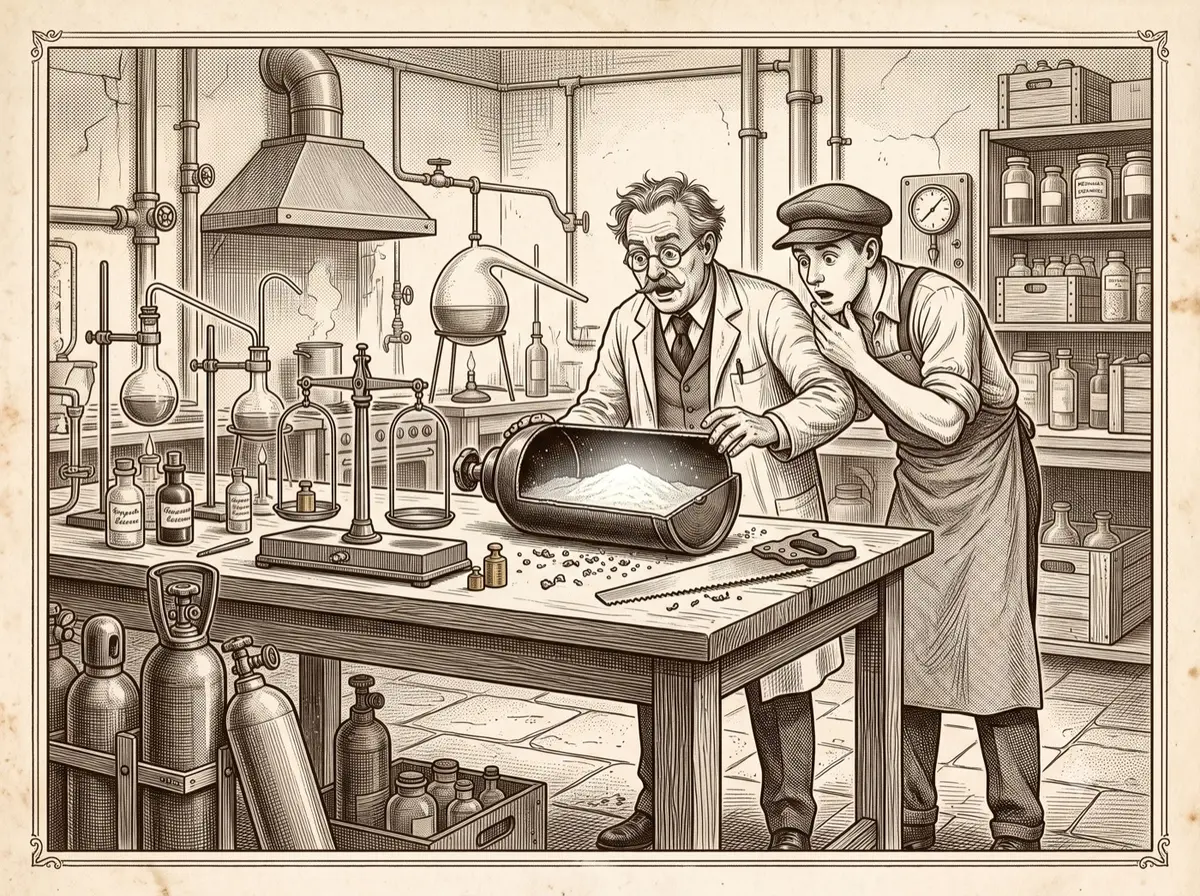
On April 6, 1938, a DuPont chemist named Roy Plunkett opened the valve on a small steel cylinder of refrigerant gas and got nothing. No hiss, no gas, no smell. The cylinder should have been empty. Instead, when he set it on a scale, it weighed exactly what it should have if it were still full. Confused, he and his lab assistant, Jack Rebok, sawed the thing open — and found the inside lined with a strange, slippery white powder that no one in the room had a name for yet.
By the Curiosities Desk · · 5 min read · Filed under Chemistry · Today’s round
What happened: The Cylinder That Weighed Too Much and Became Teflon
Plunkett was 27 years old and less than a year into his job at DuPont’s Jackson Laboratory in Deepwater, New Jersey. His assignment had nothing to do with nonstick pans or space-age materials — he was hunting for a better refrigerant. In the late 1920s and early 1930s, home refrigerators had a serious image problem: many ran on toxic or flammable gases like sulfur dioxide and ammonia, and leaks occasionally killed people. Newspapers ran headlines like “Ice Machine Gas Kills 15 in Chicago.” A GM researcher named Thomas Midgley Jr. had answered the crisis with a new class of chemical refrigerants that would later be sold as Freon, but the rights belonged to Frigidaire. Other manufacturers wanted their own version, and DuPont assigned Plunkett’s team to find one.
That search led Plunkett to fluorine chemistry, and specifically to a colorless, odorless gas called tetrafluoroethylene, or TFE. He had about 100 pounds of it manufactured and stored in small pressurized cylinders, kept cold with dry ice, ready to be used in further experiments. On that April morning, he and Rebok grabbed one of those cylinders to run a routine reaction — and the gas simply wasn’t there.
Rather than shrug it off as a bad cylinder and grab another one, Plunkett did the thing that separates a good chemist from a great one: he got curious about the failure. He and Rebok cut the cylinder open and found a waxy white solid coating the inside walls. Plunkett suspected the TFE gas had spontaneously polymerized — meaning individual gas molecules had linked together into long chains, forming a completely new solid material. That process, on its own, wasn’t supposed to happen without a catalyst prompting it. Instead of discarding the mystery substance, Plunkett ran it through basic tests. It wouldn’t melt at high temperatures. It wouldn’t dissolve in acids strong enough to damage bone. And almost nothing would stick to it. He had accidentally made polytetrafluoroethylene — PTFE — the material the world would later know as Teflon.
Why it was strange: The Cylinder That Weighed Too Much and Became Teflon
Chemists of the era didn’t expect a stored gas to turn itself into a solid with no added trigger. Polymerization — the chaining-together of small molecules into long ones — usually needed a deliberate catalyst and controlled conditions, the sort of thing scientists set up on purpose, not something that happens quietly inside a sealed cylinder sitting on a shelf. Plunkett later said his own first reaction wasn’t excitement — it was closer to irritation. “My reaction was, ‘Well, we have to start over now,’” he recalled in a 1986 oral history interview. The strangeness wasn’t just that a gas had become a solid; it was that the solid defied everything a 1938 chemist thought he knew about how materials behave. Nothing was supposed to be that slippery, that inert, and that resistant to heat and corrosion all at once — especially not something that showed up as an unplanned residue in a failed experiment.
It shares a shelf with The Rocket Scientist Whose Leaky Fridge Idea Became the Super Soaker, in The Mistakes That Became Things You Still Use.
What scientists learned: The Cylinder That Weighed Too Much and Became Teflon
The underlying chemistry, once DuPont’s polymer specialists studied it further, came down to the strength of a single kind of chemical bond. Carbon and fluorine form the strongest bond in organic chemistry, and PTFE is essentially a long backbone of carbon atoms with fluorine atoms locked tightly around it. That bond is so stable that almost nothing — heat, acid, other chemicals — can pry it apart, which is exactly why the substance shrugged off everything Plunkett threw at it. Scientists also learned something less about the chemistry and more about the discovery process itself: that an anomaly worth investigating doesn’t announce itself as a breakthrough. It often looks, at first, like a ruined experiment. Plunkett’s willingness to characterize a “failed” cylinder instead of tossing it is now taught as a textbook case of scientific preparedness meeting accident — what science historians sometimes call “the prepared mind.”
Also in The Mistakes That Became Things You Still Use: The Melted Candy Bar That Invented the Microwave.
How it reaches us today: The Cylinder That Weighed Too Much and Became Teflon
For years after 1938, DuPont had a remarkable material and no clear use for it — PTFE was too expensive to manufacture for any obvious commercial product. Its first major job came during World War II, when the Manhattan Project needed to move highly corrosive uranium hexafluoride gas through hundreds of miles of piping at the Oak Ridge, Tennessee, gaseous diffusion plant. Ordinary gaskets and seals dissolved almost immediately; PTFE didn’t. DuPont registered the trademark “Teflon” after the war, and in 1951 the material got its first public introduction as a household product, when Philadelphia awarded Plunkett the John Scott Medal and gave banquet guests Teflon-coated muffin tins as party favors. The nonstick skillet followed in 1961, when inventor Marion Trozzolo began selling his “Happy Pan.” Since then, PTFE and its chemical relatives — a broad family known as PFAS, or per- and polyfluoroalkyl substances — have turned up in cookware, waterproof fabrics like Gore-Tex, dental floss, medical devices, and industrial seals. That same durability has a downside: some PFAS chemicals accumulate in the environment and the body, and the EPA has linked certain compounds in the family to health risks, which is why regulators are now working to restrict some of them. Researchers note that PTFE itself, because its molecule is so large and stable, behaves differently from the shorter-chain PFAS chemicals raising the most concern — but the science is still being sorted out, and it’s a direct descendant of the same 1938 discovery.
Another from The Mistakes That Became Things You Still Use: The Chemist Who Forgot to Wash His Hands and Discovered Saccharin.
Fun fact: The Cylinder That Weighed Too Much and Became Teflon
Plunkett kept one of those original Teflon-coated muffin tins from the 1951 award ceremony at his home for the rest of his life — a fitting keepsake, since the whole discovery started with a metal container that wouldn’t give up what was inside it.
Sources: The Cylinder That Weighed Too Much and Became Teflon
- Roy J. Plunkett — Science History Institute
- Oral history interview with Roy J. Plunkett, 1986 — Science History Institute Digital Collections
- The Long, Strange History of Teflon, the Indestructible Product Nothing Seems to Stick to — Smithsonian Magazine
- The discovery of Teflon — Royal Society of Chemistry Education
- Our Current Understanding of the Human Health and Environmental Risks of PFAS — U.S. Environmental Protection Agency
Related stories: The Cylinder That Weighed Too Much and Became Teflon
- Part of The Mistakes That Became Things You Still Use
- The Weak Glue That Took Six Years to Find a Job — and Became the Post-it Note — A glue that would not stick properly took six years to find a job
- The Secret Rubber Substitute That Became Silly Putty — A failed rubber substitute that became a toy in an egg
- The Hot Stove Accident That Invented Modern Rubber — A hot stove accident made rubber usable