The Chemist Who Forgot to Wash His Hands and Discovered Saccharin
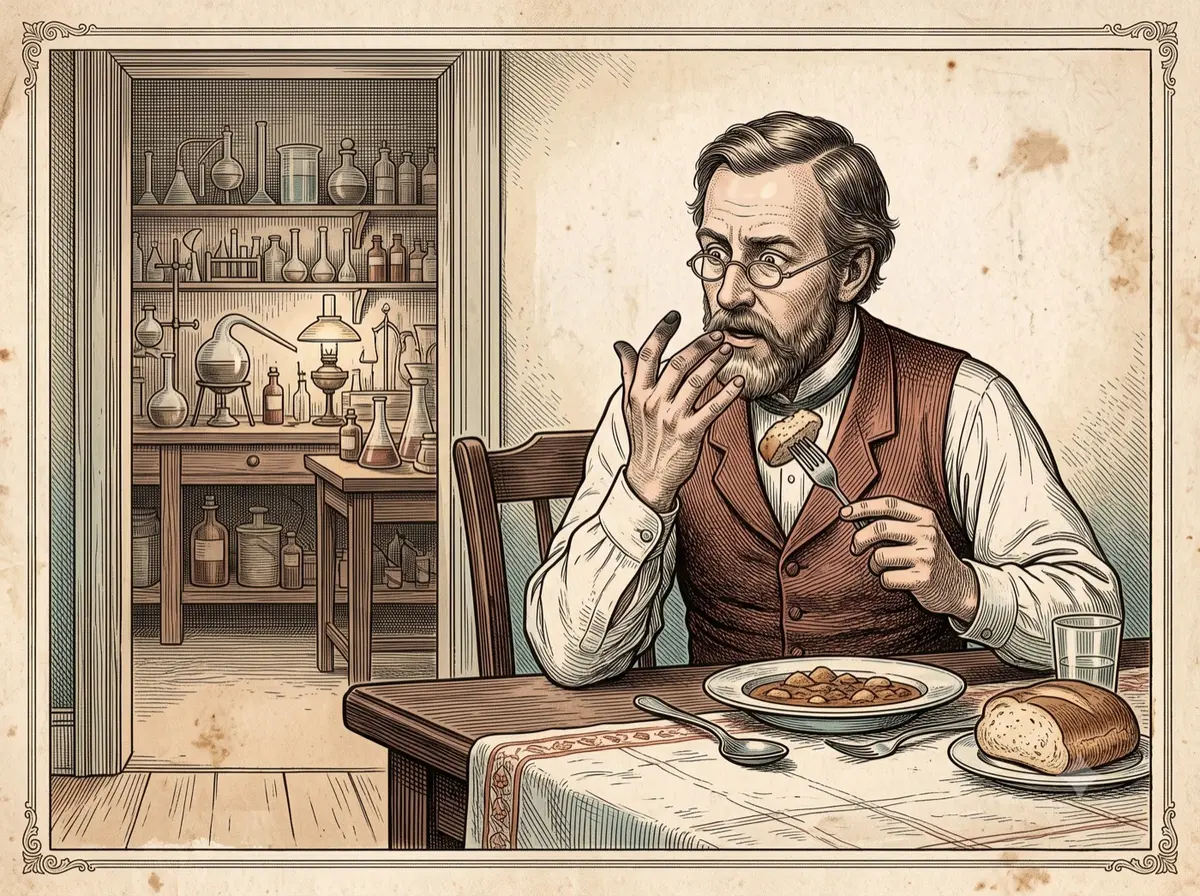
One evening in 1879, a chemist sat down to dinner without washing his hands after a long day working with coal tar. He picked up a piece of bread, and it tasted impossibly sweet. So did his thumb. So, it turned out, did nearly everything he'd touched. Constantin Fahlberg had spent the day boiling down some of the grimmest chemistry imaginable — and had somehow walked out of the lab coated in a substance hundreds of times sweeter than sugar. The little pink packet on every diner table traces back to that unwashed hand.
By the Curiosities Desk · · 6 min read · Filed under Chemistry · Today’s round
What happened: The Chemist Who Forgot to Wash His Hands and Discovered Saccharin
Constantin Fahlberg was a chemist working on coal tar derivatives in the laboratory of Ira Remsen at Johns Hopkins University in Baltimore. Coal tar — the thick black residue left over from turning coal into gas — was the pharmaceutical goldmine of the 19th century, the raw material behind dyes, drugs, and countless new compounds. Fahlberg’s assignment was unglamorous: studying the oxidation of a compound related to toluene, a coal-tar chemical.
By his own later account, published in Scientific American in 1886, the discovery came at the dinner table. Having neglected to wash up, Fahlberg noticed that his food tasted sweet, traced the sweetness to his fingers, and realized he must have carried something remarkable out of the lab. He hurried back and began tasting his own glassware — beakers, dishes, and reagents — until he found the source: a compound he and Remsen had been working on, benzoic sulfimide.
The two men published their findings on the compound in scientific journals in 1879 and 1880. Their 1880 paper described the taste in almost rapturous terms, noting that a barely visible speck of the powder placed on the tongue produced “a sensation of pleasant sweetness throughout the entire cavity of the mouth,” and that a few drops dissolved in a goblet of water made it taste “like the sweetest syrup.”
Then the partnership curdled, and the saccharin discovery became a priority fight. The 1879 and 1880 papers were joint: Remsen and Fahlberg, in that order, describing benzoic sulfimide from Remsen’s Johns Hopkins laboratory. In 1884, now working on his own in New York City, Fahlberg quietly filed for patents in several countries — including the United States and Germany — describing how to manufacture the substance he named saccharin, from the Latin for sugar. Remsen’s name was not on them. Around 1886 Fahlberg opened a factory in a suburb of Magdeburg, Germany, and grew wealthy from a compound the laboratory, not the patent, had first characterized.
Remsen spent the rest of his career saying the discovery belonged to the lab that produced it, and that Fahlberg had carried off the credit along with the unwashed residue. His verdict on his former collaborator became one of chemistry’s great insults: “Fahlberg is a scoundrel. It nauseates me to hear my name mentioned in the same breath with him.” Any honest account of the saccharin discovery has to hold both names: Fahlberg, who noticed the sweetness and industrialized it, and Remsen, whose laboratory and joint papers the compound came out of.
Why it was strange: The Chemist Who Forgot to Wash His Hands and Discovered Saccharin
Sweetness had always come from sugar — from cane, beet, honey, fruit. It was a food, something with calories and substance. Saccharin broke that link entirely. Here was a white powder distilled from coal tar, containing no nutritional value whatsoever, that fooled the tongue better than sugar itself. It is roughly 300 to 500 times sweeter than table sugar, so overwhelming that in large amounts it curdles into a bitter, metallic aftertaste.
The stranger part is that no one was trying to make a sweetener. Fahlberg was investigating an obscure oxidation reaction. The sweetness was pure accident — and it would have gone completely unnoticed if he had simply been more hygienic. A discovery worth a fortune hinged on a chemist ignoring basic lab safety and licking his own equipment.
It shares a shelf with The Cylinder That Weighed Too Much and Became Teflon, in The Mistakes That Became Things You Still Use.
What scientists learned: The Chemist Who Forgot to Wash His Hands and Discovered Saccharin
The immediate chemistry was straightforward once Fahlberg knew what to look for: benzoic sulfimide, built from that toluene-derived starting material, was the sweet culprit. But the deeper lesson took decades to arrive, and it was about human perception. Saccharin proved that “sweetness” is not a property of sugar. It’s a signal — a particular shape of molecule fitting a receptor on the tongue. Get the shape right and the brain reports “sweet,” whether or not there’s a single usable calorie attached.
That insight opened the door to an entire field. Saccharin was the first of a series of artificial sweeteners discovered, uncannily often, the same careless way: cyclamate (1937) and aspartame (1965) were both found by chemists who tasted something on their fingers or a cigarette and noticed it was sweet. The molecules differ, but the principle Fahlberg stumbled onto is the same — decouple sweetness from nutrition, and you can engineer flavor without the food.
Also in The Mistakes That Became Things You Still Use: The Wallpaper Cleaner Nobody Needed Anymore That Became Play-Doh.
How it reaches us today: The Chemist Who Forgot to Wash His Hands and Discovered Saccharin
Saccharin quietly seeded the modern diet-food industry. Its use stayed niche until sugar shortages during World War I sent people looking for substitutes, and it boomed again with the calorie-conscious dieters of the 1960s and 70s. In the United States it’s still the pink packet — sold most famously as Sweet’n Low — and it remains one of the most widely used artificial sweeteners in the world.
It also became a landmark in the science of risk. In the 1970s, studies found that very high doses of saccharin caused bladder cancer in laboratory rats, and in 1977 the U.S. Food and Drug Administration tried to ban it outright. Public backlash was so fierce that Congress instead ordered a warning label. Only later did researchers work out that the cancer mechanism — microcrystals forming in rat urine because of its unusual chemistry — simply doesn’t happen in humans. The warning label was dropped in 2000, and by 2001 both the FDA and California had reversed course and declared saccharin safe. The Environmental Protection Agency removed it from its list of hazardous substances in 2010. The whole saga became a textbook case of how findings in rats don’t always translate to people.
Another from The Mistakes That Became Things You Still Use: The Weak Glue That Took Six Years to Find a Job — and Became the Post-it Note.
Fun fact: The Chemist Who Forgot to Wash His Hands and Discovered Saccharin
Saccharin’s safety fight had a strange early champion: President Theodore Roosevelt. When the FDA’s chief chemist, Harvey Wiley, denounced saccharin as a fraudulent, health-wrecking coal-tar product, Roosevelt — who used it himself on doctor’s orders — shot back, “Anybody who says saccharin is injurious to health is an idiot.” The exchange helped derail Wiley’s crusade.
Sources: The Chemist Who Forgot to Wash His Hands and Discovered Saccharin
- “Saccharin,” Wikipedia, cross-referenced with its primary citations. https://en.wikipedia.org/wiki/Saccharin
- Remsen, I. & Fahlberg, C. (1880). “On the Oxidation of Substitution Products of Aromatic Hydrocarbons. IV.” American Chemical Journal 1(6): 426–439 (contains the original description of the compound’s sweet taste).
- “The Inventor of Saccharine,” Scientific American, July 17, 1886 (Fahlberg’s own account of the discovery).
- National Cancer Institute, “Artificial Sweeteners and Cancer.” https://www.cancer.gov/about-cancer/causes-prevention/risk/diet/artificial-sweeteners-fact-sheet
- U.S. Environmental Protection Agency, “EPA Removes Saccharin from Hazardous Substances Listing” (2010).
Related stories: The Chemist Who Forgot to Wash His Hands and Discovered Saccharin
- Part of The Mistakes That Became Things You Still Use
- The Ulcer Experiment That Splashed Out of Its Flask and Became Diet Soda — A chemist licked his finger and discovered aspartame
- The Teenager Who Tried to Make Malaria Medicine and Accidentally Invented Purple — A teenager chasing malaria medicine invented the color purple
- The Oil-Well Gunk Drillers Hated That Became Vaseline — Oil-well gunk that drillers hated became Vaseline
#artificial sweeteners #accidental discovery #history of chemistry