Accidental Discoveries · Chemistry
The Ulcer Experiment That Splashed Out of Its Flask and Became Diet Soda
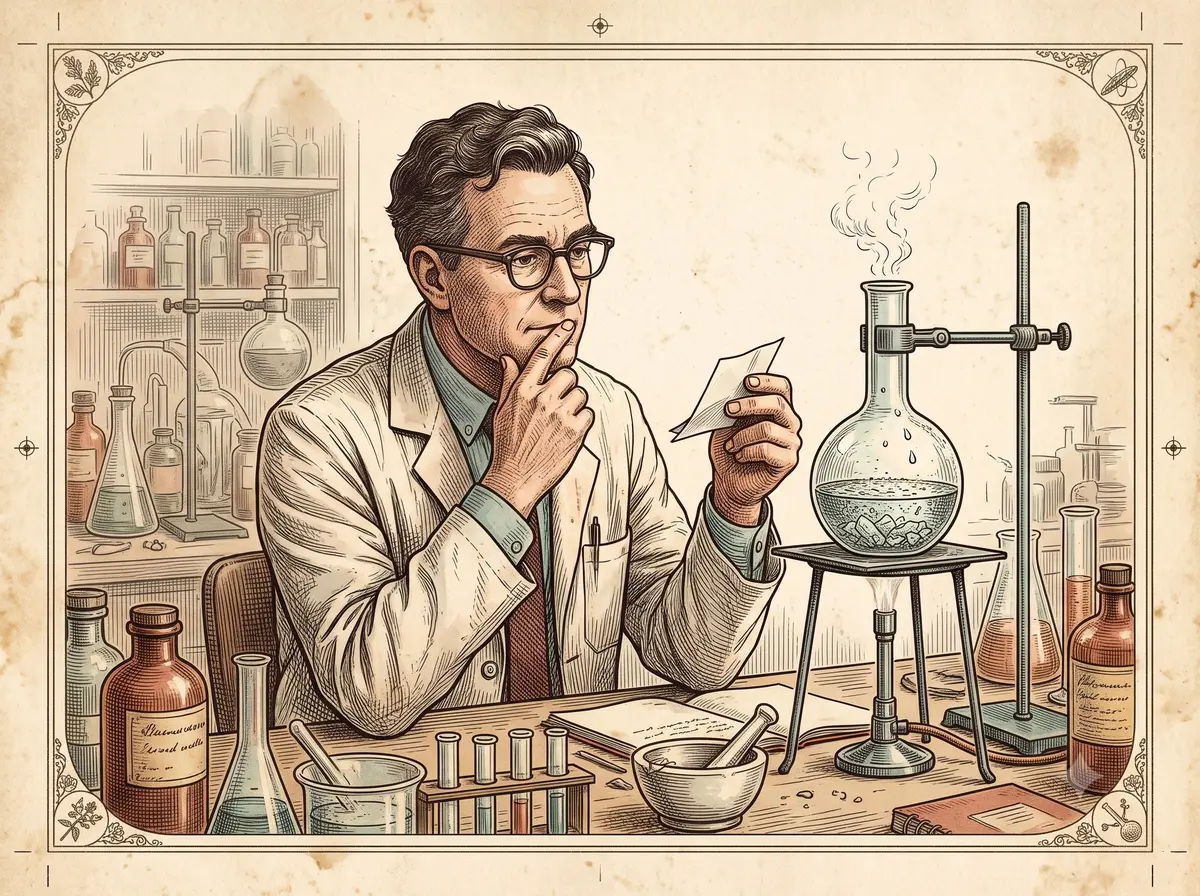
In December 1965, a chemist in Skokie, Illinois was heating a flask of methanol when some of the contents splashed onto the outside of the glass. He kept working. A while later he licked a fingertip to pick up a sheet of flimsy weighing paper, and his finger tasted intensely sweet. His first thought was that he had sugar left on his hands from breakfast — except he had washed them since. So James Schlatter did what a curious chemist does: he traced the sweetness backward, finger to flask, and found it.
By the Curiosities Desk · · 5 min read · Filed under Chemistry · Today’s round
What happened: The Ulcer Experiment That Splashed Out of Its Flask and Became Diet Soda
Schlatter worked for G. D. Searle & Company, and his assignment had nothing to do with food. He was hunting for a drug to treat stomach ulcers, which in the 1960s were believed to be caused by too much stomach acid. The plan was to interfere with gastrin, the hormone that tells the stomach to start producing acid. To study it, Schlatter set out to build a short chain of four amino acids — a tetrapeptide — matching the business end of the gastrin molecule.
Multi-step syntheses produce intermediates: partly assembled molecules on the way to the target. One of Schlatter’s intermediates was a two-amino-acid unit, aspartic acid joined to phenylalanine, with a methyl group tacked on the end. He was purifying it by recrystallizing it — dissolving the compound in hot methanol so it would re-form as cleaner crystals when it cooled. That was the step where the flask splashed.
By his own account, published years later, the detective work was quick and slightly reckless by modern lab standards: “It was clear to me that a dipeptide ester couldn’t be toxic, so I tasted a little of it deliberately, and found that it really was the same sweet substance I had previously detected by accident on my finger.”
The compound was aspartame. Searle filed a patent, granted in January 1970, which recorded its “surprisingly potent sweet taste” — roughly 200 times the sweetness of table sugar, so tiny quantities do the work of a spoonful.
Getting it into food took another sixteen years and was anything but smooth. The U.S. Food and Drug Administration approved aspartame in July 1974 for tabletop use, chewing gum, cold cereals, and dry mixes. Objections arrived within the 30-day comment window, focused on brain tumors seen in rat feeding studies. Then in 1975 an FDA task force examining Searle’s animal studies concluded that some of them were questionable, and the agency stayed its own approval — aspartame could not be sold at all. Independent auditors and FDA scientists spent years re-examining the data, a scientific Public Board of Inquiry revoked the 1974 approval in 1980, and in July 1981 the FDA Commissioner overturned that decision and let aspartame go to market in dry foods. Carbonated beverages followed in July 1983. General-purpose approval came only in June 1996.
Why it was strange: The Ulcer Experiment That Splashed Out of Its Flask and Became Diet Soda
Sweetness is supposed to be a signal, not a coincidence. Sugars taste sweet because our taste receptors evolved to spot a specific family of molecules that carry usable energy. Aspartame is not a sugar. It is a fragment of protein — the same class of molecule as the chicken in your sandwich — and the two amino acids it is made from are not sweet on their own. Aspartic acid is not sweet; phenylalanine is bitter. Bolt them together in one specific way and the result is one of the most intensely sweet substances anyone had tasted.
Stranger still is how it was found. There was no theory of sweetness guiding Schlatter, no screening program, no assay. There was a splash, a fingertip, and a person paying attention.
The same thread — Artificial Sweeteners — continues in The Sweetener Discovered Because a Student Heard ‘Test’ as ‘Taste’.
What scientists learned: The Ulcer Experiment That Splashed Out of Its Flask and Became Diet Soda
Aspartame turned sweetness research into a structural puzzle. Searle chemists made the three mirror-image variants of the molecule and found that all of them tasted bitter — only the specific L-aspartyl-L-phenylalanine arrangement was sweet. Systematic variations showed that every sweet peptide in the family shared the same features at one end of the molecule. That is strong evidence that a sweet taste is not a property of “sugary” ingredients but of shape: a molecule either fits the receptor’s lock or it doesn’t.
The regulatory fight taught a separate lesson. Aspartame became one of the most heavily studied food additives ever approved — the FDA has reviewed more than 100 studies on it — largely because its early safety data were audited so aggressively. In 1987 the Government Accountability Office reviewed the whole affair and concluded the FDA had followed its own approval process properly.
Another time the mistake was the invention: The Seaweed Ash That Ate Its Own Vats — and Gave Up a New Element.
How it reaches us today: The Ulcer Experiment That Splashed Out of Its Flask and Became Diet Soda
Aspartame is why diet soda stopped tasting like the 1970s. Diet Coke and Diet Pepsi were sweetened with saccharin until the 1983 beverage approval, and both moved to aspartame quickly. It now appears in thousands of products under names like NutraSweet and Equal.
It also carries a permanent trace of Schlatter’s original synthesis. Because aspartame breaks down in the gut into its parts, including phenylalanine, U.S. labels on aspartame-containing products must warn that the product contains phenylalanine — a message aimed at people with phenylketonuria (PKU), an inherited condition in which phenylalanine cannot be processed normally. It is the reason newborns get a heel-prick blood test before leaving the hospital.
Aspartame remains argued over. The FDA and the WHO’s expert committee on food additives consider it safe within daily intake limits, while the WHO’s cancer agency classified it in 2023 as “possibly carcinogenic to humans,” a hazard category the FDA publicly disputed. Separately, the WHO advises against using non-sugar sweeteners for weight control, on the grounds that the long-term benefit hasn’t been demonstrated. The honest summary is that the evidence is contested at the edges and settled in the middle.
Another accident worth keeping: The Teenager Who Tried to Make Malaria Medicine and Accidentally Invented Purple.
Fun fact: The Ulcer Experiment That Splashed Out of Its Flask and Became Diet Soda
Aspartame has three mirror-image cousins, built from the same two amino acids in flipped orientations. Chemists made all of them. Every single one tastes bitter. The sweetness lives in one exact three-dimensional arrangement — flip it and the flavor is gone.
Sources: The Ulcer Experiment That Splashed Out of Its Flask and Became Diet Soda
- James M. Schlatter, “Peptide Sweetening Agents,” U.S. Patent 3,492,131, granted January 27, 1970 — https://patents.google.com/patent/US3492131A/en
- Klaus Roth & Erich Lück, “The Saccharin Saga – Part 6: Aspartame,” ChemViews Magazine (includes Schlatter’s first-person account, quoted from Stegink & Filer, Aspartame: Physiology and Biochemistry, 1984) — https://www.chemistryviews.org/details/ezine/9138171/The_Saccharin_Saga__Part_6/
- U.S. Food and Drug Administration, “Timeline of Selected FDA Activities and Significant Events Addressing Aspartame” — https://www.fda.gov/food/food-additives-petitions/timeline-selected-fda-activities-and-significant-events-addressing-aspartame
- U.S. Food and Drug Administration, “Aspartame and Other Sweeteners in Food” — https://www.fda.gov/food/food-additives-petitions/aspartame-and-other-sweeteners-food
- Joe Schwarcz, “A Taste of the Science of Aspartame,” McGill University Office for Science and Society — https://www.mcgill.ca/oss/article/nutrition/taste-science-aspartame
This article touches on food safety and diet. If you have questions about sweeteners, PKU, or how either fits your own health, a doctor or registered dietitian is the right person to ask.
Related stories: The Ulcer Experiment That Splashed Out of Its Flask and Became Diet Soda
- The Chemist Who Forgot to Wash His Hands and Discovered Saccharin — A chemist skipped washing his hands and tasted sweetness
- The Cylinder That Weighed Too Much and Became Teflon — A gas cylinder that weighed too much held the first Teflon
- The Weak Glue That Took Six Years to Find a Job — and Became the Post-it Note — A glue that would not stick properly took six years to find a job
#artificial sweeteners #accidental discovery #chemistry #FDA