The Billiard Ball Prize That Invented Plastic
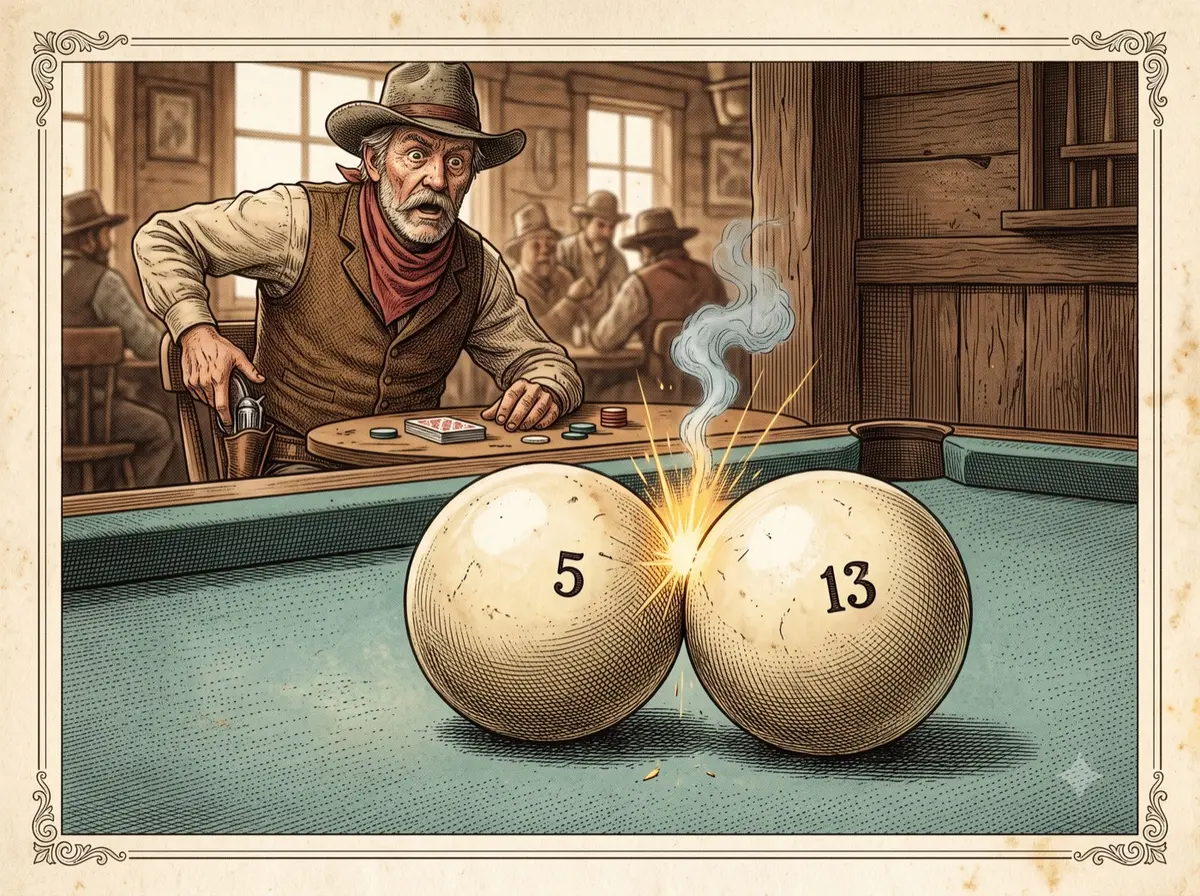
Two ivory-colored balls click together on a saloon table in Colorado, and instead of the usual soft knock, there's a sharp crack — like a gunshot. According to a letter the ball's own inventor later admitted to receiving, every man in the room went for his pistol. The balls weren't ivory at all. They were an experimental new material invented to save elephants, and it had a habit of being just a little too close to gunpowder for comfort.
By the Curiosities Desk · · 5 min read · Filed under Chemistry · Today’s round
What happened: The Billiard Ball Prize That Invented Plastic
By the 1860s, the game of billiards had a supply problem. Good billiard balls were carved from elephant ivory, and a single tusk yielded only a handful of balls of the right density and grain. Ivory was expensive, the elephant populations that supplied it were being depleted, and manufacturers worried the material simply wouldn’t last. Around 1863, the billiards equipment firm led by champion player Michael Phelan offered a reward, commonly cited as $10,000 (something like $250,000–$300,000 today, though the exact modern equivalent varies by source), to anyone who could invent a substitute for ivory that matched its weight, bounce, and feel.
A young printer from Albany, New York, named John Wesley Hyatt took up the challenge. His first attempts — pressing wood pulp, bone dust, and shellac into shapes — failed to make good billiard balls, though they were good enough to spin off into a side business making dominoes and checkers. Hyatt kept experimenting with collodion, a syrupy liquid made by dissolving nitrocellulose (cotton fiber treated with nitric acid, also known as guncotton) in alcohol and ether. Collodion was already in everyday use: photographers used it to coat glass plates, and printers, including Hyatt himself, dabbed it on their fingertips to protect them from small cuts, since it dried into a tough, flexible film.
Working with his brother Isaiah, Hyatt found that adding camphor to nitrocellulose under heat and pressure produced a hard, moldable, ivory-like solid that could be carved, dyed, and polished. Isaiah coined a name for it: celluloid. Hyatt patented his process in 1869 and, over the next few years, built companies to manufacture it — the Albany Dental Plate Company in 1870 (for billiard balls, false teeth, and piano keys) and the Celluloid Manufacturing Company in 1872, which later moved to Newark, New Jersey. It’s generally considered the first commercially successful synthetic plastic, building on earlier, less practical experiments by English inventor Alexander Parkes.
There’s one twist: despite his success, Hyatt apparently never collected the $10,000 prize.
Why it was strange: The Billiard Ball Prize That Invented Plastic
An ivory shortage — a problem about elephants and a parlor game — is what pushed a printer with no chemistry training toward inventing an entirely new category of material. And the material that resulted was strange in its own right: hard and carvable like ivory, but chemically close to guncotton, an explosive. Celluloid billiard balls really could, on rare occasions, produce a small bang when they collided hard enough — not an urban legend invented after the fact, but something Hyatt himself described decades later, including the story about the spooked Colorado saloon. Even Hyatt’s own factories caught fire more than once. A material built to imitate a symbol of luxury turned out to be, chemically, a cousin of dynamite’s ingredients.
Another object that did not start out as itself: The Chemist Who Forgot to Wash His Hands and Discovered Saccharin.
What scientists learned: The Billiard Ball Prize That Invented Plastic
Celluloid’s real lesson was about combination chemistry: nitrocellulose alone was too unstable and brittle to shape reliably, but mixing it with camphor acted as what chemists now call a plasticizer, a substance that makes a rigid polymer soft and workable without destroying its structure. That principle — combine a strong-but-brittle base material with something that makes it moldable — became foundational to the entire plastics industry that followed. Hyatt also pioneered an early injection-molding machine to shape the material, a manufacturing technique still central to how plastic products are made today.
Another ordinary thing with a strange past: The Dentist Who Invented Cotton Candy — and Sold 68,655 Boxes of It.
How it reaches us today: The Billiard Ball Prize That Invented Plastic
Celluloid kicked off the plastics age, but its flammability had consequences that outlasted the billiard table. The same nitrocellulose base became the film stock for early motion pictures, and that “nitrate film” was so combustible that it could keep burning underwater and release its own oxygen as it did. Projection-booth fires were a real and recurring danger in cinemas for decades; one 1936 trade-journal estimate suggested a film projectionist died roughly every 18 days in the U.S., partly due to nitrate film hazards. Film archives eventually replaced it with safer acetate and, later, polyester stock, and surviving nitrate reels today are stored in specialized fireproof vaults. Meanwhile, celluloid’s safer chemical descendants — including cellulose acetate — still show up in eyeglass frames, guitar picks, and table-tennis balls, and the broader idea of engineering a moldable synthetic material to replace a scarce natural one became the founding logic of the modern plastics industry, for better and for worse.
A close cousin: The Minister Who Lived Next to a Brewery and Invented Soda Water to Cure Scurvy.
Fun fact: The Billiard Ball Prize That Invented Plastic
Hyatt’s inventing streak didn’t stop at plastic. He went on to found the Hyatt Roller Bearing Company in 1892, which supplied early automakers. In 1895 he hired a young draftsman named Alfred P. Sloan — who became company president a decade later, then went on to run General Motors after GM bought Hyatt’s bearing business in 1916.
Sources: The Billiard Ball Prize That Invented Plastic
Related stories: The Billiard Ball Prize That Invented Plastic
- The Hot Stove Accident That Invented Modern Rubber — A hot stove accident made rubber usable
- The Secret Rubber Substitute That Became Silly Putty — A failed rubber substitute that became a toy in an egg
- The Wallpaper Cleaner Nobody Needed Anymore That Became Play-Doh — A wallpaper cleaner nobody needed anymore became Play-Doh