The Slinky: The Walking Spring That Fell Off a Navy Workbench
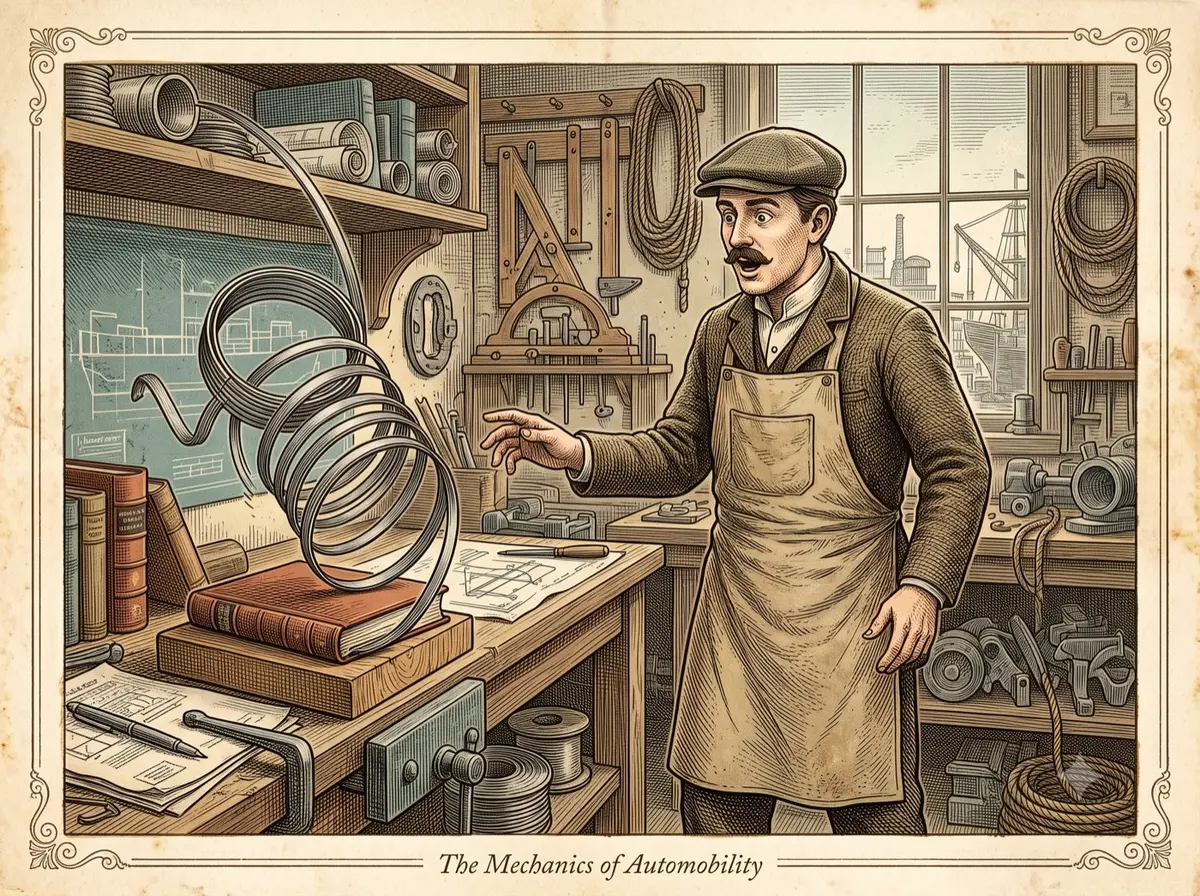
A naval engineer knocks a coil of wire off a shelf, and instead of clattering to the floor, the spring stands up, steps end over end down a stack of books, touches the ground, and gathers itself back into a tidy coil — as if it had somewhere to be. The man just stares at it. He has not invented anything yet. But a toy that will outlive him, sell hundreds of millions of units, and hover in mid-air for science is about to walk straight out of an accident.
By the Curiosities Desk · · 5 min read · Filed under Physics · Today’s round
What happened: The Slinky: The Walking Spring That Fell Off a Navy Workbench
The year was 1943, and Richard T. James was a mechanical engineer working on a very serious problem. At a shipyard in Philadelphia, he was trying to design a spring delicate enough to keep sensitive shipboard instruments — meters and gauges — steady while a ship pitched and rolled in heavy seas. The idea was that the right tension spring could absorb the motion and hold the equipment level.
According to the story James and his family told for decades, he knocked one of his sample springs off a workbench or shelf. Rather than simply falling, the coiled spring “walked”: it tipped over, transferred its coils forward, and tumbled down whatever was beneath it before settling back into a coil at the bottom. James was struck less by the engineering than by the sheer charm of the motion. He reportedly went home and told his wife, Betty, “I think I can make a toy out of this.”
Betty James was skeptical but game. She is the one who found the name. Paging through a dictionary, she landed on slinky — a word suggesting something sleek, sinuous, and graceful in motion. The couple borrowed a modest sum to manufacture the first batch, coiling roughly 80 feet of flat steel wire into each palm-sized spiral.
The hard part was selling it. A coil of metal does not look like fun sitting in a box; the magic only appears when it moves. During the 1945 Christmas season, James set up an inclined board at the Gimbels department store in Philadelphia to demonstrate the Slinky walking down a ramp. As the popular account goes, the entire first stock of several hundred sold out within minutes. The Slinky, priced at about a dollar, was a hit.
Why it was strange: The Slinky: The Walking Spring That Fell Off a Navy Workbench
The strangeness runs in two directions. First, this was a piece of failed military hardware. The springs were meant to be invisible workhorses hidden inside instruments, doing the unglamorous job of damping vibration. The “useful” version of the product never amounted to much. The useless version — the one that just looked delightful falling down stairs — became a cultural icon. The flaw was the feature.
Second, the human story curdles in a way no toy commercial would admit. In 1960, at the height of the Slinky’s success, Richard James abruptly left the company, his wife, and their six children to join a religious group in Bolivia. Betty James was left with a faltering business and a houseful of kids. Rather than fold, she took over the company entirely, moved it to Hollidaysburg, Pennsylvania, and rebuilt it — including commissioning the now-famous advertising jingle that lodged the Slinky permanently in the American ear. The man stumbled onto the invention; the woman made it last.
The same thread — Toys — continues in The Frisbee Salesmen Who Charged a Dollar for an Invisible Wire.
What scientists learned: The Slinky: The Walking Spring That Fell Off a Navy Workbench
The Slinky turned out to be one of the best physics demonstrations ever mass-produced, and its most famous trick was hiding in plain sight for decades.
Hang a Slinky from one end and let it stretch under its own weight until it stops moving. Now let go of the top. Film it with a high-speed camera and you see something that looks impossible: the bottom of the Slinky does not move. It just hangs in the air for a fraction of a second while the top races down and the coils collapse from above. Only when the collapsing section finally reaches the bottom does the whole thing fall together.
This is not a trick of the eye. Before release, the bottom coils are held up by the spring tension pulling from above, and that tension exactly balances gravity. When you release the top, that information — “you are no longer being held” — can only travel down the spring as a wave of collapsing coils, and that wave takes time to arrive. Until it does, the forces on the bottom still cancel, so it stays put. The spring’s center of mass falls normally, accelerating under gravity the entire time, exactly as physics demands. The bottom simply waits its turn. Researchers modeled this behavior in detail in a 2012 paper in the American Journal of Physics, confirming what the high-speed footage shows.
The same humble coil also makes longitudinal and transverse waves visible to the naked eye, which is why Slinkys live in physics classrooms worldwide.
Another ordinary thing with a strange past: The Spaghetti That Stumped Richard Feynman by Refusing to Break in Two.
How it reaches us today: The Slinky: The Walking Spring That Fell Off a Navy Workbench
The Slinky’s afterlife is enormous. More than 250 million have been sold since 1945, and the original design has barely changed. NASA astronauts even carried Slinkys into orbit to test how springs behave without gravity (the answer: a Slinky in free fall won’t “slink” at all — it just floats limply, since gravity is the engine of the walk). It has been inducted into the National Toy Hall of Fame and named the official state toy of Pennsylvania. And every time a teacher sends a wave rippling down a stretched coil to explain sound or light, they are using Richard James’s accident as a teaching instrument — the very thing he was originally trying to build, just for entirely different reasons.
Another object that did not start out as itself: The Wallpaper Cleaner Nobody Needed Anymore That Became Play-Doh.
Fun fact: The Slinky: The Walking Spring That Fell Off a Navy Workbench
A Slinky in deep, sustained free fall — like the falling-Slinky experiment, or aboard a spacecraft — loses its signature move entirely. The “walk” depends on gravity stretching and then collapsing the coils. Remove gravity, and the most famous walking toy in history simply hangs there, motionless, with nowhere to step.
Sources: The Slinky: The Walking Spring That Fell Off a Navy Workbench
- Smithsonian Institution / National Museum of American History — “Slinky” collection record: https://americanhistory.si.edu/collections/object/nmah_1301146
- The Strong National Museum of Play, National Toy Hall of Fame — Slinky: https://www.toyhalloffame.org/toys/slinky
- R. C. Cross and M. S. Wheatland, “Modeling a falling slinky,” American Journal of Physics 80, 1051 (2012): https://doi.org/10.1119/1.4750489
- Encyclopaedia Britannica — “Slinky”: https://www.britannica.com/topic/Slinky
- Betty James obituary, The New York Times (Nov. 2008): https://www.nytimes.com/2008/11/24/business/24james.html
Related stories: The Slinky: The Walking Spring That Fell Off a Navy Workbench
- The Rocket Scientist Whose Leaky Fridge Idea Became the Super Soaker — A leaky heat-pump idea turned into the Super Soaker
- The Secret Rubber Substitute That Became Silly Putty — A failed rubber substitute that became a toy in an egg
- The Frisbee Salesmen Who Charged a Dollar for an Invisible Wire — A dollar for an invisible wire, and the birth of the Frisbee
- Spencer Silver and the Post-it Note — The weak glue that took six years to become a product