The Sea-Monkeys That Hatched a Day Before You 'Brought Them to Life'
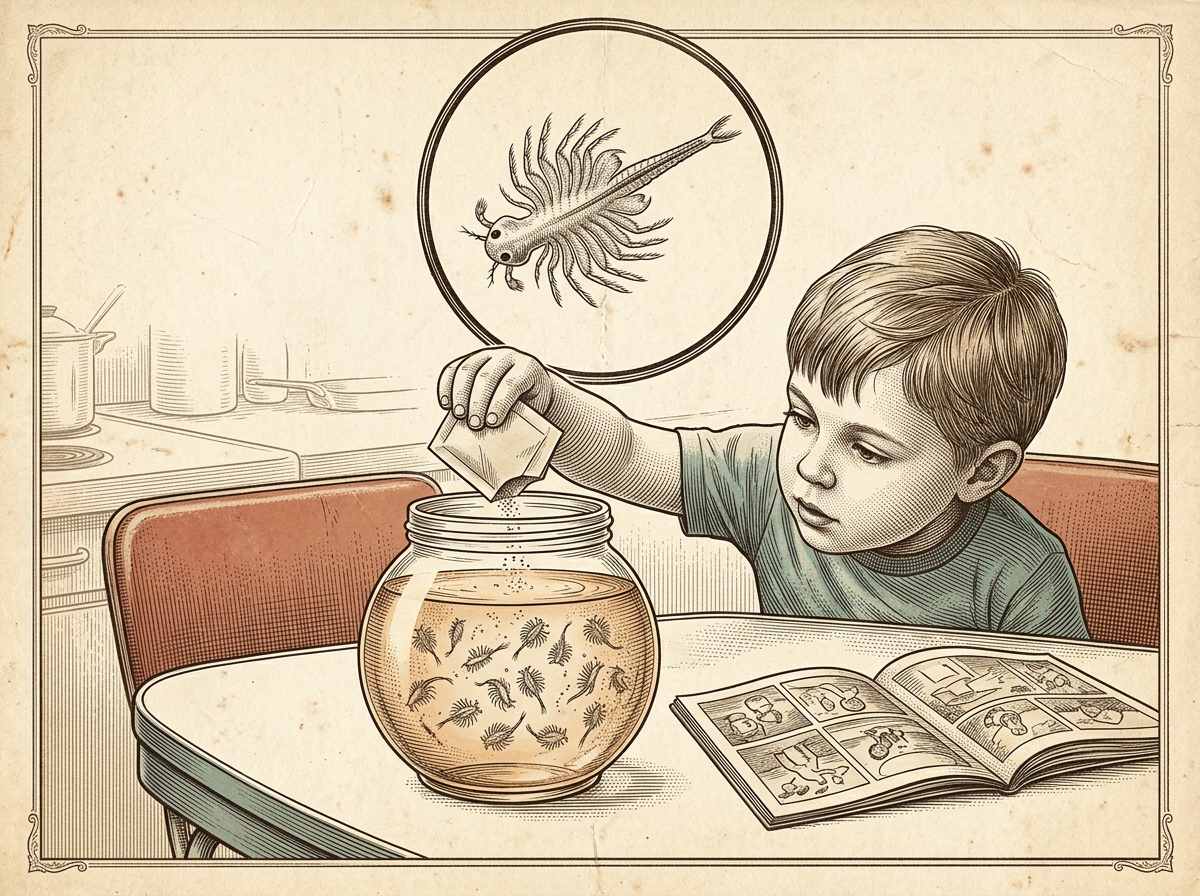
A child tears open a paper packet, pours a pinch of powder into a jar of tap water, and waits. A day later comes the second packet, labeled "Instant Life." In it goes, the water blushes with color, and suddenly the jar is full of tiny swimming specks. It looks like a miracle on demand. It was a magic trick, and the secret was patented: the "pets" had been in the jar all along, hatched from the first packet, which was sold as a water purifier.
By the Curiosities Desk · · 5 min read · Filed under Biology · Today’s round
What happened?
In 1957, an American novelty marketer named Harold von Braunhut noticed brine shrimp being sold as live food for aquarium fish. Brine shrimp are small crustaceans in the genus Artemia that live in salty lakes such as Utah’s Great Salt Lake. Their eggs have an unusual talent. Dried out, they can sit dormant for years, then hatch within about a day once they get wet and salty again.
Von Braunhut saw a toy in that. Dry eggs could be mailed in an envelope, and a child could add water and “create” life. Around 1960 he began advertising the kit as “Instant Life,” with an early price of 49 cents. Sales were weak. So he gave the animals a better name. Their long, curling tails reminded him of monkeys, and they lived in salt water: Sea-Monkeys. The renamed product arrived in the early 1960s.
The other half of the plan was the art. Through the 1960s and 1970s, ads ran on the back pages of comic books, and the best-known ones were drawn by cartoonist Joe Orlando, who later became a vice president at DC Comics. His Sea-Monkeys were a smiling family with human faces, pot bellies, and, in some versions, little crowns. The real animals reach about a centimeter long, have no faces anyone would recognize, and swim on their backs, waving feathery legs.
Von Braunhut worked with marine biologist Anthony D’Agostino to perfect the chemistry, and on July 4, 1972, he received U.S. Patent 3,673,986, “Method and materials used for hatching brine shrimp.” The patent lays out the trick plainly. The first packet holds salts to make the water briny, sodium thiosulfate to strip out the chlorine that tap water contains, and brine shrimp eggs. The water then sits for 24 to 36 hours, which the instructions describe as letting it “age.” During that wait, some of the eggs quietly hatch, but newborn brine shrimp are so small and pale they are easy to miss.
The second packet adds more salts, yeast as food, more eggs, and a water-soluble vegetable dye. The dye tints the water and makes the already-hatched larvae suddenly visible. The patent’s own claim describes the goal as “an appearance of instantaneous life.”
Sea-Monkeys sold for decades and made von Braunhut wealthy. His own story is more uncomfortable than his toy’s. In 1988 The Washington Post reported on his ties to white-supremacist groups, and some distributors dropped his ads afterward. The tiny animals in the jar, at least, had no part in it.
Why was it strange?
Kids thought they were adding life to water. They were actually adding visibility. The “Instant Life” packet didn’t do the creating; time, salt, and a dormant egg did that a day earlier. The product’s whole emotional payoff depended on a scheduling trick and a splash of food coloring.
There’s a second surprise hiding under the first. The ads oversold the animals as cartoon people, but the plain truth about those eggs is stranger than the cartoon. Something that looks like a grain of dust can wait, apparently lifeless, for years, then wake up and swim. The marketing was a gimmick. The biology underneath it was not.
What did scientists learn?
A brine shrimp egg in this state is not exactly an egg. It is a cyst: an embryo that has stopped developing partway through and wrapped itself in a tough shell. When the cyst dries out, it enters anhydrobiosis, meaning “life without water,” a kind of cryptobiosis, a state in which an organism shows no measurable signs of life yet can revive later.
Biologists have pushed these cysts surprisingly far. In a 1997 study in the Journal of Experimental Biology, biologist James Clegg kept fully hydrated Artemia franciscana embryos in water with no oxygen at all, a condition called anoxia, for four years. At least 60 percent survived and went on to hatch. Clegg found no evidence that they were using their stored energy after the first day. If they were metabolizing at all, it was at least 50,000 times slower than normal. He argued that their metabolism had simply stopped and then restarted, while cautioning that this kind of complete stop can’t be proven outright.
That challenges a basic idea in biology, that living things must keep spending energy just to hold themselves together. Brine shrimp cysts seem to manage without it, at least for a while. Their eggs have also flown on Apollo 16 and 17 in experiments testing how cosmic radiation affects developing embryos.
How does it affect us today?
The same hardiness that made Sea-Monkeys mailable now underpins a large industry. Commercial harvesting on the Great Salt Lake began in 1950, and by 1952 harvesters had switched to collecting cysts only. Today, according to Utah’s Division of Wildlife Resources, the cysts are cleaned, stored, and later hatched to feed young fish and prawns on farms. Freshly hatched brine shrimp are one of aquaculture’s standard first foods.
Brine shrimp also work in labs as a simple test animal. Researchers check how many survive exposure to a chemical as a quick first measure of its toxicity. And in classrooms, a packet of cysts is still one of the cheapest ways to watch a life cycle unfold in a jar.
Sea-Monkeys themselves are still sold, now as Artemia NYOS, which the makers describe as a hybrid breed. Their ads have changed, and the animals still don’t wear crowns.
Fun fact
Von Braunhut also sold Invisible Goldfish. Buyers received a bowl and fish supplies, and the fish lived up to the name perfectly: there weren’t any.
Sources
- U.S. Patent 3,673,986: “Method and materials used for hatching brine shrimp,” Harold N. Braunhut, granted July 4, 1972 (Google Patents)
- Clegg, J. S. (1997). “Embryos of Artemia franciscana survive four years of continuous anoxia: the case for complete metabolic rate depression.” Journal of Experimental Biology 200(3): 467–475
- Utah Division of Wildlife Resources, Great Salt Lake Ecosystem Program: Brine shrimp harvests
- McGill University Office for Science and Society: Sea-Monkeys
- ToyTales: Sea-Monkeys (Todd Coopee, 2015)