The Slice of Cork That Named the Cell
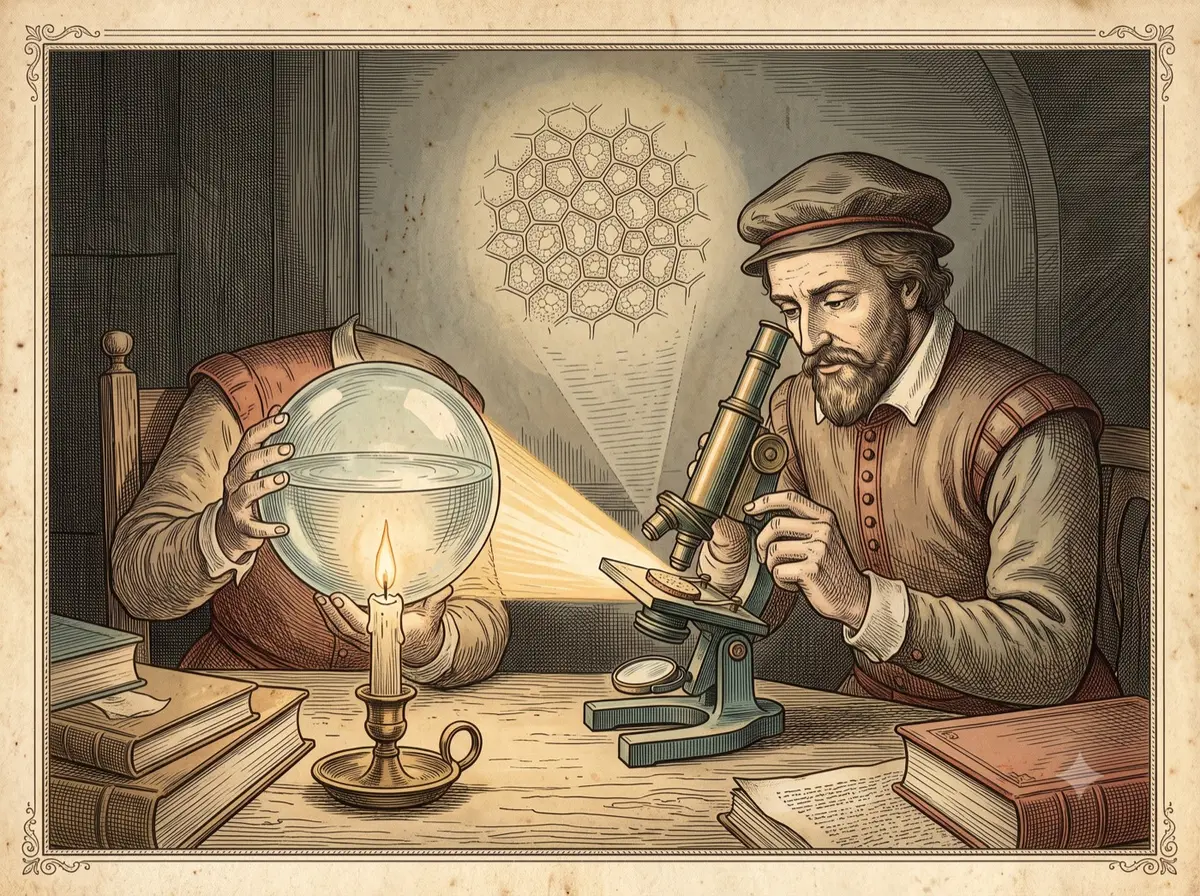
One evening in London, sometime before 1665, a restless instrument-maker trims a paper-thin sliver from a piece of bottle cork with a penknife "sharpen'd as keen as a Razor," clips it under a brass microscope, and angles a water-filled globe in front of a candle to throw more light onto the slide. He expects to see nothing much — cork is just cork. Instead he sees rank after rank of tiny walled boxes, packed together like a honeycomb. He has no idea he is about to hand every living thing on Earth its most fundamental word.
By the Curiosities Desk · · 5 min read · Filed under Biology · Today’s round
What happened: The Slice of Cork That Named the Cell
In 1662 the Royal Society of London — barely two years old — hired a sharp, curious, chronically overworked experimenter named Robert Hooke as its Curator of Experiments, tasked with bringing a fresh demonstration to the fellows at every weekly meeting. Hooke, also a talented instrument-maker, built himself a compound microscope and pointed it at anything small enough to fit under it: a fly’s eye, a razor’s edge, a flea, a snowflake.
In 1665 the Royal Society published the results as Micrographia, a lavish folio of Hooke’s observations paired with fold-out engravings so large that readers had to unfold the page to see a flea rendered the size of a house cat. It was an instant sensation. The diarist Samuel Pepys bought a copy, stayed up reading it until two in the morning, and called it “the most ingenious book that ever I read in my life.”
Buried partway through, in an entry titled “Of the Schematisme or Texture of Cork, and of the Cells and Pores of some other such frothy Bodies,” is the observation that made Hooke a fixture of biology classrooms ever since. He took “a good clear piece of Cork,” sliced it thin enough to pass light through, and examined it “very diligently” under his lens. What he saw, he wrote, was a structure “all perforated and porous, much like a Honey-comb, but that the pores of it were not regular.” He cut sections in different directions to reconstruct the shape in three dimensions — the same basic logic a CT scanner uses today.
He needed a word for the tiny boxes. “Cell” already existed in English and Latin for a small enclosed chamber — the compartments of a beehive, or cavities of the brain and bladder, in the medical language of the day. Hooke borrowed it, calling these “the first microscopical pores I ever saw, and perhaps, that were ever seen.” Cork wasn’t even his main interest; he assumed, incorrectly, it wasn’t tree bark at all but something “analogous to the Mushrome, or Moss on other Trees.” Still, he noticed the same honeycomb texture in the living pith of elder, fennel, and carrots — and it was the word “cell” that stuck.
Why it was strange: The Slice of Cork That Named the Cell
Here’s the twist that museum placards often smooth over: the “cells” Hooke found in cork were dead. Cork is bark, and by the time it matures the tissue has died — what Hooke was looking at were the leftover, air-filled walls of cells whose living contents were long gone. He had, in effect, named a foundational concept of biology after its own empty packaging.
It’s also widely repeated — including in more than one recent peer-reviewed plant-biology paper — that Hooke chose the word “cell” because the boxes reminded him of the tiny rooms monks lived in at a monastery. It’s a tidy story, and it also appears to be invented. A 2024 essay in the journal Plant Cell, by biologist Winfried Peters, traced the claim back through Hooke’s writings and found no mention of monks, monasteries, or the Latin word cellula anywhere. What Hooke actually wrote was that the structure reminded him of a honeycomb — not a cloister. Treat the monastery version as legend, not fact.
Just as surprising: Hooke didn’t picture his cells as empty boxes at all. In fresher plant material he noticed the compartments were “fill’d with juices,” and theorized they were segments of long pipes carrying a plant’s nutritive fluid, divided at intervals by tiny “diaphragms,” or valves. He’d effectively described plumbing, not architecture. The now-familiar idea of a cell as a self-contained, independent unit of life wouldn’t arrive for another 170 years.
Another object that did not start out as itself: The Pudding Recipe That Gave Microbiology Its Favorite Jelly.
What scientists learned: The Slice of Cork That Named the Cell
Hooke’s specific theory about cells was wrong, but his word proved durable. The real turning point for biology came in the 1830s, when the botanist Matthias Schleiden and the physiologist Theodor Schwann, working separately on plants and animals, proposed what’s now called cell theory: every living organism is built from cells, and the cell is the basic structural and functional unit of life. Two decades later, the pathologist Rudolf Virchow added a crucial piece — every cell arises only from a pre-existing cell, ruling out the older idea that living matter could spring up spontaneously. Hooke supplied biology’s most famous word almost two centuries before anyone worked out the theory to go with it.
Plant science has also gently corrected Hooke’s original description, while still honoring the observation. Cork is dead bark tissue whose cell walls are soaked in a waxy, water-repelling substance called suberin — exactly what makes cork buoyant, compressible, and airtight, properties Hooke could see under his lens without knowing quite why they existed.
Another ordinary thing with a strange past: The Germ-Fighting Paper Cup Named After the Doll Company Next Door.
How it reaches us today: The Slice of Cork That Named the Cell
“The cell is the basic unit of life” opens nearly every introductory biology course on Earth, and the vocabulary it’s taught in — cell wall, cell membrane, cell division — traces back to Hooke’s slice of cork. Cell theory underwrites essentially all of modern medicine and biology: cancer is fundamentally a disease of cells dividing out of control, vaccines train cells of the immune system, and gene and stem-cell therapies work by manipulating what happens inside individual cells.
Cork itself is still doing real work, some of it far from a wine rack. Cork oak bark can be stripped from a living tree roughly once every nine years without killing it, making cork one of the more sustainable materials in wide commercial use; around 13 billion cork stoppers are produced worldwide each year, most from Portugal. NASA has also used cork-based ablative material on the heat shield of its Space Launch System rocket, where it chars away to protect the engine section during ascent — the same waxy, dead cell walls Hooke examined by candlelight, now helping shield a rocket bound for the Moon.
A close cousin: The First Roman Letter Found Near Hadrian’s Wall Was About Socks and Underpants.
Fun fact: The Slice of Cork That Named the Cell
Hooke didn’t just look — he did the math. He counted about sixty of his tiny cells packed into one-eighteenth of an inch, then calculated outward: something over a thousand cells to the inch, more than a million to the square inch, and, in his own words, “above twelve hundred Millions” — over a billion — packed into a single cubic inch of cork.
Sources: The Slice of Cork That Named the Cell
- Robert Hooke, Micrographia (1665), Observation XVIII, “Of the Schematisme or Texture of Cork” — full text via the Robert Hooke Archive, Westminster School
- Winfried S. Peters, “Will the real Robert Hooke please stand up?”, The Plant Cell, Vol. 36, Issue 11 (2024): 4680–4682 — Oxford Academic
- Royal Museums Greenwich, “‘The most ingenious book that ever I read in my life’: Pepys and Micrographia” — rmg.co.uk
- NASA, “Foam and Cork Insulation Protects Deep Space Rocket from Fire and Ice” — nasa.gov
- Britannica, “Cork” (plant anatomy) — britannica.com
Related stories: The Slice of Cork That Named the Cell
- The Glow Across the Room That Let Us See Inside the Body — A glow across a darkened lab let us see inside the living body
- From Mendel’s Peas to CRISPR: A Short History of Genetics — Pea plants to gene editing in one long thread
- The Moldy Petri Dish That Almost Got Thrown Away — A contaminated petri dish that nearly went in the bin
You came for the cork slice. The rest of the archive is stranger — one true story, every Thursday. Subscribe