Everyday Objects · Archaeology
The First Roman Letter Found Near Hadrian's Wall Was About Socks and Underpants
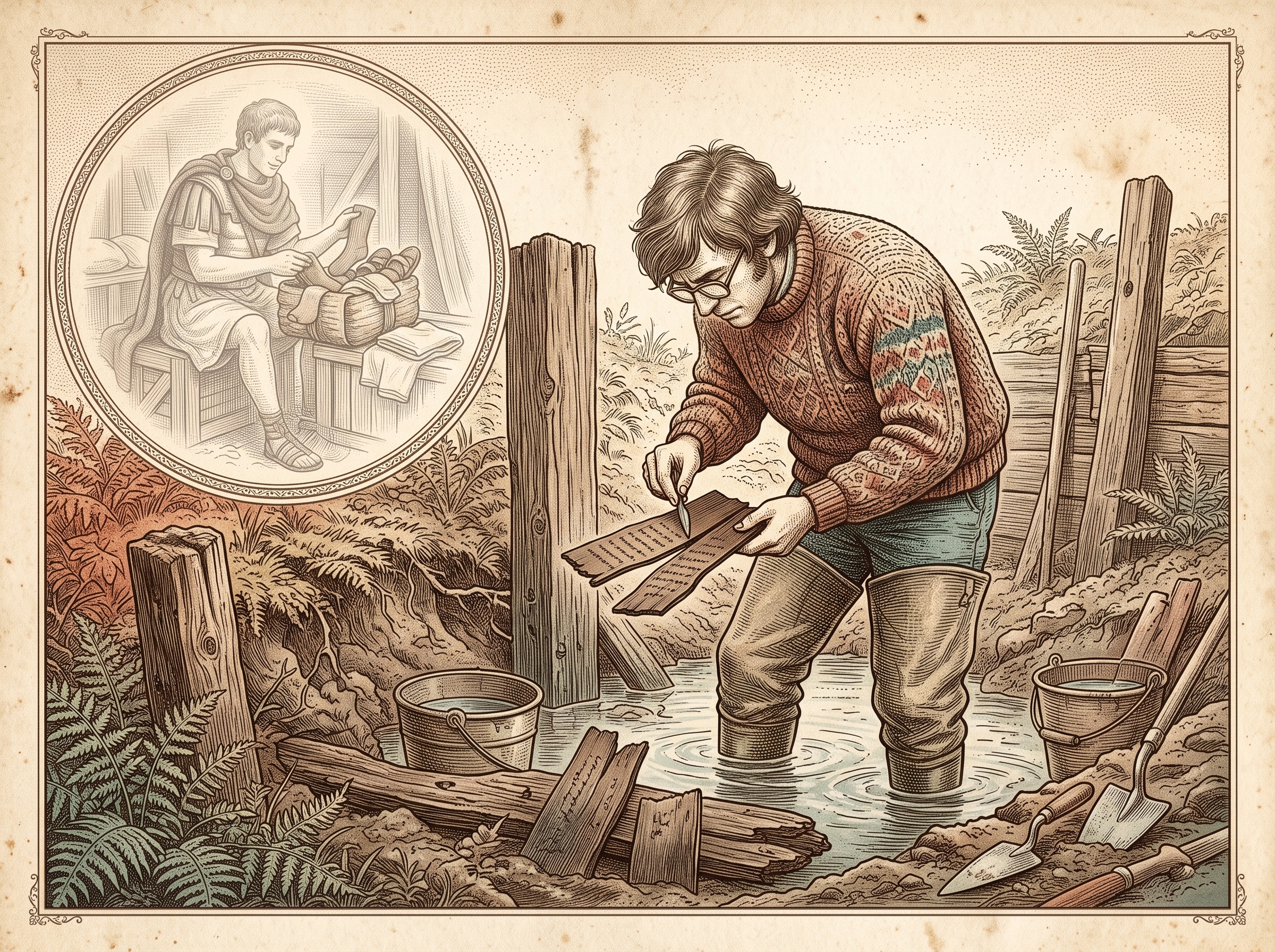
In March 1973, at Vindolanda, a Roman fort just south of where Hadrian's Wall would later run, archaeologist Robin Birley was four metres down a waterlogged drainage trench when he picked up two slivers of wood that looked like oily plane shavings. Someone prised them apart. Inside was ink. After 1,900 years in the mud, the first message to come back from the Roman frontier was this: *I have sent you … pairs of socks, two pairs of sandals and two pairs of underpants.*
By the Curiosities Desk · · 5 min read · Filed under Archaeology · Today’s round
What happened?
Vindolanda sits in present-day Northumberland, in northern England. The Romans first built a timber fort there around AD 85, along a road called the Stanegate. Hadrian’s Wall came about 40 years later, a short walk to the north. The fort was torn down and rebuilt again and again, and each new fort was built on top of the old one, sealing the earlier layers underneath.
By the early 1970s, the dig at Vindolanda had a drainage problem. Robin Birley, its director, cut a deep ditch outside the south-west corner of the later stone fort to drain the water. About four metres down, the ditch reached the earliest timber forts. The wooden posts were still standing. Around them lay a thick, wet mass of leather, cloth, straw, and bracken (a coarse fern that the soldiers had spread on their floors).
According to the official edition of the tablets, Birley described the first find as “two small thin fragments of wood which looked rather like oily plane shavings.” Some accounts credit a student volunteer, Keith Liddell, with first drawing his attention to them. When the slivers were gently prised apart, there was writing on the inner faces. Then it began to fade as soon as air hit it.
That first tablet is now catalogued as Tab. Vindol. 346. Its scholarly translation reads: “I have sent (?) you … pairs of socks from Sattua, two pairs of sandals and two pairs of underpants, two pairs of sandals … Greet …ndes, Elpis, Iu…, …enus, Tetricus and all your messmates with whom I pray that you live in the greatest good fortune.” The Latin words are udones (socks), soleae (sandals), and subligaria (underpants). Sattua is probably a person’s name. It might even be a brand, since the same name has turned up stamped on a leather patch. Nobody knows who sent the parcel or who received it. The editors date it to about AD 104–120.
Birley later wrote that he doubted he would “ever again experience the shock and excitement I felt at my first glimpse of ink hieroglyphs on tiny scraps of wood.” That first season produced more than 200 fragments. Today the British Museum holds more than 1,700 Vindolanda tablets, and the dig still turns up new ones; around a dozen came out of the ground in 2023.
Why was it strange?
Historians had assumed that soldiers on the frontier wrote mostly on wax tablets, scratching letters into wax with a metal stylus, and that wax rarely survives. Ink letters were known from Egypt, where papyrus lasts in the desert. Nobody expected to find them in rainy northern England, written on wooden leaves about the size of a postcard.
What preserved them was not exactly dignified. The official edition notes that the bracken floor holding the first tablets was mixed with bones, oyster shells, and “a considerable quantity of human excrement,” and was “heavily saturated with urine,” probably from leather-tanning nearby. Layers of clay sealed this mess off from the air. The tannin from the leather and plants helped too.
There is one more twist. According to the British Museum, when the Romans cleared out old paperwork, it looks as though they tried to burn the tablets more than once. Either the ground was too wet or the rain put out the fire. The weather that made the soldiers want socks also saved their mail.
Another object that did not start out as itself: The 5,700-Year-Old Chewing Gum That Held an Entire Human Genome.
What did scientists learn?
The tablets survived because the deposits were waterlogged and anaerobic, meaning they held almost no oxygen. Without oxygen, the bacteria and fungi that normally eat wood, leather, and cloth can’t do their work. That is why Vindolanda has also given up thousands of leather shoes, a wooden toilet seat, and a pair of leather boxing gloves.
Reading the tablets was another challenge. The ink was carbon-based, the handwriting was a fast cursive script, and there was no punctuation. The texts were deciphered over decades by palaeographers (specialists in ancient handwriting) Alan Bowman and David Thomas, who usually worked on papyri from Egypt. Infrared photography helped bring out ink that had faded to almost nothing.
What they found was the daily life of a frontier fort, in its own words. A strength report from around AD 90 lists 752 men of the First Cohort of Tungrians, of whom only 265 were fit for active duty. One memo sizes up the local fighters and calls them Brittunculi, “wretched little Britons.” In another letter, a cavalry officer named Masclus asks his commander for orders, then adds a postscript: “My fellow-soldiers have no beer. Please order some to be sent.” And around AD 100, Claudia Severa invited her friend Sulpicia Lepidina to her birthday party and signed off in her own hand. The British Museum calls it the earliest example of a woman’s handwriting from anywhere in the Roman Empire.
Another ordinary thing with a strange past: The Tube of Paint That Got a Funeral in an English Garden.
How does it affect us today?
Before 1973, almost everything we knew about Roman Britain came from stone inscriptions, coins, and histories written by elite men far away. The Vindolanda tablets added the voices of the people who were actually there: soldiers short on beer, officers’ wives planning parties, families mailing underwear across the sea. The tablets are freely searchable online through the Roman Inscriptions of Britain project, so anyone can read them.
They also changed how archaeologists dig. The official edition suggests other sites may have tablets that nobody spotted because they looked like scraps of wood. Excavators now treat thin, dark slivers from wet ground with a lot more respect.
A close cousin: The 22-Pound Lump of 2,000-Year-Old Butter Turf Cutters Dug Out of a Bog.
Fun fact
In the beer letter, Masclus opens by addressing his commanding officer as regi suo, “his king.” The editors think it was simply a flattering way to say “patron.” Considering what he asked for in the postscript, the flattery may have been strategic.
Sources
- Tab. Vindol. 346: the socks, sandals and underpants letter — Roman Inscriptions of Britain (edition and translation)
- The Discovery of the Writing-Tablets and the Archaeological Context — Tabulae Vindolandenses I, Roman Inscriptions of Britain
- The Vindolanda tablets — British Museum (Richard Hobbs, Senior Curator)
- Tab. Vindol. 628: “My fellow-soldiers have no beer” — Roman Inscriptions of Britain
- Tab. Vindol. 164: the “Brittunculi” memo — Roman Inscriptions of Britain