Everyday Objects · Archaeology
The Roman Pocket Sundial Shaped Like a Ham
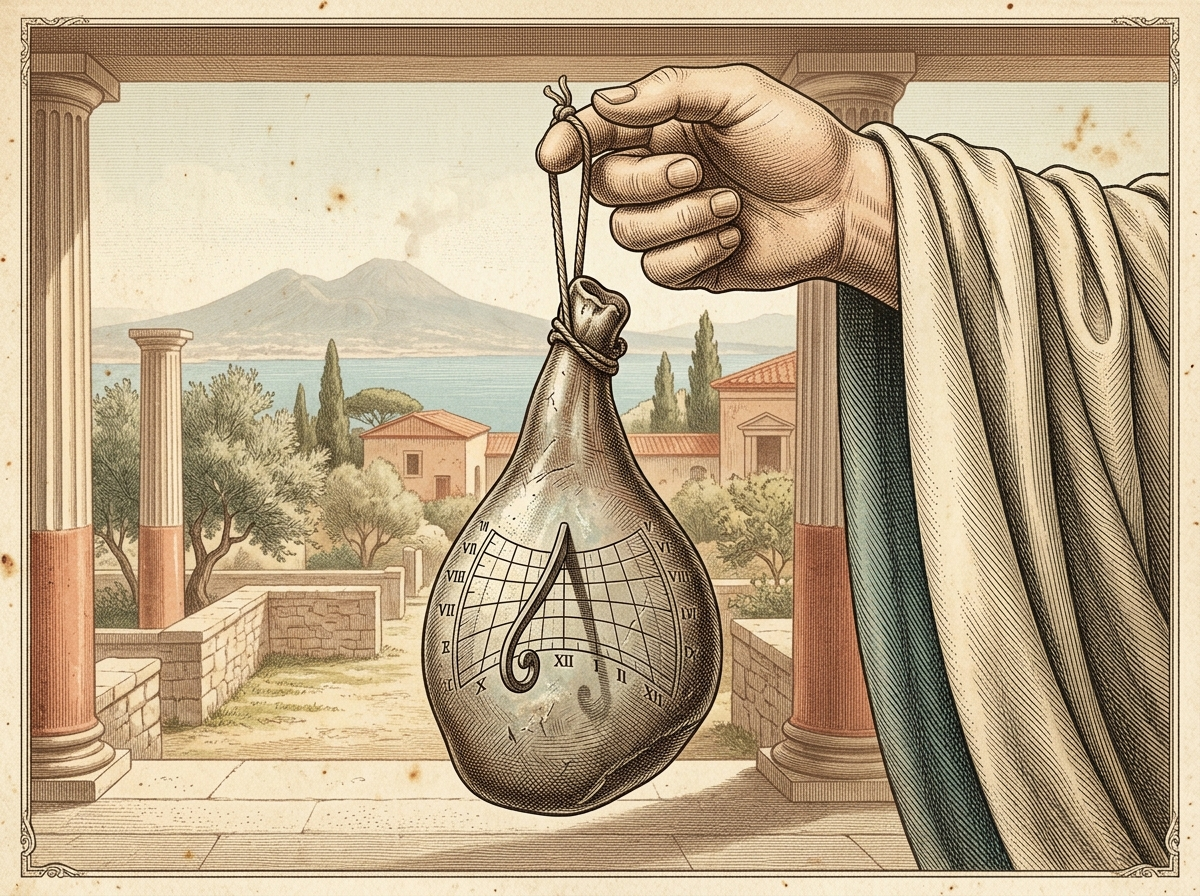
On June 11, 1755, workers tunneling through hardened volcanic debris at Herculaneum pulled out a small lump of silvered bronze shaped exactly like a leg of ham. One side carried a lopsided grid of lines and tiny Latin labels. It wasn't a toy and it wasn't a decoration. It was a clock — one of the oldest portable sundials known from the ancient world — and its owner had carried the time around in the shape of a cured pork leg.
By the Curiosities Desk · · 5 min read · Filed under Archaeology · Today’s round
What happened?
In AD 79, Mount Vesuvius buried the towns around the Bay of Naples. One of the properties it swallowed was a sprawling seaside estate at Herculaneum now called the Villa of the Papyri, named for the hundreds of carbonized scrolls later found in its library. Historians have long linked the villa to Lucius Calpurnius Piso Caesoninus, the father-in-law of Julius Caesar, though that attribution has never been proven.
In the 1750s, excavators working for the Bourbon king of Naples dug into the villa through underground tunnels, hauling statues, bronzes and papyri up to the royal museum at nearby Portici. On June 11, 1755, according to the North American Sundial Society’s account of the excavation records, they recovered the ham. Because it went to the Portici collection, it became known as the Prosciutto di Portici. Today it sits in the National Archaeological Museum of Naples.
The object is small — press reports have described it as fist-sized, or small enough to fit in a coffee mug. Its pointer, called a gnomon (the part of a sundial that casts the shadow), is missing. But an 18th-century museum curator recorded what it looked like: a curly piece shaped like a pig’s tail.
News of the find traveled, and not everyone got the joke right away. In 1757, the French Encyclopédie published the first widely read description of it. Five years later, the scholars of the Accademia Ercolanese, who were responsible for publishing the Herculaneum finds, printed their own detailed account of how it worked — and gently mocked the Encyclopédie for failing to notice that it was shaped like a prosciutto.
The sundial then waited more than 250 years for someone to study it closely. Christopher Parslow, a classicist at Wesleyan University, photographed the original in Naples and worked with Christopher Chenier of Wesleyan’s digital design studio to build a 3D model. The university’s printers produced plastic copies in a matter of hours, complete with a reconstructed pig-tail gnomon. Parslow presented the results in January 2017, and in 2024 Oxford University Press published his full study, The Prosciutto Sundial.
Why was it strange?
Most Roman sundials were heavy stone bowls or slabs set up in public squares and gardens. They stayed put. A personal timepiece you could carry and dangle from your hand sounds like an invention from a much later century. Yet this one was in use before AD 79. Alexander Jones, a historian of ancient science at New York University, told National Geographic that only about 25 other portable sundials survive from antiquity, and that the ham is either the oldest or the second oldest of them.
Then there’s the shape. Why would anyone build a precision instrument as a ham? There is no ancient text that explains it, so any answer is educated guesswork. One idea, favored by Parslow, points to the villa’s intellectual life. Among its scrolls were works by Philodemus, a philosopher of the Epicurean school, which taught that a good life is built on calm, simple pleasures. Critics liked to call Epicureans pigs. Some Epicureans seem to have embraced the jab. “There was a lot of humor among the Epicureans,” Getty Museum curator Kenneth Lapatin told National Geographic. A pork-shaped clock may have been an inside joke — though that remains a hypothesis, not a fact.
What did scientists learn?
The ham works as what’s called an altitude dial. It doesn’t need to face north. Instead, it measures how high the sun is in the sky. You let it hang from a string so that sunlight falls on its left side, then turn it until the shadow of the pig’s tail lands on the vertical line for the current month. Where the tip of the shadow falls among the horizontal lines tells you the hour.
Those hours weren’t our hours. Romans divided the daylight into 12 equal parts no matter the season, so a summer hour was much longer than a winter one. As Wesleyan astronomer Bill Herbst explained, an hour in December was shorter than an hour in June. The ham’s warped grid is built to handle that: the months run across it, and the hour lines curve to match the sun’s changing path.
The month labels gave the researchers a dating clue. One of them is an abbreviation for August — a month that only got that name in 8 BC, when it was renamed for the emperor Augustus. So the sundial was made sometime between then and the eruption.
How well does it work? Wesleyan students testing the replicas found they could read it to within about 10 minutes. Parslow was more cautious, telling National Geographic that the quarter-hour precision the design allows is “the theoretical ideal rather than the reality.” The scale is tiny, and a dangling ham sways in the breeze. His conclusion was that it was partly a status object, the ancient version of an expensive watch worn as much to be seen as to be read.
How does it affect us today?
The ham is a reminder that the urge to carry the time with us is old. Long before pocket watches appeared in 16th-century Europe, people were tucking small sundials into their belongings. Similar hanging altitude dials, often called shepherd’s dials, stayed in use in parts of Europe for centuries.
It’s also a small success story for new tools in old fields. The original is too fragile to hand around, but a 3D-printed copy can be taken outside, hung in the sun and tested. That kind of hands-on experiment — rebuilding an artifact to see how it actually behaves — is now a common way for archaeologists to test ideas about how ancient objects were used.
Fun fact
On the ham’s dial, the line for the sixth hour of daylight marks midday. The Latin for “sixth hour,” sexta hora, is where Spanish gets the word siesta — the midday rest.
Sources
- Christopher Parslow, The Prosciutto Sundial: Casting Light on an Ancient Roman Timepiece from the Villa dei Papiri in Herculaneum, Oxford University Press, 2024.
- Christopher Parslow, “Hamming It at the Villa dei Papiri”, Society for Classical Studies annual meeting abstract.
- Traci Watson, “Ancient Sundial Shaped Like Ham Was Roman Pocket Watch”, National Geographic, January 19, 2017.
- “Telling Time in Antiquity”, Wesleyan University Magazine, April 2017.
- “Prosciutto di Portici: Sundial’s Owner”, North American Sundial Society, June 2025.