Accidental Discoveries · Chemistry
The Sweetener Discovered Because a Student Heard 'Test' as 'Taste'
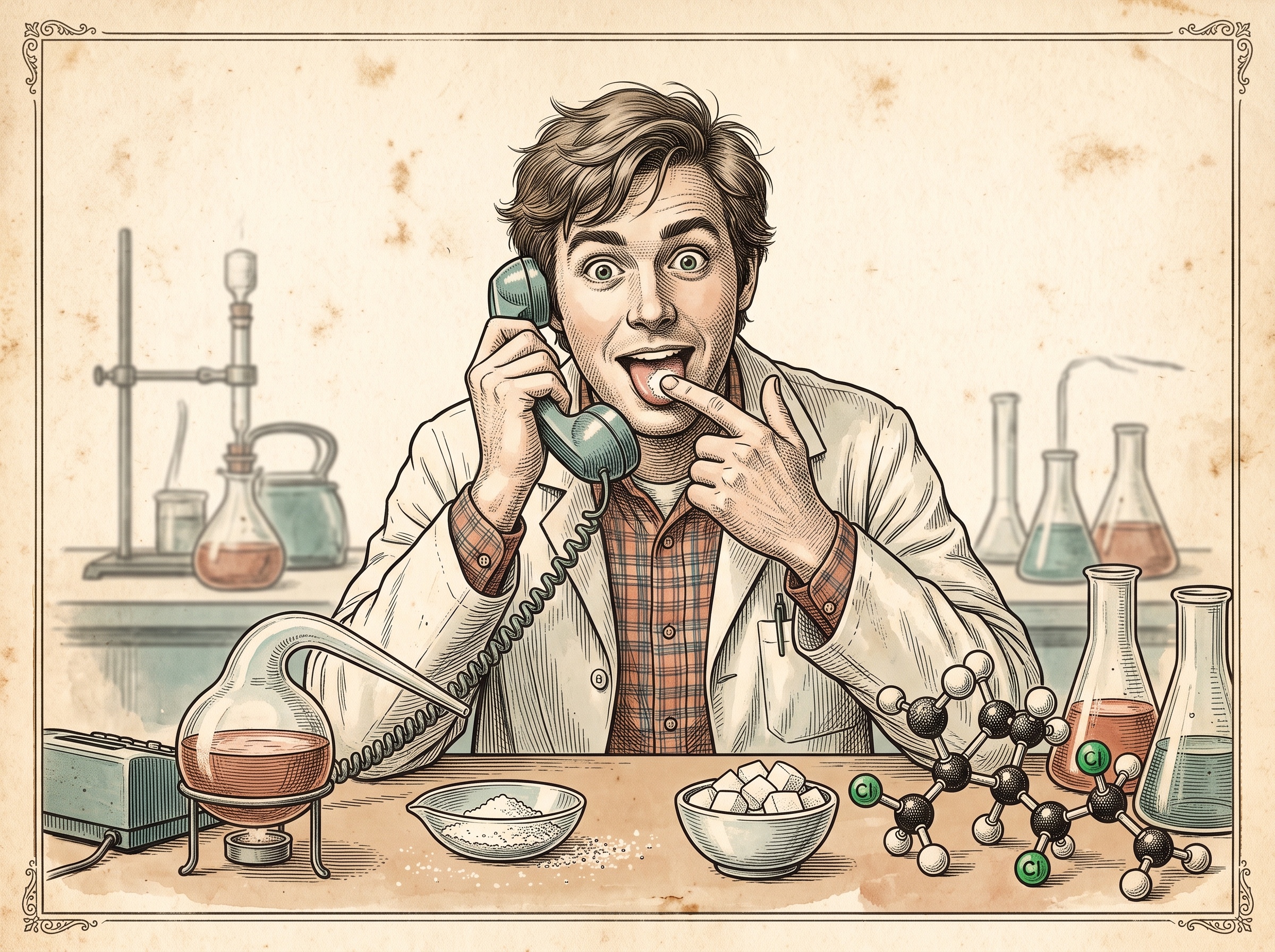
In a London chemistry lab in the mid-1970s, the phone rang with a simple request: send over samples of some new chlorinated sugars for testing. Graduate researcher Shashikant Phadnis heard something slightly different. He thought they wanted the chemicals *tasted*. So he put a bit of an untested, chlorine-studded sugar compound on his tongue — and it was astonishingly sweet. That one misheard word is the reason there is a yellow packet of Splenda on café tables around the world.
By the Curiosities Desk · · 5 min read · Filed under Chemistry · Today’s round
What happened?
In 1975 or 1976 (accounts differ by a year), Shashikant Phadnis was working in the lab of Professor Leslie Hough at Queen Elizabeth College, now part of King’s College London. The project was sponsored by the British sugar giant Tate & Lyle, and it had nothing to do with sweeteners.
At the time, the world was producing more sugar than it needed. Tate & Lyle wanted to know whether sucrose — ordinary table sugar — could become a cheap raw material for the chemical industry. Hough’s team was methodically swapping out parts of the sugar molecule. Sucrose has eight hydroxyl groups (an oxygen atom bonded to a hydrogen, the “–OH” bits that make sugar dissolve so easily in water). The chemists were replacing some of them with chlorine atoms. The plan was to use these chlorinated sugars as stepping stones, or intermediates, on the way to other useful chemicals. Nobody was thinking about flavor.
Then came the phone call. As Hough later told the story, Phadnis misheard a request to prepare a sample for testing and understood it as a request for tasting. Some retellings say it was Hough himself who asked, and that his accent caused the mix-up; the version Hough co-wrote in New Scientist in 1986 says the call came from the sugar company. Either way, the result was the same. Phadnis tasted the compound. “He found that, rather surprisingly, it was very sweet,” Hough recalled to Chemistry World in 2010.
It was a lucky taste in more ways than one. Tasting an unknown compound is something no modern lab would allow, and many chlorinated organic chemicals are harmful. This one, as later safety studies showed, happened not to be.
What Phadnis had tasted was a sugar carrying four chlorine atoms. Tate & Lyle quickly set up a professional taste panel at the University of Reading to sample a long line of chlorinated sugars. The team discovered that sweetness swung wildly depending on exactly where the chlorines sat. One chlorine in one spot made the sugar sweeter; add another in the wrong spot and all sweetness vanished. Some arrangements made the molecule as bitter as quinine.
The winner had just three chlorines. Its full chemical name is 4,1’,6’-trichloro-4,1’,6’-trideoxygalactosucrose. Its much friendlier name is sucralose, and it turned out to be roughly 600 times sweeter than sugar. Patents followed in 1976.
Getting from lab bench to kitchen table took far longer than the discovery itself. Canada approved sucralose in 1991. The US Food and Drug Administration approved it for 15 food and drink categories in April 1998, then as a general-purpose sweetener in 1999. The European Union followed in 2004.
Why was it strange?
Chemists had long assumed that tinkering with sugar ruins it. Most changes to the sucrose molecule make it less sweet, and one close relative, sucrose octaacetate, is so bitter it has been used to make industrial alcohol undrinkable. Nobody expected that bolting on chlorine — an element better known from bleach and swimming pools — would make sugar hundreds of times sweeter.
It is also strange how often this happens. Saccharin was found when a chemist forgot to wash his hands. Cyclamate, by most accounts, turned up on a cigarette set down on a lab bench. Aspartame was noticed when a chemist licked his finger to turn a page. Sucralose joins the club with perhaps the most human mistake of all: a mix-up over one vowel.
The same thread — Artificial Sweeteners — continues in The Ulcer Experiment That Splashed Out of Its Flask and Became Diet Soda.
What did scientists learn?
Sweetness is not a property you can read off a chemical formula. It happens when a molecule fits into the sweet taste receptors on the tongue, a pair of proteins scientists now call T1R2 and T1R3. The shape and the placement of certain atoms matter enormously.
The chlorinated sugars became a natural experiment in that idea. By moving chlorine atoms from one position to another, researchers could watch sweetness jump, disappear, or turn bitter. That helped support theories that a sweet molecule needs a particular arrangement of spots that can form weak hydrogen bonds with the receptor, plus a water-repelling region nearby.
Sucralose also taught a practical lesson. Because of those chlorine atoms, the body barely recognizes it as sugar. Most of it passes through without being absorbed or broken down for energy, which is why it adds essentially no calories. It is also stable when heated, unlike aspartame, so it can be used in baking.
Another accident worth keeping: The Teenager Who Tried to Make Malaria Medicine and Accidentally Invented Purple.
How does it affect us today?
Sucralose, sold most famously as Splenda, is now found in thousands of products, from diet sodas and yogurts to chewing gum and protein bars. It is one of a handful of high-intensity sweeteners approved in the US, alongside saccharin, aspartame, and acesulfame potassium.
The science around it is still moving. In 2023 the World Health Organization issued a conditional recommendation against using non-sugar sweeteners, sucralose included, to control body weight, after a review found no clear long-term benefit for reducing body fat. Researchers also continue to study sucralose’s possible effects on gut bacteria and on related compounds formed during manufacturing. Regulators including the FDA currently consider sucralose safe at normal levels of use, but it remains an active area of research rather than a closed case.
Another time the mistake was the invention: The Unwashed Flask That Fell 11 Feet and Became Your Windshield.
Fun fact
Phadnis’s famous taste wasn’t even of sucralose. The compound on his tongue had four chlorine atoms. The sweetener you can buy today has only three, and it turned out to be sweeter.
Sources
- Leslie Hough and John Emsley, “The Shape of Sweeteners to Come,” New Scientist, 19 June 1986 (co-written by the professor who led the team).
- Emma Davies, “Sweets for My Sweet,” Chemistry World, Royal Society of Chemistry, June 2010.
- US Food and Drug Administration, “Food Additives Permitted for Direct Addition to Food for Human Consumption; Sucralose,” Federal Register, 3 April 1998.
- US Food and Drug Administration, “Aspartame and Other Sweeteners in Food.”
- World Health Organization, “WHO Advises Not to Use Non-Sugar Sweeteners for Weight Control in Newly Released Guideline,” 15 May 2023.