The Scientist Behind It · Chemistry
The Chemist Who Fed the World and Gassed the Trenches
On the evening of April 22, 1915, German chemist Fritz Haber stood near the front lines outside Ypres, Belgium, and watched a pale green-yellow cloud drift toward French and Algerian trenches. He had spent months convincing a skeptical army command that gas — some 168 tons of chlorine, released from thousands of buried cylinders on his orders — could finally break the deadlock of trench warfare. It worked, horribly: within minutes, well over a thousand men were dead or dying, in what's widely considered the first large-scale chemical weapons attack in modern war. Nine days earlier, at a party held in his honor, Haber's wife — herself a chemist — had confronted him about the work. Within the week, she was dead too. Three years later, Haber won the Nobel Prize — not for the gas, but for a different discovery that today helps grow food for nearly half the people on Earth.
By the Curiosities Desk · · 7 min read · Filed under Chemistry · Today’s round
Part of The Person Who Would Not Drop It
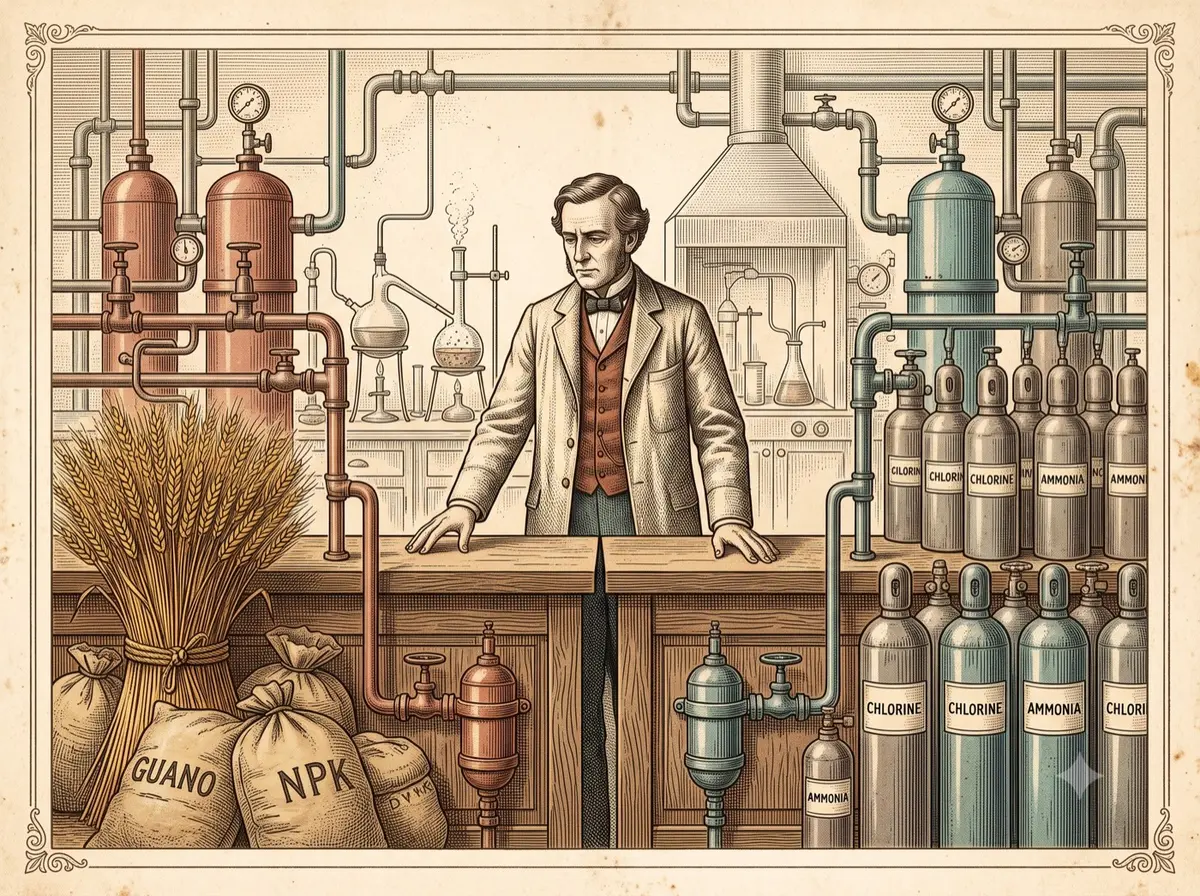
What happened: Fritz Haber
Haber was born in 1868 in Breslau, Prussia (now Wrocław, Poland), to an assimilated Jewish merchant family. He converted to Lutheranism as a young man — common among German Jews seeking easier entry to academic life — and by the 1900s was a physical chemistry professor at the University of Karlsruhe.
There he chased a problem that had frustrated chemists for decades: pulling nitrogen from the air to make ammonia, the building block of both fertilizer and explosives. Plants need nitrogen, but atmospheric nitrogen is locked in a molecule too stable for them to use directly. Farmers relied on manure and imported nitrate deposits — finite sources some feared would eventually cap how much food the planet could grow.
In 1909, working with assistant Robert Le Rossignol, Haber combined nitrogen and hydrogen gas into ammonia in the lab, using a catalyst under high heat and pressure. It was delicate and expensive at bench scale. BASF engineer Carl Bosch then worked out how to run it industrially, and by 1913 the Haber-Bosch process was operating commercially — letting nations manufacture fertilizer, and munitions, without depending on imported nitrates.
Then came World War I. Haber, an ardent German nationalist, threw his institute into military research. When the Western Front bogged down, he proposed releasing chlorine gas, heavier than air, to drift into enemy trenches and drive soldiers into the open. He personally oversaw the plan and was present at Ypres when it was carried out, then led Germany’s chemical warfare program for the rest of the war, eventually reaching the rank of captain — one he’d been denied during his mandatory military service 25 years earlier.
His wife, Clara Immerwahr, was the first woman to earn a chemistry doctorate from the University of Breslau but had largely set aside her career after marrying Haber in 1901. Accounts describe her as unhappy in the marriage and troubled by his wartime work. On the night of May 1–2, 1915, days after Ypres and a party celebrating Haber’s promotion, Clara took his service pistol into their garden and shot herself. Their 12-year-old son found her still alive; she died soon after. No note survived, and historians still debate how much this was tied to the gas attack versus other strains in the marriage — but the timing has made it one of the war’s haunting footnotes. Haber left for the Eastern Front within days to oversee a gas attack on Russian troops.
After the war, Haber’s 1918 Nobel Prize (awarded in 1919, delayed by the war) caused an uproar among Allied scientists who viewed him as a war criminal. He kept working through the 1920s, unsuccessfully trying to extract gold from seawater to help pay Germany’s war debts. In 1933, the Nazi regime’s new civil service laws targeted Jewish scientists, and despite his conversion and wartime service, Haber was forced to resign. He fled Germany, eventually reaching England, where physicist Ernest Rutherford refused to shake his hand over the gas work. Chaim Weizmann then offered him a post in Mandatory Palestine. Haber accepted but died of heart failure in a Basel hotel in January 1934, en route, at 65.
Why it was strange: Fritz Haber
The same mind produced, within a few years of each other, an invention that would help sustain billions of people and a weapon built purely to kill soldiers efficiently. Haber reportedly saw no contradiction, arguing that death was death regardless of the tool, and that a chemist’s wartime duty was to his country, not to some abstract humanity. Few careers force the question of whether scientific brilliance and moral responsibility are the same thing quite this bluntly.
A darker irony sits on top. In the 1920s, scientists at Haber’s own institute helped develop a cyanide-based fumigant called Zyklon A. Haber had no direct role in it and died years before a related formulation, Zyklon B, was used by the Nazi regime to murder more than a million people — among them several of Haber’s own relatives.
The same thread — Nobel Prize — continues in The Graduate Student, the ‘Little Green Men,’ and the Nobel That Got Away.
What scientists learned: Fritz Haber
Haber’s synthesis rested on Le Chatelier’s principle, which describes how a chemical system at equilibrium shifts to counteract an imposed change. Ammonia breaks down into nitrogen and hydrogen at high temperatures, so chemists assumed the reverse reaction was impractical. Haber and Le Rossignol showed that high pressure plus the right catalyst could push the reaction toward ammonia even at temperatures fast enough to be useful — a painstaking optimization later refined by Bosch’s engineers to survive industrial pressures.
The war years produced a grimmer lesson, sometimes called Haber’s rule: that low-concentration, long-term exposure to a toxic gas can cause roughly the same harm as brief exposure to a high concentration — real toxicology, born from research meant to kill more efficiently.
Another person who would not drop the question: The Obituary That Supposedly Created the Nobel Prize — and That Nobody Has Ever Found.
How it reaches us today: Fritz Haber
The Haber-Bosch process still makes essentially all the world’s synthetic nitrogen fertilizer, at a scale of well over 100 million tons a year. Researcher Vaclav Smil estimated that without it, something like two-fifths of the world’s current population would likely not have enough food to exist — a major driver behind global population growth from around 1.6 billion in Haber’s early adulthood to more than 8 billion today, even as the same fertilizer now drives algae blooms and dead zones downstream of heavily farmed land.
The chemical-weapons side of his legacy also endures: the horror of Ypres helped drive international bans on chemical weapons, from the 1925 Geneva Protocol to the 1997 Chemical Weapons Convention. Haber’s career remains a standard case study in science ethics courses on whether discovery alone is ever enough justification.
Elsewhere in chemistry: The Minister Who Sold Gold From Seawater — With a Diver Hiding Under the Wharf.
Fun fact: Fritz Haber
Haber’s Berlin institute was renamed the Fritz Haber Institute in 1953 and still operates today as part of the Max Planck Society — named, without apparent irony, for a man both mourned and condemned by scientists of his own generation.
Sources: Fritz Haber
- “Fritz Haber,” Encyclopædia Britannica. https://www.britannica.com/biography/Fritz-Haber
- “Fritz Haber,” Science History Institute. https://www.sciencehistory.org/education/scientific-biographies/fritz-haber/
- “Fritz Haber’s Experiments in Life and Death,” Smithsonian Magazine. https://www.smithsonianmag.com/history/fritz-habers-experiments-in-life-and-death-114161301/
- “Fritz Haber,” Wikipedia, drawing on Daniel Charles’s Master Mind: The Rise and Fall of Fritz Haber and Dietrich Stoltzenberg’s Fritz Haber: Chemist, Nobel Laureate, German, Jew (with primary-source citations). https://en.wikipedia.org/wiki/Fritz_Haber
- “Second Battle of Ypres,” Wikipedia, citing Allied and German military casualty records. https://en.wikipedia.org/wiki/Second_Battle_of_Ypres
A note on a sensitive subject: this article discusses suicide and wartime death. If you or someone you know is struggling, reaching out to a trusted person or a local mental health professional can help.
Related stories: Fritz Haber
- The Chemist Who Put Lead in Gasoline and Holes in the Ozone — The same man gave us leaded gasoline and CFCs
- The Obituary That Supposedly Created the Nobel Prize — and That Nobody Has Ever Found — The obituary that supposedly shamed Alfred Nobel into a prize
- The Molecule So Foul a Waitress Sprayed Deodorant at the Chemists Who Made It — A stench so foul a waitress sprayed the chemists with deodorant