Science Gone Wrong · Chemistry
The Molecule So Foul a Waitress Sprayed Deodorant at the Chemists Who Made It
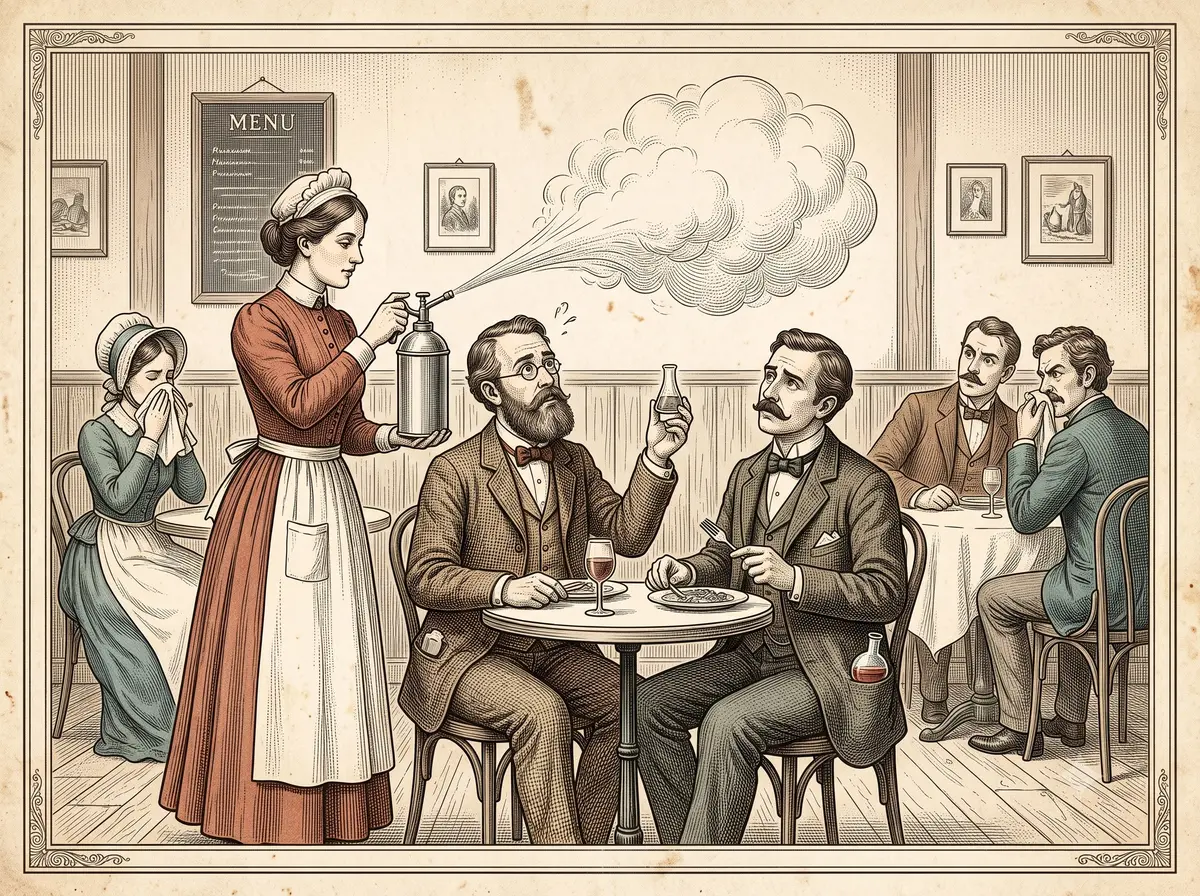
Two chemists sit down for lunch near Oxford after a morning with thioacetone, a molecule with a claim on the title of worst smell in chemistry. They have showered. Their clothes are clean. They have spent the morning heating a few milligrams — a speck, a crumb — in a sealed apparatus. And yet, one by one, the other diners turn to stare. Eventually a waitress walks over, says nothing, and sprays air freshener around their table.
By the Curiosities Desk · · 6 min read · Filed under Chemistry · Today’s round
Part of When the Experiment Left the Lab
What happened: The Molecule So Foul a Waitress Sprayed Deodorant at the Chemists Who Made It
The compound is thioacetone. It is acetone — ordinary nail-polish-remover acetone — with its single oxygen atom swapped for a sulfur atom. That one substitution turns a familiar solvent into one of the foulest-smelling substances chemists have ever recorded.
It first appeared in 1889 at the University of Freiburg, in the laboratory of Eugen Baumann, a well-regarded German chemist better known for discovering that the thyroid gland concentrates iodine. Working with his colleague Emil Fromm, Baumann was treating acetone with hydrogen sulfide to make sulfur-containing versions of ketones. What they mainly got was trithioacetone — three thioacetone molecules linked into a ring, a waxy solid that melts at about room temperature. Thioacetone itself showed up only as a trace impurity. It was enough. Their results were published that year in Berichte der deutschen chemischen Gesellschaft under the flat, unpromising title “Ueber Thioderivate der Ketone” — “On Thio-Derivatives of the Ketones.”
What happened next in Freiburg, in 1889, is the part everyone repeats, and it deserves a careful hand. The trace of thioacetone got out of the building. Later retellings — the version Derek Lowe popularized, and the one behind the phrase “Freiburg evacuation” — describe the smell rolling across the city, people fainting in the streets, and a panicked departure from the neighborhood within about half a mile of the lab. That is the story as it is now told.
The contemporaneous record is real and more restrained. An offensive odor spread rapidly over a large part of the town. There were reports of nausea and vomiting. The 1889 paper itself is a synthetic note, not a municipal incident report, so it does not settle whether anyone fainted or whether “evacuation” is the right word for people leaving the area. What is not in dispute is the scale: a trace of thioacetone, inside a university laboratory in Freiburg in 1889, made itself unmistakably known across a German city. The smell belongs to 1889. The evacuation, as a scene of fainting and flight, belongs to the retelling.
The English-speaking world got its own introduction the following year. In 1890, chemists at the Whitehall Soap Works in Leeds — people who worked around tallow and lye for a living, and were therefore not easily impressed by a bad smell — encountered the same class of compound and reported that the odor was “fearful.” They also noted something that sounds like nonsense and turns out to be the key detail: diluting it seemed to make it worse.
Then, in 1967, researchers at an Esso laboratory south of Oxford, in Abingdon, went back to thioacetone on purpose. Victor Burnop and Kenneth Latham were investigating whether thioketones could be made into useful polymers. Their published account, in the journal Polymer, contains what may be the most quietly devastating paragraph in industrial chemistry. A stopper popped out of a bottle of residues and was replaced immediately — and colleagues in a building two hundred yards away complained of nausea. Two chemists who had cracked only “minute amounts” of trithioacetone found themselves, as the paper puts it, “the object of hostile stares in a restaurant” and suffered “the humiliation of having a waitress spray the area around them with a deodorant.”
The lab staff insisted it wasn’t them. They were working in closed systems and could barely smell anything. So the team ran an experiment on themselves: observers were spread out around the site, some as far as a quarter of a mile away, and a single drop of the crude material was placed on a watch glass inside a fume cupboard. The odor was detected downwind in seconds.
Why it was strange: The Molecule So Foul a Waitress Sprayed Deodorant at the Chemists Who Made It
Chemistry is built on the idea that swapping one atom for a chemically similar one produces a chemically similar result. Oxygen and sulfur sit in the same column of the periodic table. Acetone is so unremarkable that it’s sold in drugstores.
Thioacetone breaks that intuition in two directions at once. It is wildly unstable — above about −20 °C it clumps into a trimer or a polymer within moments, so the pure compound can only be held at low temperature. And its smell violates the everyday rule that dilution weakens a thing. The people standing inside the fume-hood room smelled less than the people a quarter mile downwind. That is why the Esso chemists “genuinely denied responsibility.” They weren’t being evasive. Their own noses were telling them the truth as they could measure it.
Another time it went sideways: The Chemist Who Put Lead in Gasoline and Holes in the Ozone.
What scientists learned: The Molecule So Foul a Waitress Sprayed Deodorant at the Chemists Who Made It
The dilution paradox has a plausible explanation in how smell works. Olfactory receptors don’t report concentration the way a thermometer reports temperature; at very high concentrations, receptors saturate and the perceived character of an odor can change or flatten out — a familiar effect with strong solvents. Meanwhile, the detection threshold for small sulfur compounds is astonishingly low. Human noses are exquisitely tuned to volatile organosulfur molecules, a sensitivity that likely served our ancestors well, since rot and spoilage announce themselves in sulfur.
The 1967 work also mapped the practical chemistry: trithioacetone can be cracked back to the monomer at 500–600 °C, and the resulting polymer chains vary widely in length depending on how you make them. The polymer research was legitimate. It simply came with an occupational hazard no risk assessment had a column for.
Another good intention with a bad landing: The Minister Who Sold Gold From Seawater — With a Diver Hiding Under the Wharf.
How it reaches us today: The Molecule So Foul a Waitress Sprayed Deodorant at the Chemists Who Made It
Our nose’s talent for sulfur is now a safety system. Natural gas is odorless; utilities deliberately add trace sulfur compounds — usually tert-butyl mercaptan or similar odorants — so that a leak is detectable long before it is dangerous. The whole warning system depends on the same biology that made thioacetone unbearable.
The Esso paper also endures as a small classic of scientific honesty. The team could have written “odor issues were encountered.” Instead they described the restaurant, the stares, and the deodorant, and in doing so left behind a permanent, citable reminder that lab hazards include ones nobody thought to list.
A close cousin: The Manhole Cover a Nuclear Test Fired Into the Sky — and the Single Camera Frame That Caught It.
Fun fact: The Molecule So Foul a Waitress Sprayed Deodorant at the Chemists Who Made It
The 1967 researchers reported that a single drop of crude material on a watch glass, inside a fume cupboard, was detected by observers standing a quarter of a mile away — in seconds.
Sources: The Molecule So Foul a Waitress Sprayed Deodorant at the Chemists Who Made It
- Baumann, E.; Fromm, E. “Ueber Thioderivate der Ketone,” Berichte der deutschen chemischen Gesellschaft 22(2), 2592–2599 (1889) — the original synthesis paper. DOI: 10.1002/cber.188902202151 · full text
- Burnop, V. C. E.; Latham, K. G. “Polythioacetone Polymer,” Polymer 8, 589–607 (1967) — the primary source for the restaurant account. DOI: 10.1016/0032-3861(67)90069-9
- American Chemical Society, Molecule of the Week: Thioacetone
- Lowe, Derek. “Things I Won’t Work With: Thioacetone,” In the Pipeline, Science/AAAS (2009). Link
- Chemical News and Journal of Industrial Science, 1890, p. 219 — the Whitehall Soap Works (Leeds) report. Google Books
Related stories: The Molecule So Foul a Waitress Sprayed Deodorant at the Chemists Who Made It
- The Chemical That Sets Fire to Sand — and the Rocket Chemist Who Recommended Running Shoes — A chemical that sets sand, asbestos, and test engineers on fire
- The Weedkiller That Made New Zealand’s Trousers Explode — A weedkiller that turned New Zealand’s farm trousers into fire hazards
- The Alchemist Who Boiled Urine Looking for Gold and Found Phosphorus — An alchemist boiled urine looking for gold and found glowing phosphorus