Science Gone Wrong · Chemistry
The Minister Who Sold Gold From Seawater — With a Diver Hiding Under the Wharf
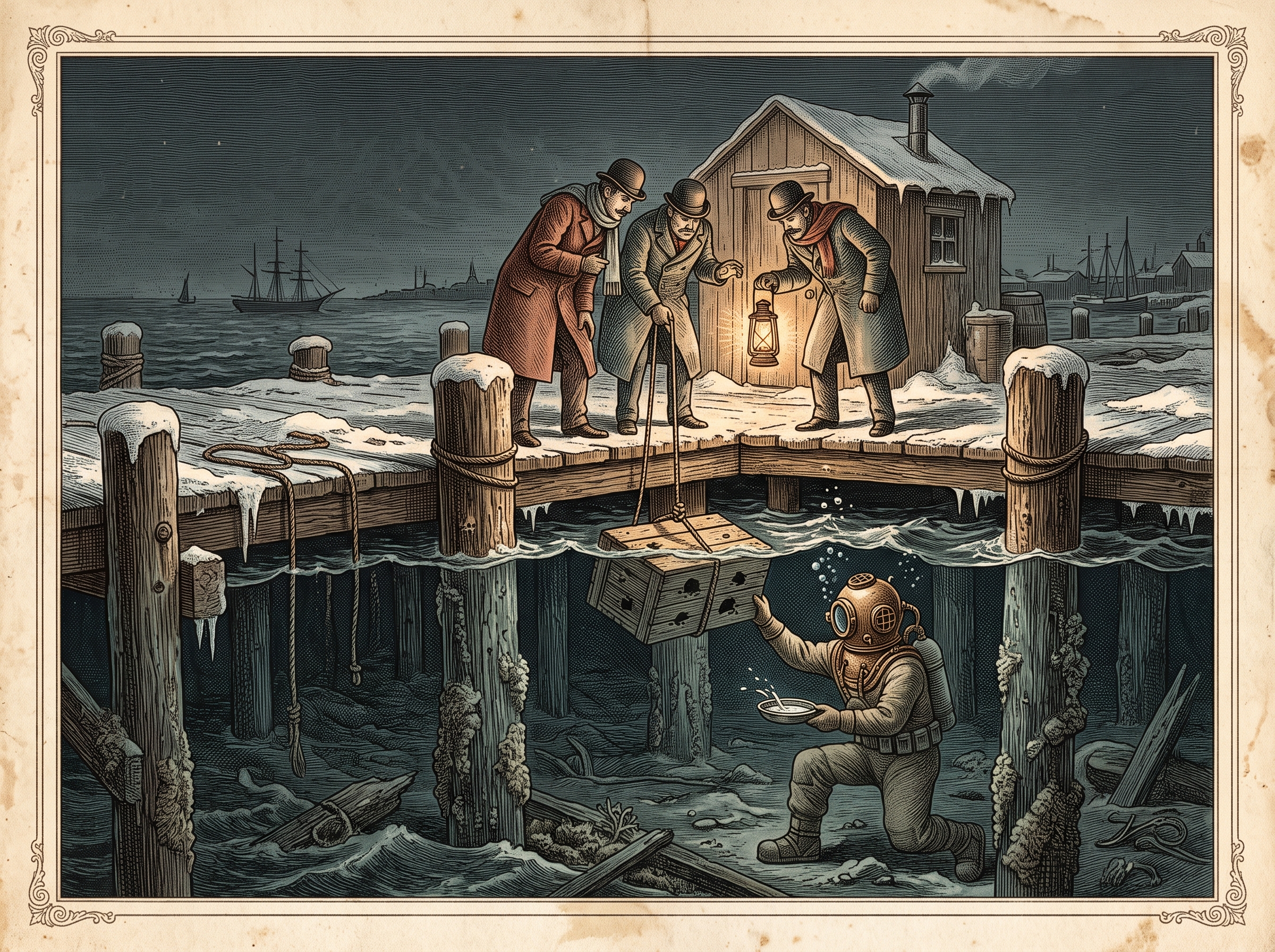
On a freezing night in February 1897, a Providence jeweler named Arthur Ryan and a few skeptical friends sat up in a shanty on a Narragansett Bay wharf, keeping watch over a wooden box they had lowered into the sea. Inside it was a pan of mercury wired to a battery. By morning, the mercury held flecks of real gold, which an assayer valued at about $4.50. The ocean, it seemed, could be mined like a riverbed. What nobody in the shanty knew was that a man in a diving suit had been working under the wharf in the dark.
By the Curiosities Desk · · 5 read · Filed under Chemistry · Today’s round
What happened?
The idea belonged to the Reverend Prescott Ford Jernegan, a Baptist minister from Edgartown on Martha’s Vineyard. In late 1896 he went to Ryan with a story: a vision, he said, had shown him a cheap way to pull dissolved gold out of seawater. His device, the “Gold Accumulator,” was a wooden box punched with holes so seawater could flow through. Inside sat a pan of mercury mixed with a secret ingredient, connected to a small battery. Leave it in the tide overnight, Jernegan said, and the gold would collect in the mercury.
It wasn’t as wild as it sounds. Chemists really had found gold in seawater. In 1872 the English chemist Edward Sonstadt reported traces of it, and later estimates suggested the oceans held trillions of dollars’ worth. The catch, everyone agreed, was that it was too thinly spread to recover at a profit. Jernegan claimed he had solved exactly that problem.
Jernegan didn’t attend the Providence test. He handed over the box and the instructions and let the investors run it themselves, which made the result feel airtight. The gold that turned up in the morning convinced them. What they didn’t know was that Jernegan’s partner, Charles Fisher, was a trained diver. According to later accounts of the fraud, Fisher swam beneath the wharf in his diving suit and swapped the clean mercury for mercury already loaded with gold.
In late 1897, Jernegan, Ryan, and other backers formed the Electrolytic Marine Salts Company, with an office in Boston. Jernegan and Fisher arrived in Lubec, Maine, that October. Lubec, at the far eastern tip of the United States, had two attractions: tides that rise and fall around 20 feet, and a remote coastline where shareholders couldn’t easily drop by. The company leased Hiram Comstock’s old tidal grist mill on Mill Creek in North Lubec and turned it into Plant No. 1, ringed with a high fence, barbed wire, and “No Admittance” signs.
The money poured in, mostly from investors in Massachusetts, New York, and Connecticut, many of them fellow Baptists. Shares reportedly opened at $33 and climbed to $150 within weeks. The company’s prospectus claimed a cubic mile of seawater held at least $65 million in gold. By July 1898 the local paper, the Lubec Herald, counted 240 accumulators in the water, with 60 hauled up each week. The “harvest” was shipped to New York as proof. Fisher, it later emerged, had been planting gold bought in Boston.
The company kept growing. A second plant was started on the North Lubec canal, designed for 5,000 accumulators. More than 700 laborers worked on it, many of them Italian immigrants recruited from railroad jobs with the promise of better pay. There was even a company steam launch, The Gold Bug.
Then, in July 1898, the accumulators stopped producing. Fisher had vanished. Jernegan soon disappeared too; he had sailed for France under an assumed name with his family and, reportedly, more than $200,000. Work in Lubec was suspended on July 29, about 700 workers lost their jobs, and on August 1 The Boston Herald was among the New England papers exposing the scheme.
Why was it strange?
The hoax worked because it was built on real chemistry. Gold does dissolve in seawater, and mercury really does grab gold. The swindle didn’t need a fake science; it needed only to skip one step, the question of how much gold is actually there. The investors also did the sensible thing: they ran the test themselves, out of the inventor’s reach, and watched the box all night. They just watched it from the wrong side of the water.
The ending is odd, too. No one was ever prosecuted. From Europe, Jernegan sent back about $75,000, and with the sale of the company’s assets, stockholders recovered roughly 36 cents on every dollar. That refund led some people to suspect Fisher, not the minister, had been the true ringleader. Jernegan eventually became a schoolteacher in the Philippines and wrote a history of the islands. Fisher was never found.
Another time it went sideways: The Chemist Who Put Lead in Gasoline and Holes in the Ozone.
What did scientists learn?
The accumulator borrowed a real technique: amalgamation, in which liquid mercury dissolves gold to form an alloy called an amalgam. Gold miners had used it for centuries to capture fine gold from crushed ore. But it only works when there is gold to catch, and in seawater there is almost none.
How little became clear in the 1920s, when the German chemist Fritz Haber, a Nobel laureate, tried to do honestly what Jernegan had faked. Haber hoped seawater gold could help Germany pay its crushing World War I reparations. From 1920 to 1926 his team analyzed water from several ocean voyages, including Germany’s 1925 Meteor expedition. The answer was disappointing: there was far less gold than the older figures promised, by some accounts about a thousand times less, and extracting it would cost more than the gold was worth.
Modern measurements confirm the gloom. NOAA notes that gold in seawater is measured in parts per trillion, and one study found roughly one gram of gold for every 100 million metric tons of water.
Another good intention with a bad landing: The Molecule So Foul a Waitress Sprayed Deodorant at the Chemists Who Made It.
How does it affect us today?
NOAA’s verdict today is that there is still no cost-effective way to mine gold from the ocean. The more lasting lesson is about testing claims. Ryan’s overnight trial looked like independent verification, but it left one route unguarded. Today, a good test controls for that: the equipment and samples come from people with no stake in the result, and the measurement is repeated by others. And the first question is always the one Haber asked: not “Is it there?” but “How much?”
A close cousin: The Weedkiller That Made New Zealand’s Trousers Explode.
Fun fact
After the swindle collapsed, the North Lubec gold plant didn’t go to waste. The Standard Sardine Company used the old mill for several years, so the factory that promised to pull gold from the sea ended up packing fish instead.
Sources
- Maine Memory Network (Lubec Memorial Library and Lubec Historical Society), “Klondike: Lubec’s Gold from Sea Water Hoax”, and the original 1898 Electrolytic Marine Salts prospectus by P. F. Jernegan
- Museum of Hoaxes, “The Gold Accumulator”, citing the Chicago Daily Tribune (Aug. 2, 1898) and Scientific American (Aug. 13, 1898)
- American Heritage, “Would You Believe Salted Salt Water?”
- NOAA National Ocean Service, “Is there gold in the ocean?”
- Magda Dunikowska and Ludwik Turko, “Fritz Haber: The Damned Scientist” (on Haber’s 1920–1926 seawater gold project)