Accidental Discoveries · Chemistry
The Seaweed Ash That Ate Its Own Vats — and Gave Up a New Element
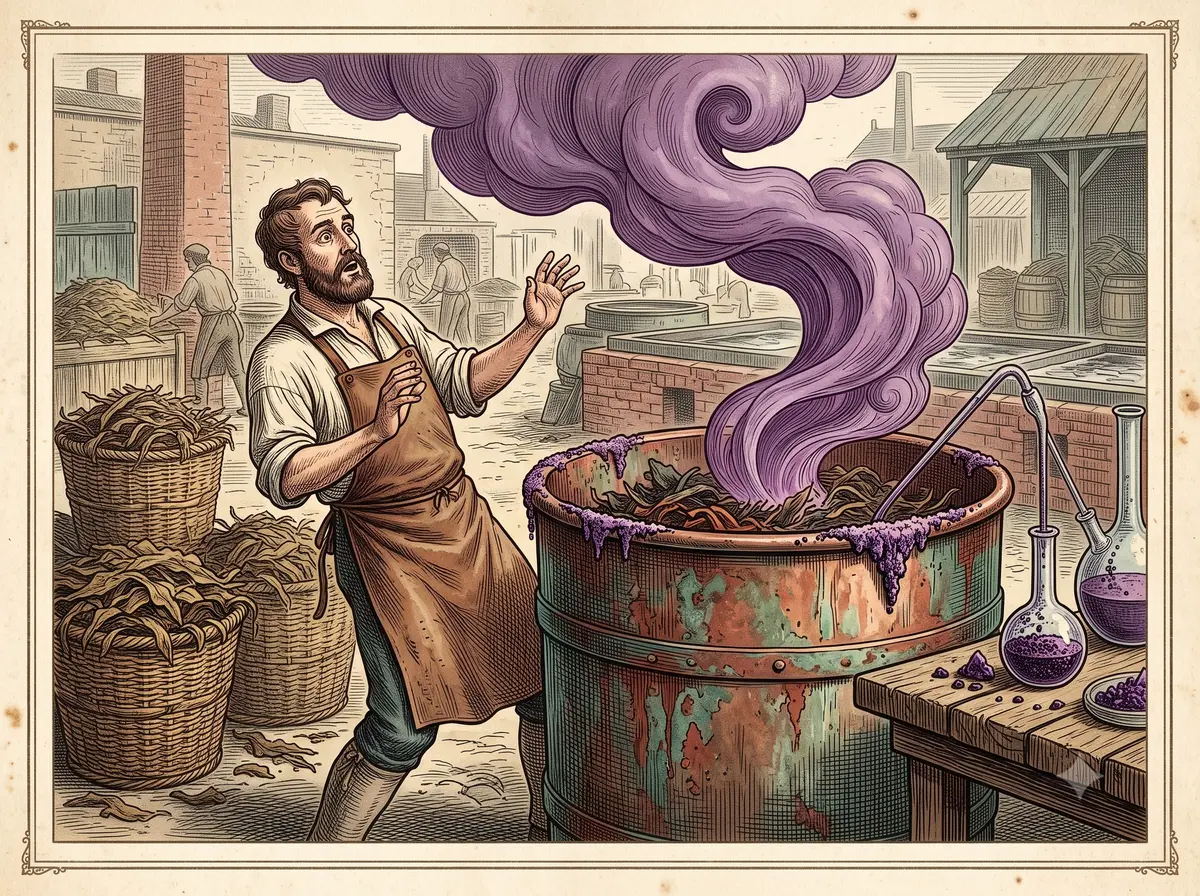
In a walled yard in northeast Paris, sometime late in 1811, a gunpowder maker splashed sulfuric acid onto a slurry of burnt seaweed. A violet cloud climbed out of the vat — not smoke, not steam, a deep vaporous purple — drifted up, and settled on every cold surface it touched as dark crystals with the shine of graphite. Bernard Courtois had been trying to keep Napoleon's cannons firing. He had just found element 53.
By the Curiosities Desk · · 5 min read · Filed under Chemistry · Today’s round
What happened: Iodine in Burnt Seaweed
Gunpowder needs saltpetre, and saltpetre needs potash. Both were short in imperial France. Britain controlled the cheap Indian saltpetre and was blockading French ports, so France grew its own in walled plantations called nitraries — beds of manure, garbage and lime, soaked with urine and left to ripen for a year while nitrifying bacteria did the chemistry. The leached liquor was then treated with potash, potassium carbonate, traditionally taken from wood ash. The main qualification for running a nitrary was a tolerance for the smell.
Bernard Courtois, born in Dijon in 1777, grew up in this world; his father ran a nitrary there, and he had trained as a chemist at the École Polytechnique. By 1810 he had his own nitrary in Paris. Wood ash was scarce — France was running short of forest — so he turned to varec: seaweed washed up along the coasts of Brittany and Normandy, gathered, dried and burned by the ton. Its ash was full of sodium and potassium salts. It also, it turned out, contained something that quietly chewed holes in his copper vessels.
Accounts differ on what happened next: some say he simply added too much sulfuric acid to the ash liquor one day, others that he was hunting the culprit and the acid was his test. Every version agrees on the moment. Acid met seaweed ash, violet vapour rose, and it condensed on cold metal and ceramic as lustrous purple-black crystals.
Courtois started poking at it. The crystals matched nothing catalogued, and mixed with ammonia they became a powder that detonated at a touch — nitrogen triiodide, which a feather will set off. But he wasn’t a member of the Académie des Sciences and had a business to run, so in May 1812 he handed samples to two acquaintances, Nicolas Clément and Charles Desormes, and asked them to work it out.
They sat on it for eighteen months. Clément finally announced the substance in Paris in late November 1813 — at almost exactly the moment Humphry Davy happened to be in town. Europe’s most famous chemist had travel papers from Napoleon’s government despite the war, and had brought his 22-year-old assistant, Michael Faraday, whose journal for 1 December records that “Sir H. Davy made many new experiments on the substance discovered by M. Courtois.”
What followed was a priority scramble between Davy and Joseph Louis Gay-Lussac, conducted in near-simultaneous papers and mild bad temper. In the closing weeks of 1813 the Annales de Chimie ran all three men’s papers back to back — Courtois’s read aloud for him by Clément, since he wasn’t a member, and credited simply to a saltpetre maker of Paris. Both rivals named him the discoverer. The name came from the Greek ioeidēs: violet.
Why it was strange: Iodine in Burnt Seaweed
Elements are supposed to be found by people looking for elements. This one was found by a man trying to make explosives out of rotting seaweed, and it announced itself by ruining his equipment.
There’s a stranger inversion in what came after. In 1815 the wars ended, cheap Indian saltpetre flowed back into France, and the gunpowder business that had led Courtois to iodine collapsed. He spent the rest of his life manufacturing the element instead, and watched it become a medicine; the French Academy gave him a 6,000-franc prize in 1831 for its medical value. It didn’t save him. He died in Paris in 1838, penniless, leaving his wife and son destitute.
One thing worth flagging, because you’ll see it everywhere: the story that Courtois’s cat knocked over a bottle of sulfuric acid and thereby discovered iodine. It’s charming, and it has no support in the 1813 papers or in the scholarly accounts of his life. The self-devouring vats are the better story anyway, and they’re documented.
Another accident worth keeping: The Hot Stove Accident That Invented Modern Rubber.
What scientists learned: Iodine in Burnt Seaweed
The violet cloud was iodine doing something most solids don’t: sublimating, passing straight from solid to vapour without pausing to be a liquid, then re-condensing straight back to crystals on a cold surface. That’s why the discovery was so theatrical, and it’s still how iodine is purified in teaching labs.
Working out what iodine was took longer, and it’s a snapshot of chemistry half a century before the periodic table. It had the heft and lustre of a metal but dissolved in ether, and chemists suspected a chlorine compound until it combined with hydrogen into a new acid, hydroiodic rather than hydrochloric. Nothing broke it down, not even red-hot carbon: a corps nouveau, a new body. Its family resemblance to chlorine — what we now call the halogens — became one of the patterns Mendeleev would hang his table on.
Another time the mistake was the invention: The Oil-Well Gunk Drillers Hated That Became Vaseline.
How it reaches us today: Iodine in Burnt Seaweed
The medicine came fast. In 1819 the Swiss physician Jean-François Coindet — who knew burnt sponge and seaweed had been used against goiter since antiquity — guessed iodine was the active ingredient and tested a tincture on patients. It worked. The reason took another century: the thyroid cannot make its hormones without iodine, and those hormones govern metabolism and, critically, the development of a fetal brain.
The public-health payoff arrived in 1924, when Michigan — deep in the American “goiter belt,” where the soils are iodine-poor — began adding iodine to table salt. Goiter rates fell sharply, and salt iodization spread worldwide. It remains one of the cheapest public-health measures ever devised, and it’s unfinished business: UNICEF estimates around 19 million newborns a year are at risk of preventable brain damage because their mothers didn’t get enough iodine.
Tincture of iodine was also a frontline antiseptic through the American Civil War, adopted decades before germ theory was accepted, simply because it kept wounds from going bad. Povidone-iodine is still what a surgeon paints on your skin before cutting.
(As with most nutrients, more is not better — too much iodine can disturb the thyroid as surely as too little. Questions about your own thyroid belong with a clinician, not a salt shaker.)
A close cousin: The Sweetener Discovered Because a Student Heard ‘Test’ as ‘Taste’.
Fun fact: Iodine in Burnt Seaweed
No portrait of Bernard Courtois exists — not a painting, not a sketch — and the photograph captioned “Bernard Courtois” that circulates online is some other unlucky stranger. It can’t be him: Courtois died in September 1838, and Daguerre’s process wasn’t announced until August 1839. Which is its own small irony, because the daguerreotype worked by fuming a polished silver plate with iodine vapour to make it light-sensitive. The element he pulled out of a vat of burnt seaweed made the first practical photographs possible, and it missed him by eleven months.
Sources: Iodine in Burnt Seaweed
- Primary source: Bernard Courtois, “Découverte d’une substance nouvelle dans le Vareck,” Annales de Chimie 88 (1813), 304–310 — the original announcement, read to the Académie on his behalf, followed in the same volume by Gay-Lussac (311–321) and Davy (322–329). Full citation and discussion in the Marshall paper below.
- James L. Marshall and Virginia R. Marshall, “Rediscovery of the Elements: Courtois and Iodine,” The Hexagon, Winter 2009, 72–75 (University of North Texas) — https://chemistry.unt.edu/system/files/james-l-marshall-pdfs/iodine.pdf
- William B. Ashworth Jr., “Scientist of the Day — Bernard Courtois,” Linda Hall Library — https://www.lindahall.org/about/news/scientist-of-the-day/bernard-courtois/
- Tracey McIntire, “Gunpowder and Seaweed: The Story of Iodine,” National Museum of Civil War Medicine, 19 October 2022 — https://www.civilwarmed.org/story-of-iodine/
- UNICEF, “Nearly 19 million newborns at risk of brain damage every year due to iodine deficiency” — https://www.unicef.org/press-releases/newborns-brain-damage-iodine-deficiency
Related stories: Iodine in Burnt Seaweed
- The Alchemist Who Boiled Urine Looking for Gold and Found Phosphorus — An alchemist boiled urine looking for gold and found glowing phosphorus
- The Blank Squares That Predicted Three Undiscovered Elements — Mendeleev left gaps in his table, and the missing elements showed up
- The Element Discovered on the Sun 27 Years Before Anyone Found It on Earth — Helium was found in sunlight 27 years before anyone found it here