Accidental Discoveries · Physics
The Spotted X-Ray Film That Traced the First Atomic Bomb — Through a Cardboard Box
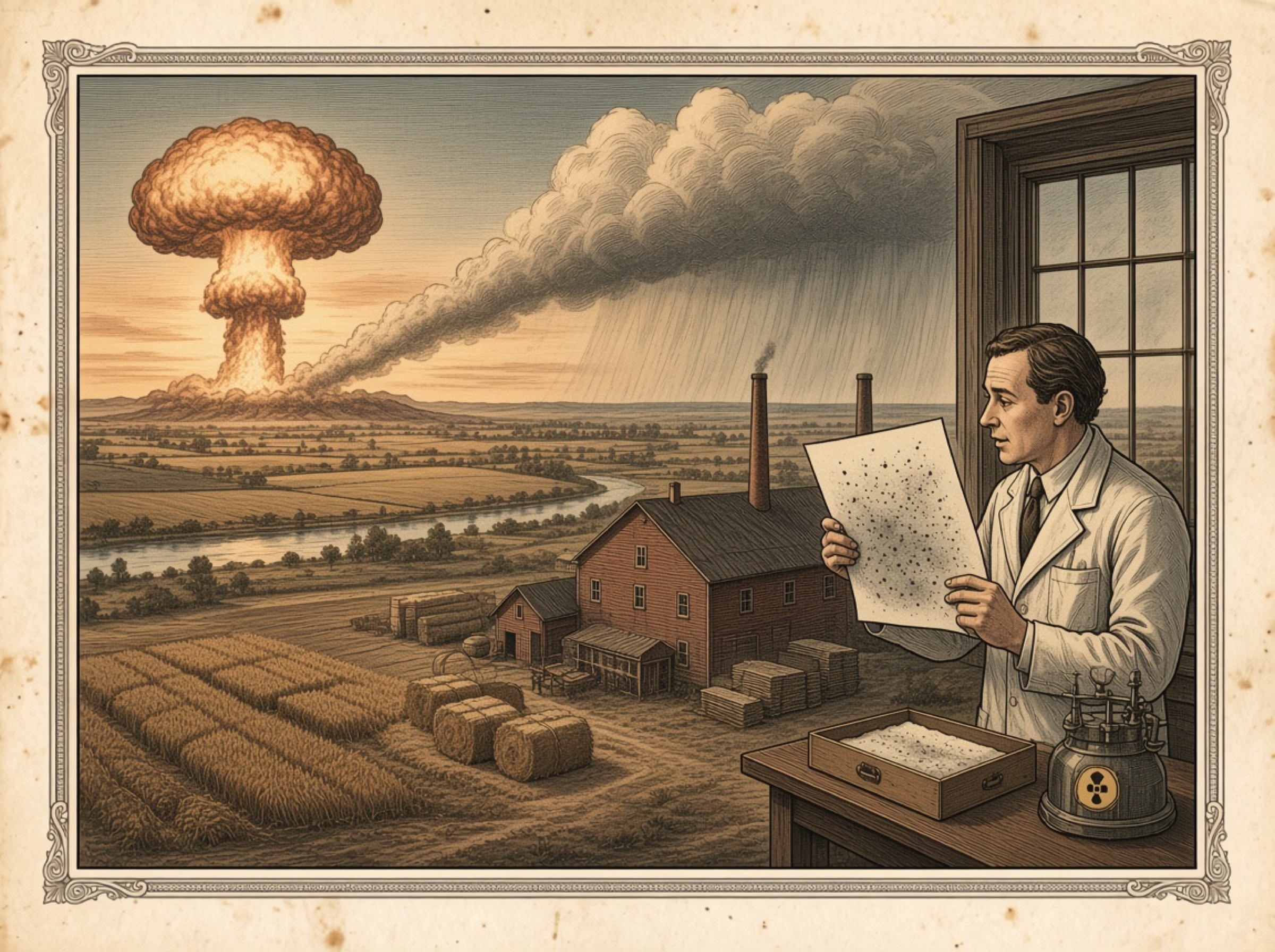
In the late summer of 1945, Kodak's customers started opening boxes of brand-new X-ray film and finding something nobody had photographed: tiny dark spots and foggy patches, as if the film had been exposed before it ever left the factory. The culprit turned out to be the cardboard it was packed in — and the cardboard, it turned out, had been touched by the world's first atomic bomb, set off more than a thousand miles away.
By the Curiosities Desk · · 5 min read · Filed under Physics · Today’s round
What happened?
On July 16, 1945, the United States detonated the first nuclear weapon, code-named Trinity, in the desert near Alamogordo, New Mexico. The test was secret. The cloud it threw up was not obedient to secrecy: it carried radioactive dust high into the atmosphere, and the winds carried it east.
Meanwhile, in Rochester, New York, Eastman Kodak was dealing with a quality-control headache. Photographic film is, at heart, a radiation detector. Its emulsion — a thin layer of light-sensitive silver salts — darkens wherever light, X-rays, or other radiation strikes it. Kodak knew this better than anyone, and it had already been burned once. Before the war, the company had discovered that recycled cardboard could carry traces of radium from the luminous-paint industry, which spoiled film. So it arranged for a paper mill in Indiana to make its packaging from carefully selected raw materials, according to the Oak Ridge Associated Universities’ Museum of Radiation and Radioactivity.
That precaution is why the new problem was so puzzling. In late summer 1945, batches of X-ray film began showing up fogged and spotted. Kodak physicist Julian H. Webb investigated. The film chemistry was fine. The processing was fine. The trouble lined up with one thing: a particular batch of strawboard (stiff cardboard pressed from cereal straw) made at a mill in Vincennes, Indiana, on the Wabash River. Webb traced the contamination to a run of strawboard produced on August 6, 1945 — by coincidence, the same day the bomb fell on Hiroshima.
Then word arrived that strawboard from a second mill, on the Iowa River in Iowa, had the same problem — and the two contaminants looked practically identical, even though the mills were hundreds of miles apart.
Webb measured the cardboard’s radiation the way a detective dusts for prints. It gave off strong beta radiation (fast electrons), weak gamma rays, and almost no alpha particles, which ruled out the usual suspects, radium and uranium. Most tellingly, the activity faded with a half-life of about a month. Webb concluded the most likely culprit was cerium-141, an isotope with a half-life of about 32.5 days that doesn’t occur in nature but is produced when uranium or plutonium atoms split.
Something had been splitting atoms in America, and its dust had rained into the Midwest’s rivers, which fed the mills’ water supply, which soaked into the pulp, which was pressed against Kodak’s film.
Recognizing how sensitive this was, Webb sat on his findings. He published them in the journal Physical Review in 1949 under the plain title “The Fogging of Photographic Film by Radioactive Contaminants in Cardboard Packaging Materials.”
Why was it strange?
The world’s most closely guarded weapons program left fingerprints on a shipping box. No spy was involved, no leak, no informant — just a physicist trying to figure out why a product was getting customer complaints.
It’s often retold as “Kodak discovered the atomic bomb,” and that’s an oversell worth correcting. By the time Webb finished his analysis, the bombing of Hiroshima had been announced publicly, and Kodak was hardly an outsider: its subsidiary Tennessee Eastman ran a uranium-enrichment plant for the Manhattan Project at Oak Ridge. What Webb actually showed was subtler and stranger: that a single test in the New Mexico desert had sprinkled measurable fission products across the middle of the continent, and that ordinary film could detect them.
(One more wrinkle: some later accounts, including a 1997 Senate hearing, describe the packaging as made from corn husks. Webb’s own paper says straw.)
The same thread — Manhattan Project — continues in The Cylinder That Weighed Too Much and Became Teflon.
What did scientists learn?
The Kodak episode was an early, concrete demonstration of long-range fallout: radioactive particles from a nuclear explosion travel far beyond the test site and come down with rain and snow.
It also showed why film fogged so badly from such tiny amounts. Beta particles only travel about a millimeter through solid material, so they don’t do much from across a room. But here, the radioactive cardboard was pressed directly against the emulsion for days or weeks. A very weak source, in intimate contact with a very sensitive detector, adds up. A 2026 Stanford physics course analysis of Webb’s data estimates the contamination was far too weak to harm people — but more than enough to spoil film.
Finally, it showed that half-life works like a timestamp. Measuring how quickly radioactivity fades narrows down which isotope is present, and if that isotope is a fission product, it points straight to a nuclear source.
Another time the mistake was the invention: The Schoolboy Whose Hot Ice Cream Froze Faster — and Baffled Physicists for 60 Years.
How does it affect us today?
Kodak didn’t stop at one incident. The company installed air samplers on its building ventilation intakes to watch for fallout. When atmospheric testing began in Nevada in January 1951, a snowstorm over Rochester brought down fallout that researchers later reported at 25 times normal radiation levels. Kodak complained, reportedly threatened to sue, and the Atomic Energy Commission agreed to give the film industry advance notice of tests, including maps and forecasts of where contamination was expected.
That arrangement later became a pointed part of the history. In 1997, researchers at the Institute for Energy and Environmental Research noted that film manufacturers got fallout forecasts while dairy farmers and families downwind, whose milk could carry radioactive iodine, did not. That contrast fed into the public reckoning over fallout and thyroid health from 1950s testing.
Today, monitoring networks track airborne radioactivity around the world, and the idea that a sensitive material can quietly record an invisible event is still at the heart of radiation detection — from the film badges once worn by X-ray technicians to modern dosimeters.
Another accident worth keeping: The Botanist Who Ground Up a Piece of the Sphinx to See If It Would Wiggle.
Fun fact
The isotope that gave the game away, cerium-141, doesn’t exist naturally on Earth. Finding it in a cardboard box in 1945 was like finding a footprint of a creature no one was supposed to know existed.
If questions about fallout exposure or thyroid health hit close to home, a doctor can talk through whether screening makes sense for you.
Sources
- Webb, J. H. “The Fogging of Photographic Film by Radioactive Contaminants in Cardboard Packaging Materials.” Physical Review 76, no. 3 (1949): 375–380. https://journals.aps.org/pr/abstract/10.1103/PhysRev.76.375
- Oak Ridge Associated Universities, Museum of Radiation and Radioactivity. “Kodak Film Fogged by the Trinity Test (1945).” https://www.orau.org/health-physics-museum/collection/nuclear-weapons/trinity/kodak-film.html
- Ohal, T. “Kodak Film and the Trinity Fallout.” Stanford University, PH241 coursework (2026). http://large.stanford.edu/courses/2026/ph241/ohal1/
- Davidson, L. “Film manufacturers told of '50s fallout, while public was not.” Deseret News, September 30, 1997. https://www.deseret.com/1997/9/30/19336946/film-manufacturers-told-of-50s-fallout-while-public-was-not/