Accidental Discoveries · Physics
The Botanist Who Ground Up a Piece of the Sphinx to See If It Would Wiggle
In the summer of 1827, Robert Brown, a famously careful Scottish botanist, sat at his microscope in London and did something that sounds like a prank on the ancient world: he took a fragment of the Sphinx, broke it down into fine dust, mixed it with water, and peered at it to see whether it would dance. It did. So did crushed window glass, London soot, and pollen from plants that had been dead and pressed flat for a hundred years. Brown had set out to study how flowers reproduce. Instead he had stumbled onto the first visible evidence that atoms are real.
By the Curiosities Desk · · 5 min read · Filed under Physics · Today’s round
What happened?
By 1827, Robert Brown (1773–1858) was one of the most respected botanists in Britain. He had sailed to Australia as the naturalist aboard HMS Investigator in 1801 and collected around 3,400 plant species there, roughly 2,000 of them new to science.
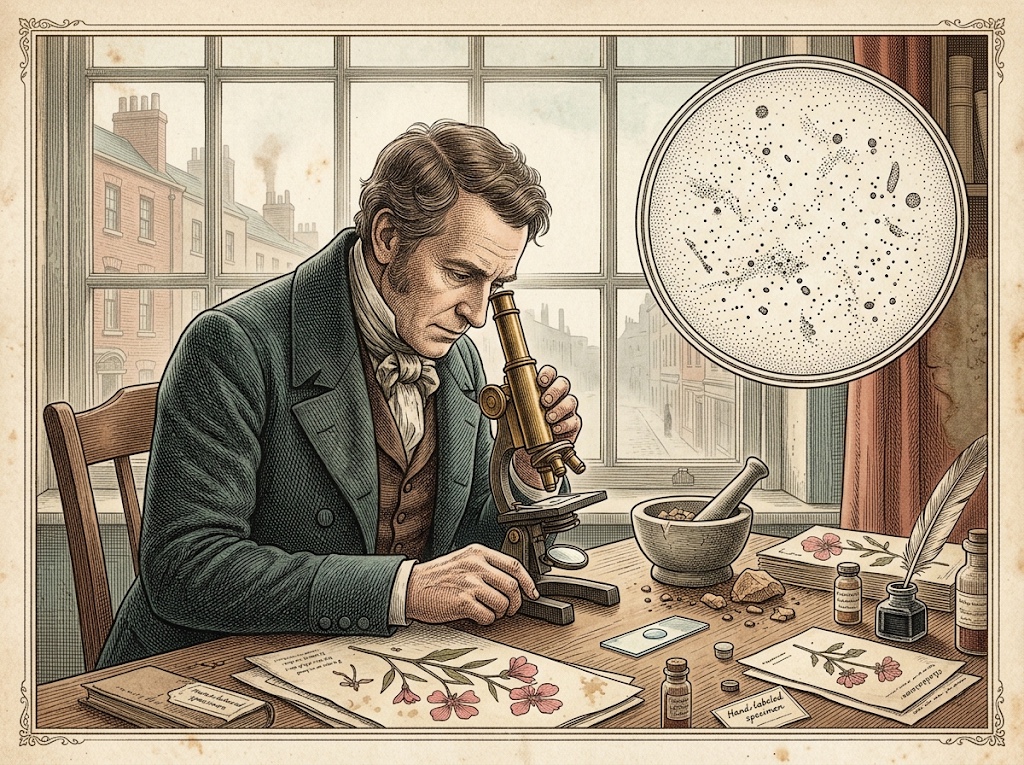
His question that summer was about plant reproduction. He wanted to know how pollen does its job — in his own words, the “mode of action of the pollen in the process of impregnation” — and specifically “whether the larger particles acted upon the ovule.” Starting in June 1827, he put the pollen of Clarkia pulchella, a pink wildflower from western North America, into water and watched it under a single-lens microscope that he estimated magnified 370 times.
A common textbook version says Brown saw the pollen grains themselves jiggling. He didn’t. What Brown watched were much smaller bodies that spilled out of them: oblong particles a few thousandths of a millimeter long and even tinier round specks, which he called “molecules.” (Modern researchers identify them as amyloplasts, which store starch, and spherosomes, which store oils.) These particles, he wrote, “have a manifest motion.” They drifted, turned, and trembled without stopping.
Brown was not the first person to see small things jitter in liquid — the Dutch scientist Jan Ingenhousz had described coal dust moving on alcohol in 1785. Brown’s contribution was to refuse the easy explanations. He checked whether currents in the water or slow evaporation could be pushing the particles around, and concluded the motion “belonged to the particle itself.”
The obvious next guess was that the particles were alive, or at least carried some vital spark special to living things. So Brown tested it. He looked at pollen from herbarium specimens that had been dried for “upwards of twenty” years, and some for “not less than a century.” Their particles still moved. Perhaps, he reasoned, these were the building blocks of all organic matter. “I now therefore expected to find these molecules in all organic bodies,” he wrote, and he found them in other plant and animal tissues.
Then he went further, to materials that had never been alive at all. He crushed “a minute fragment of window-glass” right on the microscope stage. He powdered rocks of all ages, including ones with no trace of fossils, and minerals and metals such as manganese, nickel, bismuth, antimony, and arsenic. He concluded that the soot settling on everything, “especially in London,” was “entirely composed of these molecules.” And among the granite samples he examined was, as he noted almost in passing, “a fragment of the Sphinx.” His paper doesn’t say how he got it, or even which sphinx.
Everything jiggled. Brown published his observations in 1828 under the long title A Brief Account of Microscopical Observations… on the General Existence of Active Molecules in Organic and Inorganic Bodies. In a follow-up in 1829 he made a point of rejecting the idea that the particles were animated, and admitted he was left with “motions for which I am unable to account.”
Why was it strange?
Brown’s experiment ran backward from what he expected. He began with a question about life and ended up removing life from the answer entirely. The motion appeared in living pollen, century-old dead pollen, glass, metal, soot, and a relic of ancient Egypt — and it never stopped. Something with no motor and no food kept moving forever. For nearly eighty years, nobody could say what.
The same thread — Albert Einstein — continues in The Ether-Hunting Machine That Found Nothing — and Broke Physics.
What did scientists learn?
The answer came in 1905, from a 26-year-old patent clerk. In a paper published in Annalen der Physik, Albert Einstein argued that if liquids are made of tiny molecules in constant thermal motion, then any small particle floating in them should be bombarded unevenly from all sides, and would wander in a random, zigzag path. He predicted exactly how far such a particle should drift over time, a prediction that depended on the size of molecules. The Polish physicist Marian Smoluchowski reached a similar theory independently in 1906.
This mattered because, at the time, atoms and molecules were still a useful idea rather than settled fact; a number of respected scientists doubted they physically existed. Starting around 1908, French physicist Jean Perrin put Einstein’s math to the test. He made emulsions of tiny resin spheres from gamboge and mastic, sorted them by size, and tracked and counted the grains under a microscope. His measurements gave values for Avogadro’s number — the number of molecules in a standard amount of a substance — that agreed closely across several independent methods. “The objective reality of molecules and atoms which was doubted twenty years ago, can today be accepted as a principle,” Perrin said in his Nobel lecture after winning the 1926 Nobel Prize in Physics “for his work on the discontinuous structure of matter.”
In other words, the jiggle Brown saw was water molecules, far too small to see, shoving the particles around. A fragment of the Sphinx was being knocked about by the invisible.
Another accident worth keeping: The Glow Across the Room That Let Us See Inside the Body.
How does it affect us today?
Brownian motion — the random wandering of small particles pushed by molecular collisions — is now a basic tool across science. It explains how molecules diffuse inside living cells and why proteins and other small structures in your body never sit still. In 2010, physicists finally measured the instantaneous speed of a single glass bead jittering in air while holding it with laser “optical tweezers.” And the mathematics of random walks — first explored by Louis Bachelier in 1900 to model stock prices, then made rigorous by Norbert Wiener in the 1920s — is now used everywhere from finance to physics.
Another time the mistake was the invention: The Schoolboy Whose Hot Ice Cream Froze Faster — and Baffled Physicists for 60 Years.
Fun fact
Brown’s other famous discovery is just as fundamental. In 1831 he gave the cell nucleus its name, from the Latin for “kernel.” Other microscopists had seen it before, but the name he chose is the one biology still uses — which means a botanist trying to understand pollen ended up naming both the control center of the cell and the motion that proved atoms exist.
Sources
- Brown, Robert. “A Brief Account of Microscopical Observations Made in the Months of June, July and August, 1827, on the Particles Contained in the Pollen of Plants; and on the General Existence of Active Molecules in Organic and Inorganic Bodies.” Philosophical Magazine, 1828. (Primary source: Brown’s own account, including the Sphinx fragment.)
- Pearle, Philip, et al. “What Brown Saw and You Can Too.” American Journal of Physics, 2010. (Re-creates Brown’s observations and identifies the particles he actually watched.)
- Perrin, Jean. “Discontinuous Structure of Matter,” Nobel Lecture. 1926. Nobel Foundation.
- APS News. “This Month in Physics History: Robert Brown and Molecular Motion in Pollen.” August 2016.
- The Linnean Society of London. “Robert Brown (1773–1858).”