Accidental Discoveries · Physics
The Physicist Who Tried to Bottle a Mountain Fog — and Caught Subatomic Particles Instead
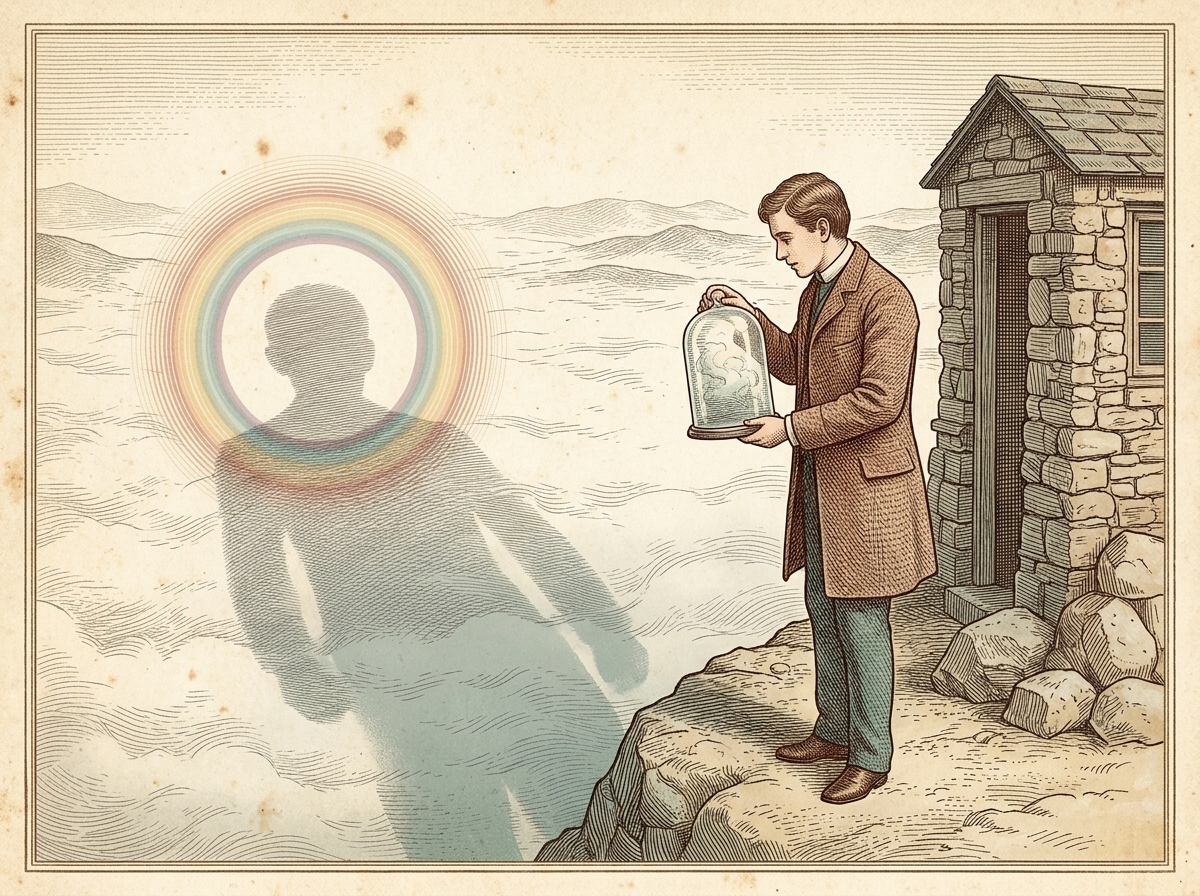
In September 1894, a young Cambridge physicist stood on the summit of Ben Nevis, Britain's highest mountain, and watched his own shadow float on a bank of fog, ringed by a halo of colored light. He decided he had to make that cloud again, indoors, in a glass jar. Seventeen years later, the little clouds in his jar were drawing pictures of things no one had ever seen: the paths of single subatomic particles.
By the Curiosities Desk · · 5 min read · Filed under Physics · Today’s round
What happened?
Charles Thomson Rees Wilson, known as C.T.R., was born on 14 February 1869 in the parish of Glencorse, near Edinburgh, the son of a farmer. His father died when he was four, and the family moved to Manchester. He first studied biology, planning to become a doctor, before physics pulled him away. He graduated from Cambridge in 1892.
In September 1894 he spent a few weeks at the Ben Nevis Observatory, a stone weather station on the 1,345-metre summit where observers recorded readings every hour, day and night. The mountaintop was often wrapped in cloud, and the sunlight did strange things to it. Wilson saw coronas, the colored rings that form around the sun when it shines through thin cloud. He also saw a “glory”: when the sun was behind him and fog lay below, his shadow appeared on the cloud surrounded by rainbow-colored rings. (A glory seen around a giant, ghostly shadow is often called a Brocken spectre.)
Wilson was hooked. In early 1895 he began trying to recreate clouds at Cambridge’s Cavendish Laboratory. His method was simple in principle. He sealed moist air inside a glass vessel, then let it expand suddenly. Expansion cools the air, and cool air can’t hold as much water vapor. The air becomes “supersaturated,” meaning it holds more vapor than it normally could, and the extra water is ready to condense into droplets.
But droplets need somewhere to form. Usually that’s a speck of dust. Wilson filtered the dust out and found that, with a big enough expansion, a faint rain of droplets still appeared. Something else invisible was seeding them. In early 1896, shortly after X-rays were discovered, he shone them into his chamber and the cloud grew far thicker. The seeds, he concluded, were ions: atoms or molecules that have gained or lost an electron and carry an electric charge.
That meant his fog jar could be a detector. If a fast charged particle tore through the air, it would leave a line of ions behind, and droplets would bead up along that line like dew on a spider’s thread. Busy with teaching, Wilson didn’t come back to the idea properly for years. Then, in early 1911, he became the first person to see and photograph the tracks of individual alpha and beta particles. He called the trails left by electrons “little wisps and threads of clouds.” His paper, received by the Royal Society on 19 April 1911, described alpha-particle tracks as “remarkably sharply defined lines, about 1/10 mm. wide.”
Why was it strange?
Wilson wasn’t hunting for atoms. He wanted to understand weather, and specifically a pretty optical effect he had seen on a Scottish mountain. The tool he built to study clouds turned out to be a window into a world far too small to see.
It also flipped the usual relationship between scientists and particles. Before 1911, physicists knew about alpha and beta rays mostly through indirect clues: flashes on a screen, clicks in a counter, the slow discharge of an electroscope. Wilson’s chamber let them see where one particle went, where it swerved, and where it stopped. The physicist Ernest Rutherford later called it “the most original and wonderful instrument in scientific history.” Wilson’s bottled fog was even sensitive to X-rays, the same mysterious radiation told about in The Glow Across the Room That Let Us See Inside the Body.
What did scientists learn?
The key lesson was about condensation itself: droplets don’t just appear in clean, supersaturated air. They need nuclei to grow on, and electric charges work as nuclei. That insight, from Wilson’s 1895–1900 experiments, made particle tracks possible.
Once the chamber was refined (Wilson perfected his design in 1923), it became the workhorse of early particle physics. Put a cloud chamber inside a magnet and charged particles curve, which tells you their charge and momentum. In 1932, Carl Anderson at Caltech spotted a track that curved the “wrong” way for an electron: the positron, the first known particle of antimatter. Anderson found the muon with a cloud chamber in 1936, and George Rochester and Clifford Butler found the kaon in 1947. All three were caught in cosmic rays, the high-energy particles that rain down from space. Those alpha tracks, by the way, belong to helium nuclei, the element found first on the sun, as told in The Element Discovered on the Sun 27 Years Before Anyone Found It on Earth.
Wilson shared the 1927 Nobel Prize in Physics “for his method of making the paths of electrically charged particles visible by condensation of vapour.”
How does it affect us today?
Cloud chambers were eventually overtaken. Donald Glaser’s bubble chamber, invented in 1952, traced particles as bubbles in a superheated liquid, and by the early 1960s cloud chambers were largely retired from frontline research. But the idea Wilson started with, recording a particle’s path as a trail it leaves in matter, still underlies modern detectors.
The chamber also lives on in classrooms and museums. A simpler “diffusion” version, developed by Alexander Langsdorf in 1936, runs continuously using alcohol vapor and a very cold plate, often cooled with dry ice. Build one on a kitchen table and you can watch stray cosmic-ray particles from space leave brief white streaks through the mist. Physics has a habit of hiding the universe in background noise, as another team learned in The Pigeon Mess That Turned Out to Be the Echo of the Big Bang.
Fun fact
Wilson never lost his love of weather. In 1925 he suggested, on theoretical grounds, that electrical discharges could flash high above thunderclouds. Those flashes, now called sprites, weren’t photographed until 1989, when University of Minnesota scientists caught one by accident on a low-light camera.
Sources
- Nobel Prize Outreach, “C.T.R. Wilson – Biographical” — birth, Ben Nevis visit, 1895–1896 experiments, 1911 tracks, “little wisps and threads of clouds,” and Rutherford’s verdict.
- C.T.R. Wilson, “On a Method of Making Visible the Paths of Ionising Particles through a Gas”, Proceedings of the Royal Society of London A 85: 285 (1911) — the original paper describing the first photographed tracks.
- National Records of Scotland / ScotlandsPeople, “Our Records: Ben Nevis Observatory” — the observatory’s 1883–1904 history, hourly readings, and Wilson’s September 1894 stay.
- Nobel Prize Outreach, “The Nobel Prize in Physics 1927 – C.T.R. Wilson: Facts” — the official prize motivation.
- American Physical Society, “August 1932: Discovery of the Positron” — Carl Anderson’s cloud-chamber discovery of antimatter.