The Scientist Behind It · Medicine
The Country Surgeon Who Took Out His Own Appendix to Prove a Point — and Fixed His Own Hernia at 70
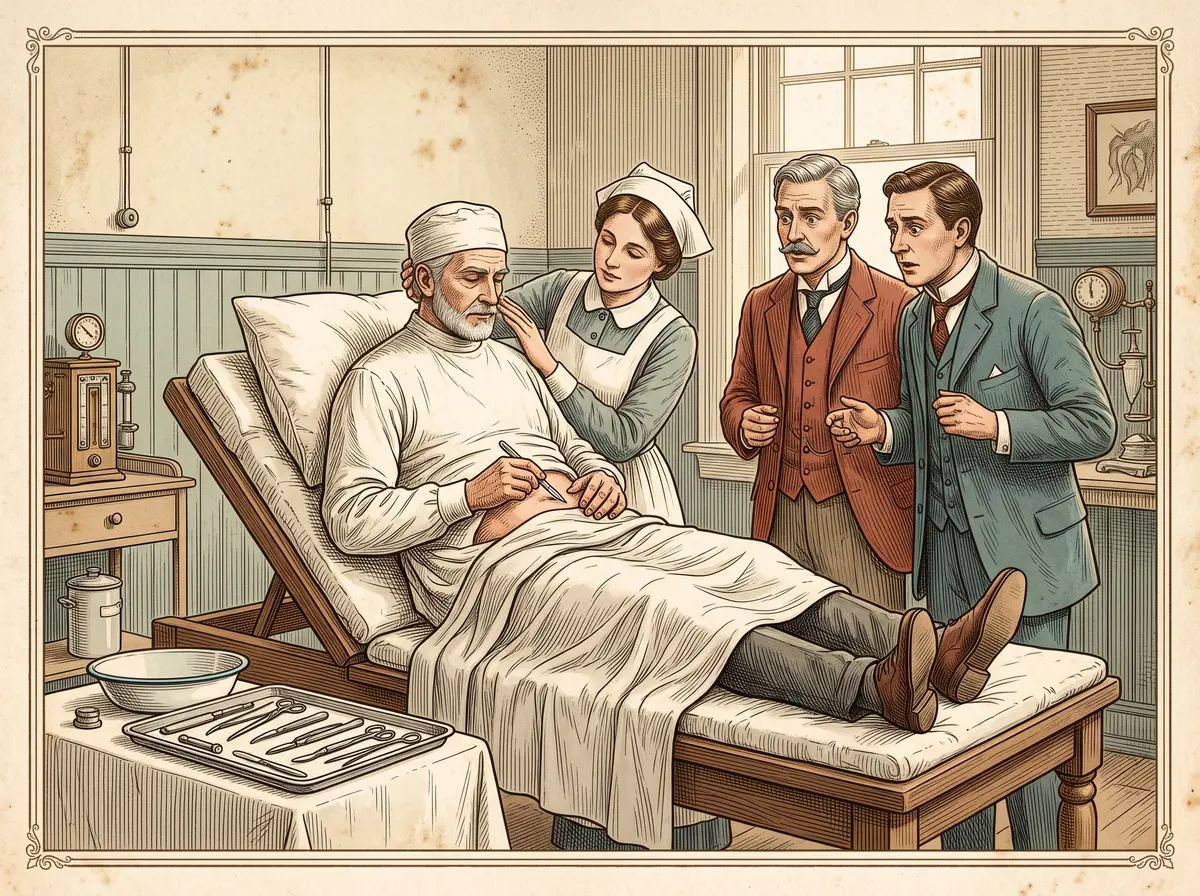
On February 15, 1921, in the small lumber town of Kane, Pennsylvania, a surgeon sat propped up on pillows on his own operating table, a nurse gently pushing his head forward so he could see. Dr. Evan O'Neill Kane had removed nearly 4,000 appendixes in his career. This time the abdomen in front of him was his own, and he was holding the scalpel.
By the Curiosities Desk · · 5 min read · Filed under Medicine · Today’s round
What happened: The Country Surgeon Who Took Out His Own Appendix to Prove a Point — and
Evan O’Neill Kane was born in Darby, Pennsylvania, in April 1861 and graduated from Jefferson Medical College in Philadelphia in 1884. A few years later his family founded a small hospital in the town that bore their name. It grew into Kane Summit Hospital, and Evan became its chief surgeon. He was a country doctor with a tinkerer’s streak who published a steady stream of practical ideas in medical journals.
One of the things he cared most about was anesthesia. In the early 20th century, most major operations were done under general anesthesia, usually ether, which put the patient fully unconscious. Ether worked, but it carried real risks, especially for people with weak hearts or lung trouble. Kane believed it was overused. He argued that many operations, including removing an appendix, could be done with a local anesthetic, a drug injected into the tissue to numb only the area being cut while the patient stayed awake.
Kane also had a problem of his own: chronic appendicitis, a long-running inflammation of the appendix. He needed the operation anyway. So he decided to be his own test case.
His own case report, published a month later in the International Journal of Surgery under the title “Autoappendectomy,” describes the plan. After a day of fasting and a dose of morphine, he injected the anesthetic into his skin and abdominal wall. His report names cocaine and adrenaline as the numbing mixture; many later retellings, starting with newspaper coverage at the time, say novocaine. He waited a few minutes for it to take effect, then made an incision about three and a half inches long.
He cut through the layers of the abdominal wall, tying off blood vessels as he went. At one point he tensed his stomach muscles without meaning to, and a few loops of intestine slipped out through the opening. They went back in without trouble. He found the appendix, an assistant held it steady while he tied it off, and he cut it free. His assistants then stitched the wound closed. The operation took about half an hour, and Kane reportedly grumbled that it would have gone faster if his staff hadn’t been so nervous.
Witnesses included his brother Tom and two other physicians. A few hours later, Kane told a reporter he felt fine, and he went home the next day.
Remarkably, that wasn’t the end of it. In 1919 he had already amputated one of his own infected fingers. And in January 1932, at age 70, he repaired his own inguinal hernia (a weak spot in the groin where tissue pushes through the abdominal wall), an injury from a horse-riding accident. This time a photographer was present. Press reports said he smiled and joked with the nurses. He grew drowsy near the end, and a younger colleague, Howard Cleveland, finished the stitching. Kane was reportedly back in the operating room about a day and a half later.
Why it was strange: The Country Surgeon Who Took Out His Own Appendix to Prove a Point — and
The whole setup of surgery, from the sterile drapes to the team around the table, assumes the person with the knife and the person on the table are two different people. Kane collapsed that distinction on purpose.
He also wasn’t stranded on an ice shelf or cut off from help. He had a fully staffed hospital and colleagues willing to operate on him. That makes his choice less about survival and more about evidence: he wanted to show his peers, and future patients, that the operation could be done awake. In his words to reporters, he now knew “exactly how the patient feels.”
More stories like this live on The Scientists Who Ran the Experiment on Themselves.
What scientists learned: The Country Surgeon Who Took Out His Own Appendix to Prove a Point — and
Kane’s report is valuable mainly as a first-person record of what local anesthesia did and didn’t block. He wrote that cutting and handling most of the tissue was manageable, but he felt “some discomfort” when tightening a tie around the appendix’s blood supply, and pain from some of the stitches. Moving his bowel around produced pain he felt near his belly button or on his left side, not at the spot being touched.
That fits what physiologists now understand about visceral pain, the pain from internal organs. The intestines are fairly insensitive to being cut but react strongly to stretching and pulling. And because the nerves serving the appendix enter the spinal cord at the same level as nerves from the skin around the navel, the brain often “maps” that pain to the middle of the belly. It’s the same reason appendicitis often starts as a vague ache near the belly button before settling in the lower right side.
One self-operation is a single case, not a clinical trial, but it was a detailed report from someone who knew exactly what he was feeling.
For the bigger picture, see From Laughing Gas Parties to the Operating Room: A Short History of Anesthesia.
How it reaches us today: The Country Surgeon Who Took Out His Own Appendix to Prove a Point — and
Local and regional anesthesia are now routine. Hernia repairs, many hand and eye operations, and countless minor procedures are done on awake patients every day, especially when general anesthesia would carry extra risk.
Self-surgery, meanwhile, remains rare and is reserved for true emergencies. The best-known later case came in 1961, when Soviet doctor Leonid Rogozov, the only physician at an Antarctic research station, removed his own inflamed appendix because there was no one else to do it.
Kane had another idea ahead of its time: in 1914 he described playing a phonograph to calm patients before they were put under. Music in the operating room is now common, and modern studies have found it can ease patients’ anxiety before surgery.
Another doctor who turned himself into the test subject: The Surgeon Who Threaded a Tube Into His Own Heart.
Fun fact: The Country Surgeon Who Took Out His Own Appendix to Prove a Point — and
Kane worried about babies getting mixed up in hospitals, so he proposed tattooing newborns and their mothers with matching marks. He is said to have signed his own work with a tiny Morse code “K” (dash, dot, dash) in India ink.
Please don’t try self-surgery. Persistent or worsening belly pain, especially on the lower right side, deserves a prompt visit to a doctor or emergency room. Appendicitis is very treatable when it’s caught early.
Sources: The Country Surgeon Who Took Out His Own Appendix to Prove a Point — and
- Kane EO. “Autoappendectomy: A case history.” International Journal of Surgery 34(3): 100–102 (March 1921). Summarized with full citation at Life in the Fast Lane: https://litfl.com/evan-oneill-kane/
- The Press (Christchurch), March 29, 1921, report on Kane’s operation, citing the New York Herald. Papers Past, National Library of New Zealand: https://paperspast.natlib.govt.nz/newspapers/CHP19210329.2.9
- Nwaogbe C, Simonds EA, D’Antoni AV, Tubbs RS. “Surgeons performing self surgery: A review from around the world.” Translational Research in Anatomy 10: 1–3 (2018). https://doi.org/10.1016/j.tria.2017.11.001
- Rogozov V, Bermel N, Rogozov LI. “Auto-appendectomy in the Antarctic: case report.” BMJ 339: b4965 (2009). https://doi.org/10.1136/bmj.b4965
- Hektoen International. “Atypical appendectomies” (2021). https://hekint.org/2021/07/13/atypical-appendectomies/