The Scientist Behind It · Medicine
The Scientist Who Burst His Own Eardrums — and Said It Let Him Blow Smoke Out of His Ears
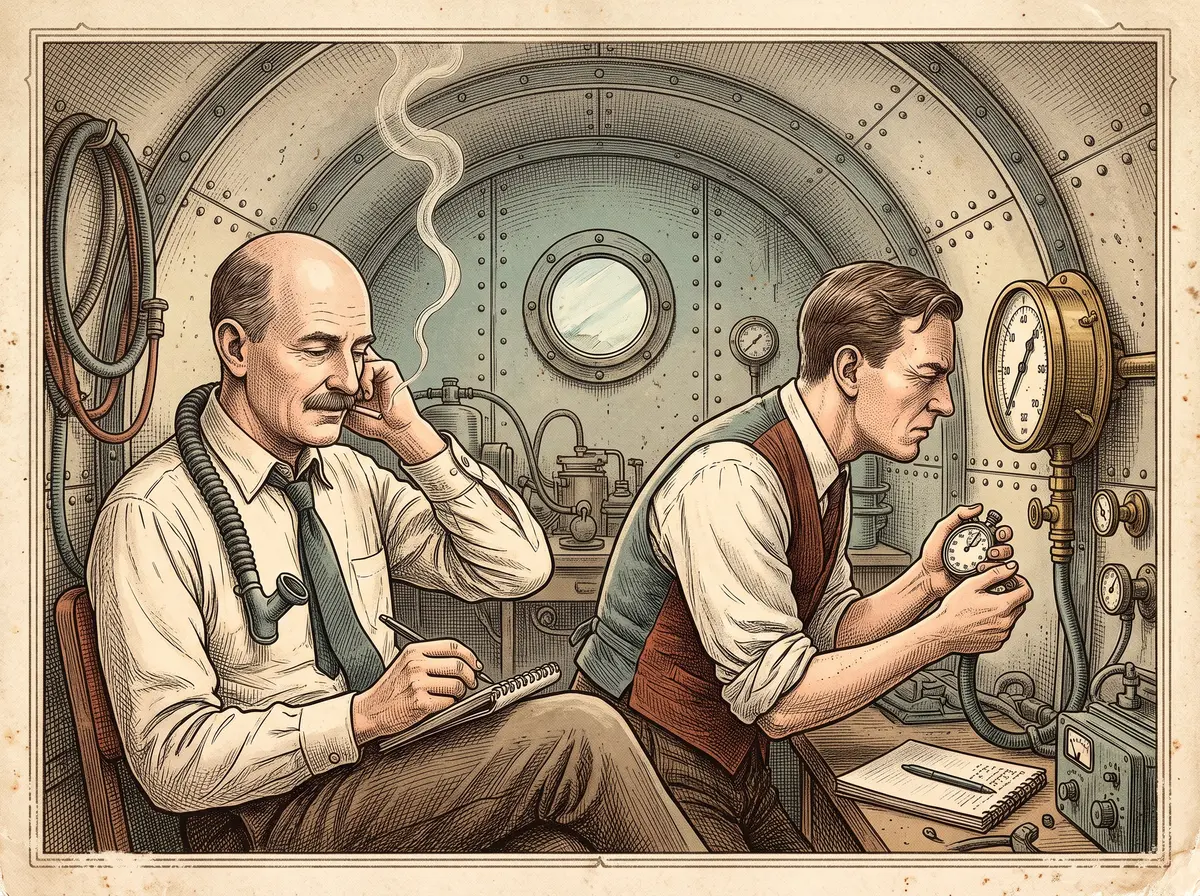
In the early 1940s, British scientist J.B.S. Haldane sealed himself inside a dark steel pressure chamber and let the air pressure climb, as he did again and again. The experiments burst eardrums, his own included. Haldane was unbothered. A torn eardrum usually heals, he explained, and if a small hole stays open, you can blow tobacco smoke out of that ear, which he called "a social accomplishment."
By the Curiosities Desk · · 5 min read · Filed under Medicine · Today’s round
What happened: The Scientist Who Burst His Own Eardrums — and Said It Let Him Blow Smoke
John Burdon Sanderson Haldane, born in Oxford in 1892, grew up as his father’s lab assistant. His father, the physiologist John Scott Haldane, studied what bad air does to miners and divers, often by breathing it himself. In 1906, at age 13, young J.B.S. tested an experimental diving suit in the sea during his father’s work for the Royal Navy.
As an adult he became a leading geneticist and physiologist, and he kept the family habit. To study what makes blood more acidic, he drank dilute hydrochloric acid. He sealed himself in an airtight room with 7% carbon dioxide and noted that it “gives one a rather violent headache.” In 1927 he wrote an essay about all this, titled “On Being One’s Own Rabbit.”
His most dangerous work started with a disaster. On June 1, 1939, the new submarine HMS Thetis sank during trials in Liverpool Bay. Of the 103 men aboard, 99 died; only four escaped. Haldane was drawn into the official inquiry and ran chamber tests on himself and volunteers, breathing stale, carbon-dioxide-heavy air like the air the trapped men had faced.
The Royal Navy then asked for more. Working with the diving-equipment company Siebe Gorman, Haldane and chemist Edwin Martin Case pressurized themselves in a small chamber to depths as great as 300 feet (about 91 meters) of simulated seawater. The chamber had no lights, since an electrical spark in that dense air could start a fire.
Under pressure, they did arithmetic and fiddly hand tasks while the nitrogen they breathed fogged their thinking. Case sat in cold water until he shook too much to finish a test. Haldane noted a toothache from a half-filled cavity and decided it was “a new type of bends.” The tooth was later pulled.
Breathing oxygen under pressure turned out to be the scariest part. According to diving researcher Rachel Lance, on May 31, 1940, Haldane’s face began to twitch during a test, the spasms spread to his limbs, and he blacked out while convulsing. Case yanked the breathing mouthpiece out of Haldane’s mouth. It was one of the first oxygen seizures ever recorded in a human.
The team kept going. Haldane’s colleague (and later wife), the biologist Helen Spurway, took part in hundreds of tests. Her seizures sometimes dislocated her jaw, which had to be popped back in inside the chamber. Another volunteer broke a vertebra in her back. Haldane’s own back was injured in one seizure, with accounts describing crushed vertebrae, and it never fully healed. All told, the group ran more than 600 tests on themselves, in air and in water.
Why it was strange: The Scientist Who Burst His Own Eardrums — and Said It Let Him Blow Smoke
We usually picture scientists watching an experiment from a safe distance. Haldane’s group was the experiment. In “On Being One’s Own Rabbit,” he argued that experimenting on yourself is often simpler than getting approval to experiment on animals.
The tone is just as surprising as the risk. Haldane wrote about burst eardrums the way most people write about a stubbed toe, and his famous smoke-ring line was a real description of what a perforated eardrum allows. That breezy tone could hide what the tests cost: dislocated jaws, broken backs, and seizures in a pitch-dark steel tube.
More stories like this live on The Scientists Who Ran the Experiment on Themselves.
What scientists learned: The Scientist Who Burst His Own Eardrums — and Said It Let Him Blow Smoke
First, why the smoke trick works. Your middle ear is an air-filled space behind the eardrum, connected to the back of your throat by a narrow passage called the Eustachian tube. When outside pressure rises fast and the tube cannot equalize it, the pressure difference can tear the eardrum. If the tear does not fully close, there is now an open path from mouth to throat to middle ear to the outside world. Puff with your mouth and nose shut, and smoke can drift out of the ear.
The bigger lessons were about gases. At depth, ordinary nitrogen acts like a drug, an effect called nitrogen narcosis. Divers still share a rough rule of thumb, sometimes called “Martini’s law,” that every 33 feet or so of depth feels like about one martini. Haldane and Case concluded that no “great trust should be placed in human intelligence under these circumstances.” Their 1941 paper also documented how carbon dioxide and cold made things worse under pressure.
Oxygen, the gas you need to live, turned out to be poisonous under enough pressure. Oxygen toxicity, damage caused by breathing oxygen at high pressure, can trigger sudden seizures. Spurway turned the team’s results into mathematical curves showing how the risk of a seizure grows with both the oxygen pressure and the time spent breathing it.
Another scientist who used his own body as the test equipment: The Doctor Who Rode a Rocket Sled at 632 MPH — and Gave Us Murphy’s Law.
How it reaches us today: The Scientist Who Burst His Own Eardrums — and Said It Let Him Blow Smoke
The work fed directly into the war effort. It helped prepare divers and the crews of X-craft, small submarines that scouted the Normandy beaches before D-Day and served as guide markers for landing craft. Divers using the team’s findings cleared underwater obstacles, and after the landings a diver in Cherbourg used a gas mixture developed by the group.
The principle behind Spurway’s curves, that oxygen’s danger depends on both pressure and time, is built into diving today. Recreational divers breathing oxygen-enriched air are taught to stay within set oxygen-pressure limits (commonly about 1.4 atmospheres while diving), and the same thinking shapes how hyperbaric medicine and navy dive tables handle oxygen.
Self-experiments like these would face a tough ethics review today, but the records they produced helped lay the foundation for those safety rules.
For another scientist who poked around behind his own eyeball, see The Needle Isaac Newton Slid Behind His Own Eyeball to Find Out Where Color Comes From.
Fun fact: The Scientist Who Burst His Own Eardrums — and Said It Let Him Blow Smoke
Haldane was a nonstop writer of popular science. His 1926 essay “On Being the Right Size,” which explains why a mouse can survive a fall that would kill a horse, is still widely read and taught nearly a century later.
A note on safety: ear pain, ringing, or muffled hearing after diving or flying can mean a damaged eardrum and deserves a check from a doctor. And if you smoke and want to quit, free support lines and apps can help. No smoke tricks required.
Sources: The Scientist Who Burst His Own Eardrums — and Said It Let Him Blow Smoke
- Case EM, Haldane JBS. “Human physiology under high pressure: I. Effects of nitrogen, carbon dioxide, and cold.” Journal of Hygiene 41(3): 225–249 (1941). https://doi.org/10.1017/s0022172400012432
- Lance R. “Developing Oxygen Toxicity Guidelines.” Alert Diver (Divers Alert Network), Fourth Quarter 2024. https://www.qgdigitalpublishing.com/article/DEVELOPING+OXYGEN+TOXICITY+GUIDELINES/4887383/835680/article.html
- University College London. “Did you know Haldane?” UCL News, March 10, 2006. https://www.ucl.ac.uk/news/2006/mar/did-you-know-haldane
- Smithsonian Magazine. “To Help the Allied War Effort, These Scientists Got Drunk on Nitrogen” (2024, adapted from Rachel Lance’s book Chamber Divers). https://www.smithsonianmag.com/history/to-help-the-allied-war-effort-these-scientists-got-drunk-on-nitrogen-180984147/
- The Sunday Post, feature on J.B.S. Haldane’s wartime experiments and D-Day, with historian Rachel Lance (2024). https://www.sundaypost.com/fp/d-day-jbs-haldane/