The 'Demon Core': The Plutonium Sphere That Killed Two Scientists
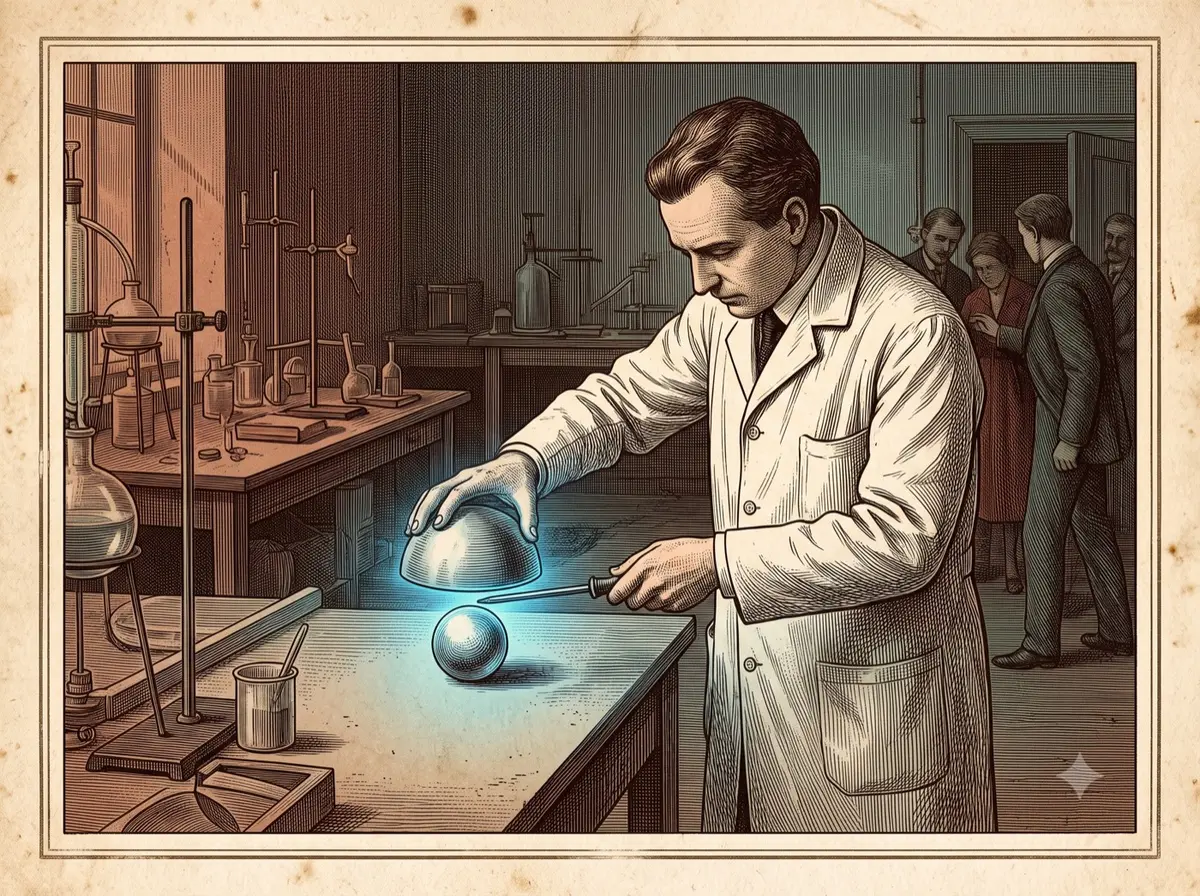
On May 21, 1946, a physicist at Los Alamos was holding two halves of a metal shell apart with the blade of a flathead screwdriver. Inside that shell sat a softball-sized sphere of plutonium. The screwdriver slipped. For a fraction of a second the room filled with a blue glow and a wave of heat, and Louis Slotin knew, instantly, that he was a dead man. He had nine days left.
By the Curiosities Desk · · 6 min read · Filed under Physics · Today’s round
Part of When Atoms Got Away From Us
What happened: The Demon Core
The sphere at the center of both tragedies was a 6.2-kilogram (about 14-pound) ball of plutonium, roughly 3.5 inches across — small enough to hold in two cupped hands, and warm to the touch from its own radioactivity. It was built during the Manhattan Project as the core of a third atomic bomb, intended for use against Japan if the war continued. Japan surrendered first, so the core stayed at Los Alamos, where scientists used it to study exactly how much nudging it took to push plutonium toward a runaway chain reaction. They were measuring the threshold of “criticality” — the point where a mass produces enough neutrons to sustain a self-amplifying nuclear reaction.
The first death came fast. On the evening of August 21, 1945, just days after the war ended, physicist Harry Daghlian was alone in the lab (with a security guard nearby), stacking bricks of tungsten carbide around the core. The bricks acted as a neutron reflector, bouncing escaping neutrons back into the plutonium and edging it toward criticality. As Daghlian moved to place one last brick, his instruments warned that it would tip the assembly over the line. He pulled back — but the brick slipped from his hand and dropped squarely onto the core. The assembly went supercritical. Daghlian instinctively knocked the brick away with his bare hand, exposing himself further to stop the reaction. He died of acute radiation syndrome 25 days later, on September 15, 1945.
Then it happened again. Louis Slotin, a Canadian-born physicist, was demonstrating a notoriously dangerous experiment to colleagues. The trick was to lower a beryllium shell around the same plutonium core, leaving a tiny gap so the assembly approached criticality without crossing it. Standard procedure called for safety shims to hold the gap open. Slotin instead balanced the upper shell on the tip of a screwdriver. When the blade slipped, the shell dropped shut, the core flashed supercritical, and witnesses saw the telltale blue glow. Slotin jerked the top shell off with his hand, ending the reaction within seconds and almost certainly saving the seven other men in the room. He absorbed a massive dose and died on May 30, 1946 — nine days after the accident.
Why it was strange: The Demon Core
The strangeness is how mundane the cause was. This was not a reactor meltdown or a bomb. It was a slipped screwdriver and a dropped brick — ordinary clumsiness, the kind that elsewhere costs you a bruise. But because the material was plutonium poised at the knife-edge of a chain reaction, a moment’s slip released an invisible, silent burst of neutron and gamma radiation. There was no explosion to throw anyone clear, no fire to run from. The men simply stood in a flash of blue light and then went back to work, even as the lethal dose was already inside them. After the second death, the plutonium ball earned a grim nickname among the staff: the “demon core.”
It shares a shelf with The Plan to Set Off a Nuclear Bomb on the Moon So Everyone Could Watch, in When Atoms Got Away From Us.
What scientists learned: The Demon Core
Both accidents taught the same brutal lesson about hands-on criticality work: a human reflex is far too slow and too unreliable to manage a reaction that grows in milliseconds. The experiments Slotin performed were known, only half-jokingly, as “tickling the dragon’s tail” — a phrase often credited to physicist Richard Feynman, who likened the work to teasing a sleeping monster. Enrico Fermi had reportedly warned the team that anyone who kept doing the experiment by hand would be “dead within a year.”
The science of the deaths themselves also advanced understanding of acute radiation syndrome — how a single overwhelming dose attacks the gut, blood, and immune system over days and weeks. The blue glow, often misremembered as the radiation itself, was actually the air around the core being ionized and fluorescing, a visible flag that a burst of energy had just passed through everyone present.
Also in When Atoms Got Away From Us: The Rocket That Exploded on Live TV and Got Called ‘Kaputnik’.
How it reaches us today: The Demon Core
The demon core deaths ended hand-assembled criticality experiments for good. Los Alamos and other labs replaced them with remote-controlled machines that bring fissile material together from a safe distance, with operators behind shielding — a principle that still governs how every nuclear facility handles dangerous material. The accidents also fed directly into the field of radiation dosimetry and the modern safety culture of “remote handling,” interlocks, and exposure limits that protect workers in nuclear power, medical isotope production, and research reactors. The two incidents are studied to this day in the Los Alamos report A Review of Criticality Accidents, which catalogs decades of such events so they need never be relearned the hard way.
As for the core itself: it was scheduled to be shipped to the Pacific for the Operation Crossroads weapons tests, but after Slotin’s death it was kept at Los Alamos. Later in 1946 it was melted down, and its plutonium was recycled into other cores. The demon core was never detonated.
Another from When Atoms Got Away From Us: The Flying Saucer the Air Force Built That Maxed Out at 35 MPH.
Fun fact: The Demon Core
The plutonium sphere ran a low fever all on its own. Plutonium-239 is mildly radioactive, and the core’s steady decay kept it noticeably warm — witnesses described it as feeling like a living thing, warm to the touch, which only deepened its eerie reputation once people started calling it a “demon.”
Sources: The Demon Core
- McLaughlin, Monahan, Pruvost, et al., A Review of Criticality Accidents (2000 Revision), Los Alamos National Laboratory report LA-13638 — https://www.osti.gov/biblio/759803
- “Demon core,” Wikipedia — https://en.wikipedia.org/wiki/Demon_core
- “Louis Slotin,” Atomic Heritage Foundation / National Museum of Nuclear Science & History — https://ahf.nuclearmuseum.org/ahf/profile/louis-slotin/
- “Harry Daghlian,” Atomic Heritage Foundation / National Museum of Nuclear Science & History — https://ahf.nuclearmuseum.org/ahf/profile/harry-daghlian/
A note: this story recounts the real, fatal accidents of two young scientists. Their deaths reshaped how the world handles radioactive material, and the safety systems that grew out of them protect lab workers to this day.
Related stories: The Demon Core
- Part of When Atoms Got Away From Us
- The Airplane That Carried a Nuclear Reactor — A bomber that flew with a live nuclear reactor aboard
- The Watch Painters Who Glowed in the Dark — The watch painters who licked radium brushes and glowed
- The Radioactive Tonic That Dissolved a Millionaire’s Jaw — A radium tonic that dissolved a millionaire’s jaw