Impossible Inventions · Engineering
The Flying Saucer the Air Force Built That Maxed Out at 35 MPH
In September 1959, on a tarmac outside Toronto, a genuine flying saucer prepared for takeoff. It was 18 feet across, perfectly circular, and built with U.S. military money at the height of UFO mania. The turborotor spun up, the disc rose from the ground — and immediately began wobbling like a coin dropped on a kitchen table, slamming each of its three wheels into the pavement in turn. The pilot fought it back down. The saucer had flown. Barely. And "barely" turned out to be its ceiling.
By the Curiosities Desk · · 5 min read · Filed under Engineering · Today’s round
Part of When Atoms Got Away From Us
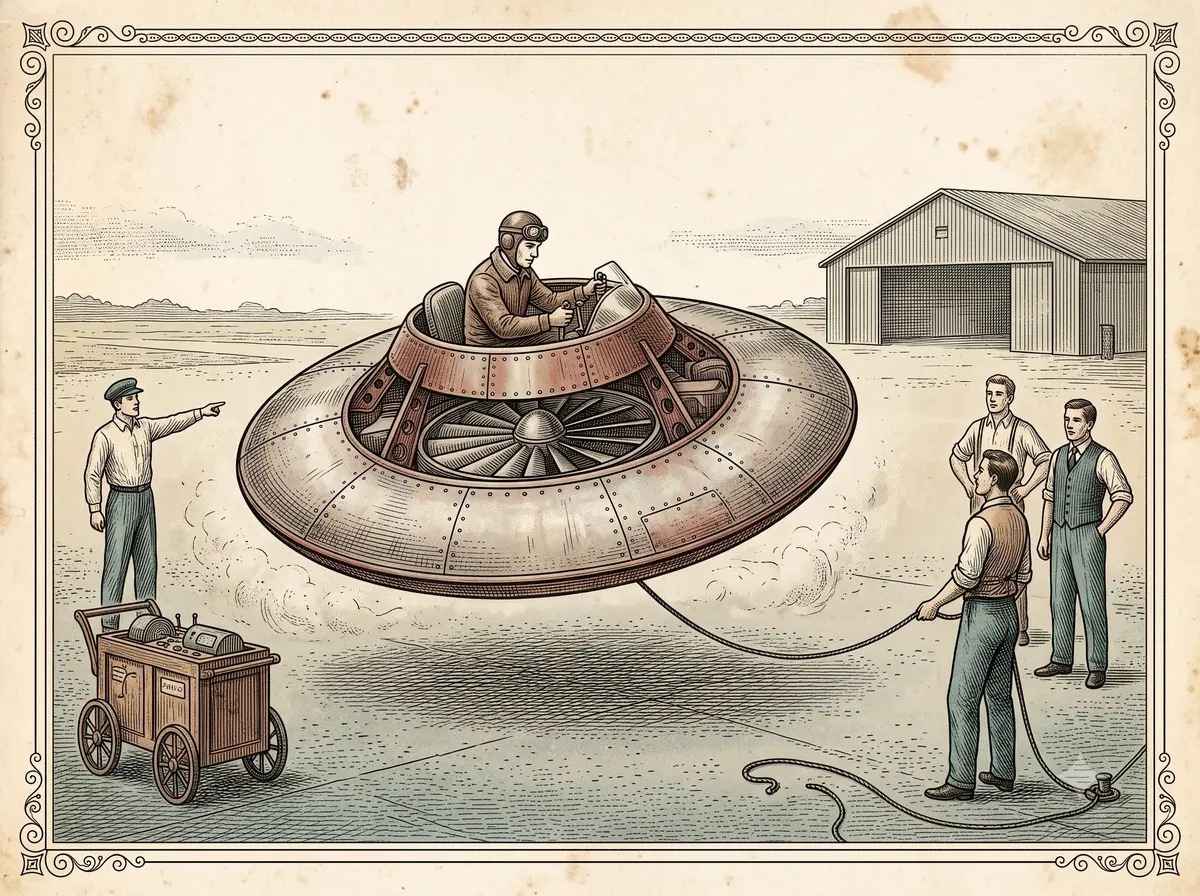
What happened: The Avrocar Flying Saucer
The story starts in 1952 at Avro Canada, an aircraft company near Toronto, where a British-born engineer named John “Jack” Frost led a design group working on a radical idea: a vertical-takeoff-and-landing (VTOL) aircraft — one that could rise straight up without a runway — shaped like a circular disc. Canada’s Defence Research Board put in an initial CAN$400,000, then backed out as costs climbed.
Frost found a new patron in 1953, when a U.S. delegation touring the plant was steered into his Special Projects area and shown mock-ups of a fully disc-shaped aircraft. The U.S. Air Force took over funding, and over the years the effort accumulated a stack of code names — Project Y, WS-606A, Project Silver Bug, and finally Project 1794. The specifications for Project 1794, later declassified, read like science fiction: a saucer that would streak along at Mach 3 to Mach 4 (three to four times the speed of sound), climb above 100,000 feet, and hover below enemy radar before rocketing up to intercept Soviet bombers.
The physics behind it was real. Frost planned to exploit the Coandă effect — the tendency of a fast-moving fluid, like jet exhaust, to cling to a curved surface — to bend a ring of exhaust around the saucer’s rim. Directed downward, the exhaust would form a cushion of air for hovering; directed backward, it would push the craft forward and up.
By 1958, the program had been scaled down into a modest two-seat test vehicle funded by both the U.S. Air Force and the U.S. Army, who wanted very different things from it. The Air Force still dreamed of a supersonic interceptor; the Army wanted a kind of flying jeep that could carry troops over any terrain. The result was designated the VZ-9AV Avrocar: 18 feet in diameter, 4,620 pounds empty, powered by three small Continental J69 turbojets whose exhaust spun a central fan.
Two were built. On September 29, 1959, test pilot W. D. “Spud” Potocki’s colleagues watched the first tethered hover attempt end in that violent, wheel-slamming oscillation. The first free flight followed on November 12, 1959. Testing continued for two more years, at Avro and in NASA’s giant wind tunnel at Ames Research Center in California, and every test agreed: whenever the Avrocar climbed more than about three feet off the ground, it began pitching and rolling uncontrollably. The engineers called the motion “hubcapping,” after a hubcap wobbling on pavement. Its top speed was 35 miles per hour. Every fix failed, and in December 1961 the project was cancelled. Avro Canada itself shut down operations the following year.
Why it was strange: The Avrocar Flying Saucer
Every part of the Avrocar is a collision between ambition and reality. This was a real flying saucer — secretly commissioned by the U.S. military during the exact years Hollywood filled theaters with saucer invasion movies and newspapers filled with UFO sightings. If a farmer had glimpsed an Avrocar test in 1959, he would have reported a flying saucer and been completely correct.
And yet the performance gap may be the widest in aviation history. The paperwork promised Mach 3 and 100,000 feet. The hardware delivered 35 mph at 3 feet — slower than a charging elephant, at roughly the altitude of a kitchen counter. The Avrocar didn’t so much fly as hover-taxi on its own cushion of air, wobbling anytime it tried to leave that cushion behind.
It shares a shelf with The Airplane That Carried a Nuclear Reactor, in When Atoms Got Away From Us.
What scientists learned: The Avrocar Flying Saucer
The Avrocar was, in effect, an accidental hovercraft. The air cushion that held it up near the ground — what engineers call ground effect — vanished as it climbed, and with it went the craft’s stability. The Coandă effect that looked so promising in steady laboratory conditions proved treacherous in messy, dynamic free flight, and the saucer shape offered almost no natural stability for the control systems of the era to lean on. Wind tunnel tests at NASA Ames confirmed the aircraft was aerodynamically unstable and had insufficient control for high-speed flight — the disc, it turned out, is a shape better suited to Frisbees, which stabilize themselves by spinning.
The program also became a case study in mismatched requirements: no single vehicle could be both the Air Force’s supersonic interceptor and the Army’s flying jeep, and chasing both doomed it to be neither.
The same thread — Declassified — continues in The Plan to Set Off a Nuclear Bomb on the Moon So Everyone Could Watch.
How it reaches us today: The Avrocar Flying Saucer
The Avrocar’s DNA survived in machines that embraced what it accidentally proved. Practical hovercraft, which deliberately ride on a contained air cushion instead of trying to escape it, matured in the same era and went on to ferry passengers and military cargo. The dream of runway-free flight was eventually realized by aircraft like the Harrier jump jet and the F-35B, which use directed jet thrust — the Avrocar’s core idea — bolted to a conventional, stable airframe. And when the U.S. National Archives declassified the Project 1794 documents in 2012, complete with cutaway drawings of a Mach-4 saucer, it handed historians something wonderful: official government blueprints for a flying saucer, stamped and dated, that explain a few Cold War “UFO” sightings rather better than visitors from space do.
Both Avrocars still exist. The flight-test vehicle sits in the U.S. Army Transportation Museum at Fort Eustis, Virginia; the wind tunnel vehicle is displayed at the National Museum of the U.S. Air Force in Dayton, Ohio, where anyone can walk up and inspect an authentic flying saucer.
Also in When Atoms Got Away From Us: The ‘Demon Core’: The Plutonium Sphere That Killed Two Scientists.
Fun fact: The Avrocar Flying Saucer
When the National Archives released the Project 1794 files in September 2012, the U.S. government confirmed, in writing, that it had once ordered a flying saucer designed to hit Mach 4 at 100,000 feet. The one it actually got could legally be overtaken by a school bus.
Sources: The Avrocar Flying Saucer
- Avro Canada VZ-9AV Avrocar fact sheet, National Museum of the United States Air Force — primary source on the program, testing, and specifications
- Project 1794 Documents (Saucer-Type Aircraft), U.S. Air Force Declassification Office
- “How to Build a Flying Saucer,” U.S. National Archives declassification blog, 2012
- Avro Canada VZ-9 Avrocar, Wikipedia — overview with citations to program histories
Related stories: The Avrocar Flying Saucer
- Part of When Atoms Got Away From Us
- The Rocket-Powered Wheel That Chased Britain’s Admirals Into Barbed Wire — A rocket-propelled wheel that chased its inventors across the beach
- The Bomb Full of Sleeping Bats That Burned Down Its Own Air Base — Bats carrying tiny incendiaries burned down the base that built them
- The Truck Driver Who Flew a Lawn Chair to 16,000 Feet on 42 Weather Balloons — A truck driver flew a lawn chair to 16,000 feet on weather balloons