Weird Medical History · Medicine
The Watch Painters Who Glowed in the Dark
The radium dial painters of Orange, New Jersey — later called the Radium Girls — sometimes dusted their teeth, nails, and eyelids with a pale, glittering powder before a night out, then flipped off the lights to show off smiles that shone in the dark. It was a private trick from the factory floor. The powder was radium. Within a decade, some of those same women would be unable to raise their arms to take an oath in court.
By the Curiosities Desk · · 6 min read · Filed under Medicine · Today’s round
What happened: The Radium Girls
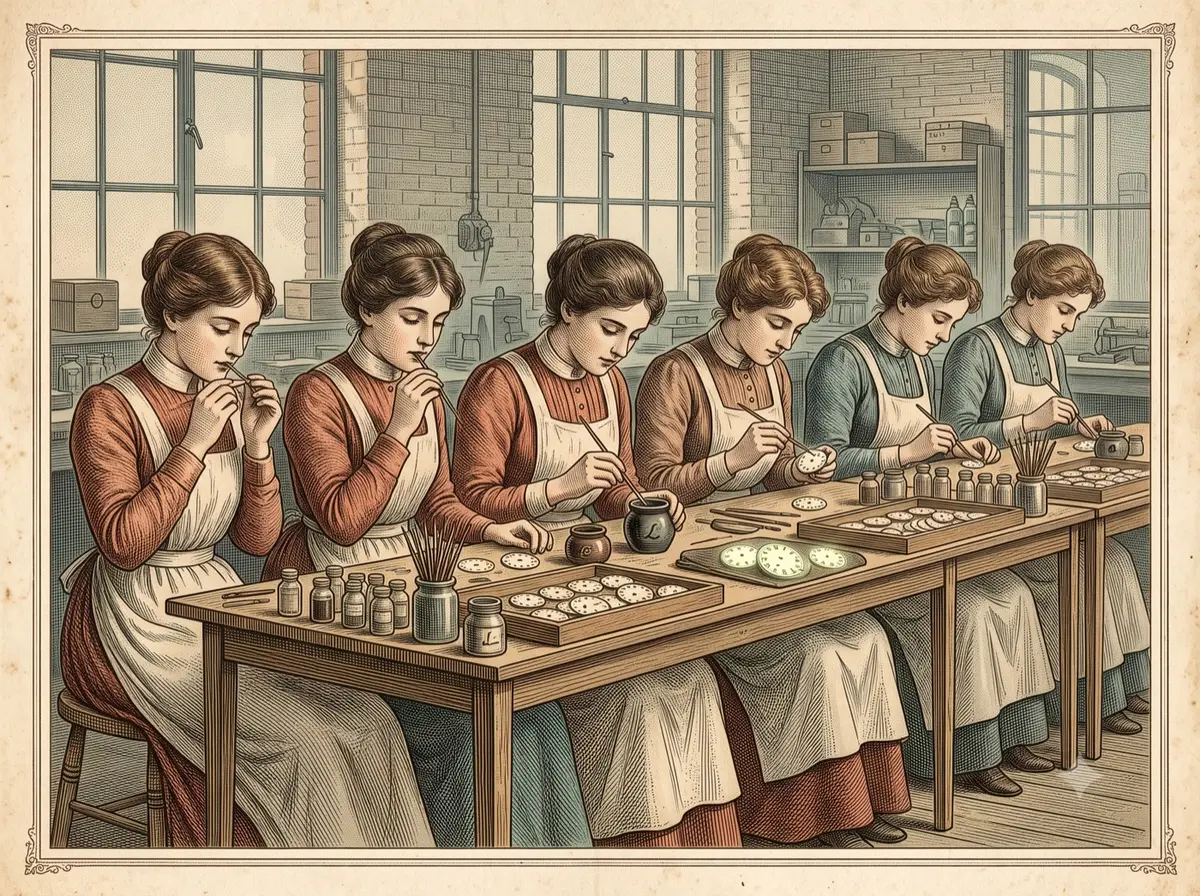
Starting around 1917, the United States Radium Corporation (USRC) hired young women — most in their teens and twenties — at a plant in Orange, New Jersey, to paint luminous numbers onto watch and clock dials and military instrument faces. The paint, marketed under the brand name Undark, was a mixture of powdered radium, zinc sulfide (a chemical that glows when struck by radiation), and gum arabic. Similar operations opened soon after in Ottawa, Illinois, and Waterbury, Connecticut. Together, these dial-painting studios employed an estimated 4,000 workers across the U.S. and Canada.
The work was fine, exacting, and piece-rate: painters earned about a penny and a half per dial, and could make roughly $3.75 for a shift of 250 dials — good money for young women at the time. But the fine camel-hair brushes lost their point after a stroke or two, and rinsing them in water or wiping them on a rag wasted time and material. So supervisors taught the women a technique nicknamed “lip, dip, paint”: moisten the brush tip between your lips to bring it to a point, dip it in the radium paint, paint the dial, then repeat. Each pass left a small amount of radium in the painter’s mouth.
The company knew radium was dangerous. Chemists in the same building who handled the raw material used lead screens, tongs, and masks. The dial painters were given none of that. Meanwhile, radium was marketed elsewhere in the culture as a wonder substance — an ingredient in tonics, cosmetics, and even a “cure-all,” so the idea that a little radium paint on a paintbrush was harmless didn’t strike most workers as reckless.
By the early 1920s, painters began falling ill: aching jaws, loose teeth that wouldn’t heal after extraction, and mysterious anemia. In 1922, one dial painter died with her jaw disintegrating; by 1924, about fifty women who had worked at the Orange plant were sick and a dozen had died. USRC’s own chief chemist died of similar symptoms. The company, facing an outside investigation from Harvard researchers Cecil and Katherine Drinker, reportedly altered an unfavorable report before submitting it to New Jersey’s labor department — a fact that came to light only because a Harvard colleague, Alice Hamilton, caught the discrepancy. Doctors on the company’s payroll blamed syphilis and other causes; the women’s dentists disagreed. Newark County physician Harrison Martland spent the mid-1920s methodically tracing the poisoning back to radium ingested at work, publishing his findings in 1925.
In 1927, five badly ill former painters — Grace Fryer, Edna Hussman, Katherine Schaub, Quinta McDonald, and Albina Larice — became known as “the Radium Girls” after finally finding an attorney willing to sue USRC. By their first court appearance in January 1928, none of the women could lift an arm to be sworn in. The case settled that autumn: $10,000 each, plus a lifetime annuity and coverage of medical costs. Similar, longer legal battles played out among dial painters in Ottawa, Illinois, through the 1930s, reaching the U.S. Supreme Court in 1939.
Why it was strange: The Radium Girls
The eeriest part isn’t just that a workplace made people sick — it’s that the harm was engineered into a habit dressed up as diligence. “Lip, dip, paint” turned good work ethic into a delivery mechanism for poison, stroke by stroke, over years. And the women didn’t discover the danger through secrecy alone; they were actively told the opposite of the truth, encouraged to paint their nails and teeth with the same radium paint for fun, while the company’s own chemists worked the material at arm’s length behind lead shielding one floor away.
It shares a shelf with The Radioactive Tonic That Dissolved a Millionaire’s Jaw, in Cures That Were Worse Than the Disease.
What scientists learned: The Radium Girls
Radium is chemically similar to calcium, so the body treats it like calcium and deposits it in bone. Once lodged there, radium’s alpha radiation — a short-range but highly damaging form of radiation — irradiates bone tissue continuously from the inside, causing anemia, bone fractures, tumors, and the jaw destruction that came to be called “radium jaw.” Because radium-226 has a half-life of about 1,600 years, the dose keeps accumulating rather than fading. Physicist Robley Evans’s careful measurements of radium retained in the bodies of surviving dial painters, beginning in the 1930s at MIT, became the data set that the National Bureau of Standards used in 1941 to set the first formal “tolerance dose” for internal radium exposure — a foundational moment for the field that became health physics, the study of how to work safely around radiation.
Also in Cures That Were Worse Than the Disease: The Doctor Who Toured America in a ‘Lobotomobile’.
How it reaches us today: The Radium Girls
The Radium Girls’ court cases helped establish a legal principle that seems obvious now but wasn’t guaranteed then: that a company can be held liable for occupational disease, not just sudden accidents. The publicity around their illness and their legal fight is widely credited as a factor in the eventual passage of clearer occupational-disease compensation laws, including a 1949 U.S. law extending compensation to workers suffering diseases caused by their jobs. The radiation dose limits used across medicine, nuclear power, and research today trace part of their lineage to Evans’s radium studies. Argonne National Laboratory ran a long-term health study of surviving dial painters from 1968 to 1993, and decades later, some dial painters’ graves and former factory sites — including a Superfund cleanup site in New Jersey — still register elevated radioactivity, a physical reminder that measured in radium’s 1,600-year half-life, almost nothing about this story is really over.
Another from Cures That Were Worse Than the Disease: When Doctors Recommended Cigarettes.
Fun fact: The Radium Girls
In 2015, one of the last known surviving Radium Girls, Mabel Williams, died at age 104 — remarkably healthy for someone who had worked as a dial painter for years. Her explanation: she’d always refused to “tip” her paintbrush with her lips, because, she said, she “didn’t think that was a good idea.”
Sources: The Radium Girls
- Coursey, Bert M. “The National Bureau of Standards and the Radium Dial Painters.” Journal of Research of the National Institute of Standards and Technology, 126, 2021.
- Wikipedia: “Radium Girls” (cross-referenced with underlying citations)
- New Jersey Department of Environmental Protection, “Radium Girls: The Story of US Radium’s Superfund Site,” Preservation Snapshot.
- Harvard T.H. Chan School of Public Health, “Deadly Occupation, Forged Report.”
- NPR, “Mae Keane, One Of The Last ‘Radium Girls,’ Dies At 107.”
Related stories: The Radium Girls
- Eben Byers and the Radium Water That Dissolved His Jaw — Eben Byers and the radium water that took his jaw
- Part of Cures That Were Worse Than the Disease
- The Shoe-Store X-Ray Machine That Kids Begged to Use — Shoe stores that x-rayed children’s feet for fun
- The ‘Demon Core’: The Plutonium Sphere That Killed Two Scientists — A plutonium sphere that killed two scientists in two separate accidents