The Radioactive Tonic That Dissolved a Millionaire's Jaw
By the time a government lawyer arrived at Eben Byers's mansion in 1931, the radium water had worked fine until his jaw came off. The champion golfer could barely speak. Most of his upper and lower jaw had been surgically removed. Holes were forming in his skull. And on the table beside him, very possibly, sat another little half-ounce bottle of the radioactive water he had been cheerfully drinking, several times a day, for years — convinced it was making him healthier.
By the Curiosities Desk · · 6 min read · Filed under Medicine · Today’s round
What happened: The Radioactive Tonic That Dissolved a Millionaire's Jaw
Ebenezer McBurney Byers was the kind of man the 1920s adored. Born in Pittsburgh in 1880, schooled at Yale, he was a wealthy industrialist who ran the Girard Iron Company and a genuinely gifted athlete — the U.S. Amateur golf champion of 1906. He was rich, charming, and used to getting what he wanted.
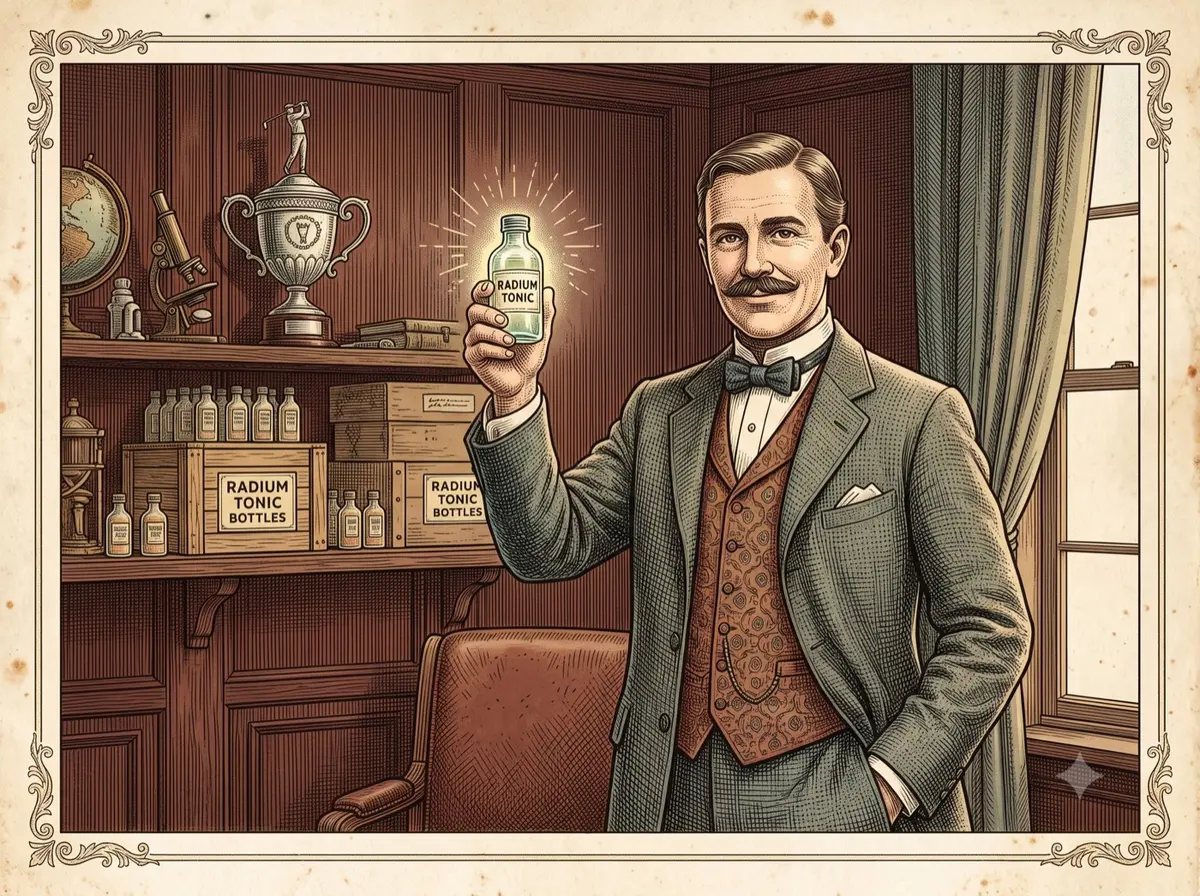
In 1927, Byers hurt his arm falling from a railway sleeping berth. The pain lingered, and a physician suggested a fashionable remedy: Radithor, a “health tonic” sold in tiny half-ounce bottles. Each one was distilled water laced with at least one microcurie each of two radium isotopes, radium-226 and radium-228. It was, quite literally, radioactive water sold as medicine.
Byers loved it. He said it gave him a “toned-up feeling,” and he drank it lavishly — several doses a day — recommending it to friends and reportedly sending cases to lady acquaintances and even to his racehorses. He kept this up until late 1930, by which point he had consumed roughly 1,400 bottles.
Then the toned-up feeling faded, and far worse arrived. He lost weight. His head ached constantly. His teeth began falling out. The radium he had swallowed had behaved chemically like calcium and lodged in his bones, where it irradiated him from the inside. His jawbone began to rot, a condition grim enough to earn its own name: radium jaw. The factory workers who developed the same injury — the radium dial painters — are a different story. Surgeons removed most of it. When the Federal Trade Commission asked Byers to testify in 1931, he was too sick to travel; the lawyer who took his statement at home reported that nearly his entire jaw was gone and that “all the remaining bone tissue of his body was disintegrating.”
Eben Byers died on March 31, 1932, at age 51. He was buried in Pittsburgh’s Allegheny Cemetery in a lead-lined coffin.
Why it was strange: The Radioactive Tonic That Dissolved a Millionaire's Jaw
The strangest part isn’t that a poison killed a man. It’s that he paid a premium to drink it, believed it was a luxury wellness product, and was egged on by the medicine of his day.
Radithor was the flagship product of William J. A. Bailey, a Harvard dropout who falsely styled himself a doctor of medicine. He marketed his radium water as “Perpetual Sunshine” and “A Cure for the Living Dead,” claiming it stimulated the endocrine system and cured everything from fatigue to impotence. Crucially, he offered prescribing physicians a kickback — a cut of every dose — which is part of why a respectable doctor handed Byers a bottle in the first place. Between 1925 and 1930, the Bailey Radium Laboratories of East Orange, New Jersey, sold an estimated 400,000 bottles.
This wasn’t a fringe scam. In the 1920s, radium was the wonder-substance of the age, the glowing element that had won Marie Curie two Nobel Prizes. It turned up in toothpaste, face cream, suppositories, and water “energizers.” The assumption was that something so powerful and so expensive — radium cost a fortune per gram — must be good for you. Byers wasn’t a fool falling for an obvious trick. He was a sophisticated man trusting the cutting edge of science exactly as his culture told him to.
It shares a shelf with The Battlefield Maggots That Became a Prescription Medical Device, in Cures That Were Worse Than the Disease.
What scientists learned: The Radioactive Tonic That Dissolved a Millionaire's Jaw
Radithor worked, in a sense, exactly as a physicist would predict — just not the way Bailey advertised. Radium emits alpha, beta, and gamma radiation. Alpha particles barely penetrate skin and are usually harmless on the outside of the body. But once you swallow radium, your skin’s protection no longer applies. The radium settles into bone, and those intensely ionizing alpha particles deposit their energy directly into living tissue, shredding cells from within. The result is bone death, anemia, and cancer.
Byers’s body became a long-running scientific case study. After his remains were exhumed in 1965, MIT physicist Robley Evans estimated his total radium intake at around 1,000 microcuries. His bones were still dangerously radioactive more than three decades after death; a later measurement put the activity at 225,000 becquerels, against roughly 4,400 becquerels for the natural potassium-40 in an ordinary human body. Evans, who also measured radium in the radium dial painters, used such cases to help establish the first scientific limits on how much radioactive material the human body can safely carry — standards that still underpin radiation protection today.
The same thread — Radium — continues in The Watch Painters Who Glowed in the Dark.
How it reaches us today: The Radioactive Tonic That Dissolved a Millionaire's Jaw
When Byers died, the FDA had warned against Radithor but lacked the legal power to ban it. The tonic was, on paper, exactly what it claimed to be — radium in water — so there was no “fraud” in the labeling. That loophole became impossible to ignore once a celebrity athlete had visibly disintegrated from a product sold as medicine.
The Federal Trade Commission moved against Bailey, and the case fed directly into a broader reform push. In 1938, Congress passed the Federal Food, Drug, and Cosmetic Act, which for the first time required that products be shown to be safe before sale and gave the FDA real teeth. Every time a modern drug or supplement carries safety testing behind it, there’s a faint line back to the man whose jaw came off. The episode is now a textbook example of why “natural,” “powerful,” or “expensive” are not the same as “safe” — a caution that still applies to today’s unregulated wellness products.
Also in Cures That Were Worse Than the Disease: The Doctor Who Toured America in a ‘Lobotomobile’.
Fun fact: The Radioactive Tonic That Dissolved a Millionaire's Jaw
The most famous account of Byers’s death is a 1990 Wall Street Journal front-page article by Ron Winslow, which carried one of the great headlines in the history of science journalism: “The Radium Water Worked Fine Until His Jaw Came Off.” (One myth worth retiring, though: the ghastly photos of a jawless man often passed around online as Byers actually come from a 1942 government surgical manual about war injuries, and the subject was never identified as him.)
Sources: The Radioactive Tonic That Dissolved a Millionaire's Jaw
- Macklis, Roger M. “Radithor and the Era of Mild Radium Therapy.” JAMA, vol. 264, no. 5, August 1, 1990, pp. 614–618. https://doi.org/10.1001/jama.1990.03450050072031
- Winslow, Ron. “The Radium Water Worked Fine Until His Jaw Came Off.” Wall Street Journal, August 1, 1990, p. A1.
- Oak Ridge Associated Universities, Health Physics Historical Instrumentation Museum Collection: “Radithor.” https://www.orau.org/health-physics-museum/collection/quackery/radithor.html
- Jorgensen, Timothy J. “When ‘energy’ drinks actually contained radioactive energy.” The Conversation, November 2, 2016. https://theconversation.com/when-energy-drinks-actually-contained-radioactive-energy-68045
- “Eben Byers” and “Radithor,” Wikipedia (used as a starting point and cross-checked against the cited sources above). https://en.wikipedia.org/wiki/Eben_Byers
A note on this story: it ends in a preventable death from a product that was sold as medicine. If you’re weighing a supplement or “wellness” remedy that promises dramatic results, it’s worth checking whether it’s actually regulated and talking it over with a doctor or pharmacist — the safeguards Byers never had are exactly what came out of his story.
Related stories: The Radioactive Tonic That Dissolved a Millionaire's Jaw
- The Radium Dial Painters Who Glowed in the Dark — The radium dial painters later called the Radium Girls
- Part of Cures That Were Worse Than the Disease
- The Goat-Gland Surgery That Ended Up Rewriting American Radio Law — Goat glands, quack surgery, and the reason radio has rules
- When Doctors Recommended Cigarettes — Doctors once appeared in cigarette ads recommending brands