The Navy That Swapped Lemons for Limes — and Forgot How to Cure Scurvy
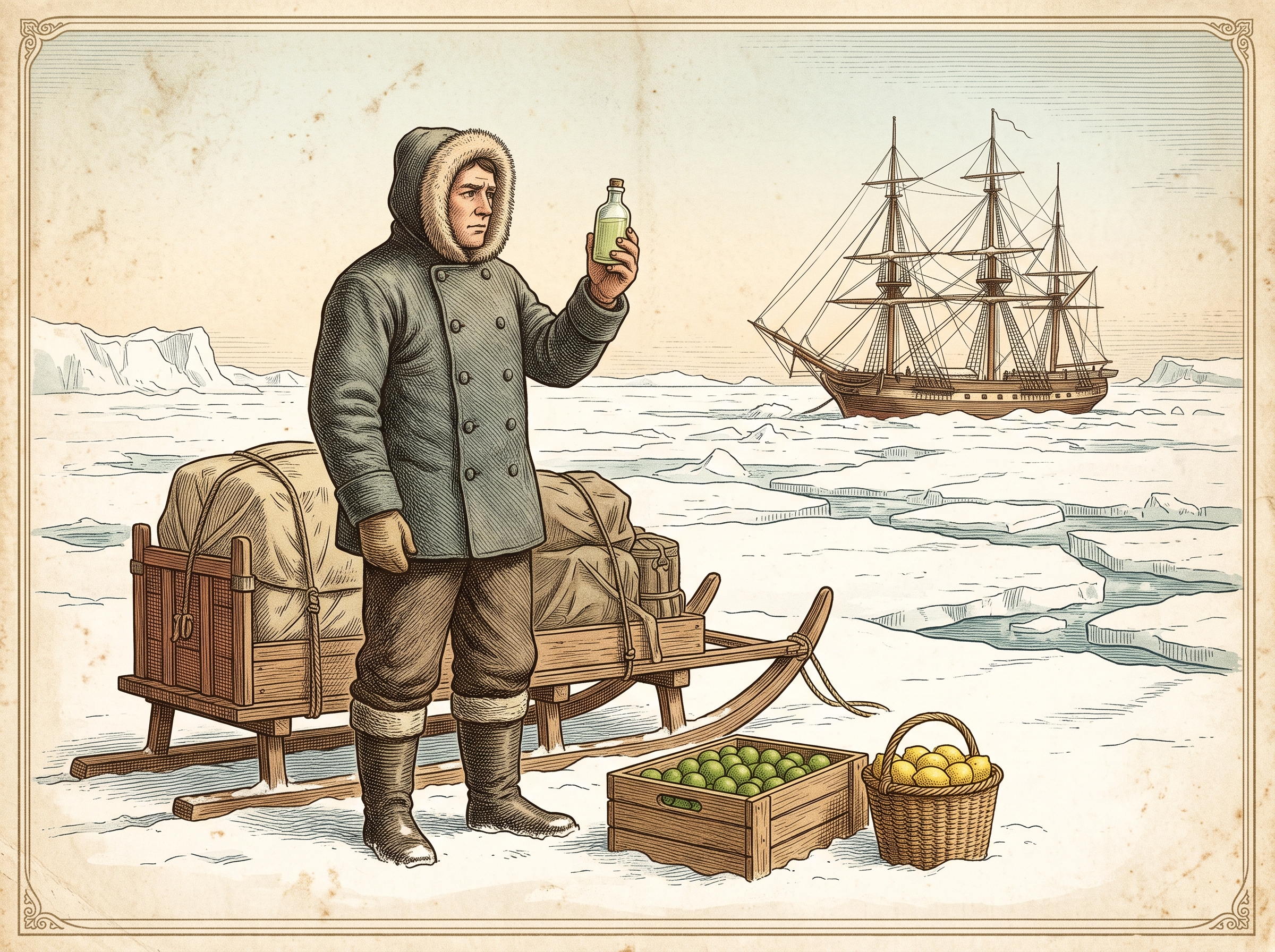
In the spring of 1876, sailors of the British Arctic Expedition were dragging sledges across the frozen sea north of Greenland when their gums began to swell and old wounds began to reopen. It was scurvy — a disease the Royal Navy had beaten eighty years earlier. Some of the men who fell ill had never missed their daily ration of the cure. The cure, it turned out, had quietly stopped working.
By the Curiosities Desk · · 6 read · Filed under Medicine · Today’s round
What happened?
The story starts with one of the most famous experiments in medicine. On May 20, 1747, aboard HMS Salisbury, the Scottish naval surgeon James Lind took 12 sailors with scurvy and split them into six pairs. Each pair got a different remedy: cider, a dilute acid called elixir of vitriol, vinegar, seawater, a purgative paste, or two oranges and a lemon a day. The fruit ran out after six days, but that was enough. The two citrus eaters recovered; the others did not.
It took decades for the Navy to act on it, but in 1795 the Admiralty began issuing lemon juice to its fleets. Between 1795 and 1814 it handed out about 1.6 million gallons. Scurvy, which had killed sailors by the thousands, faded from the Royal Navy. In 1844 Parliament made “lime or lemon juice” compulsory on merchant ships too.
Notice that phrase: lime or lemon. In the 1800s the two words were often used interchangeably for sour citrus, and that looseness set up the mistake.
In 1860, the Admiralty’s contract switched from Mediterranean lemons — grown in places like Malta and Sicily — to limes from the British West Indies. The reasons were practical. Limes grew in Britain’s own Caribbean colonies, which made them cheaper and easier to get, and plantations on the island of Montserrat were ramping up to supply them. Limes are also more acidic than lemons, and at the time many people assumed acidity was what fought scurvy. Since nobody could measure the actual anti-scurvy ingredient, juice was graded on how sour it was. By that test, limes looked like an upgrade.
They weren’t. Limes carry roughly half the vitamin C of lemons. And the juice sailors drank wasn’t fresh: it was pressed, stored, and shipped for months, losing more potency along the way.
For years, nobody noticed. Steamships were making voyages shorter, and sailors in port could get fresh food, so the weak juice was rarely put to a real test.
The Arctic provided one. In 1875, Captain George Nares led HMS Alert and HMS Discovery north to try for the North Pole. The ships froze in for the winter, and in spring the men set out man-hauling heavy sledges across the ice. One party, led by Commander Albert Hastings Markham, reached 83°20′N, a new record for farthest north. But scurvy spread through the sledging crews, and several men died. By one naval historian’s count, about 60 of the roughly 120 men were affected.
An official inquiry in 1877 blamed Nares for letting sledge parties leave without lime juice, which was awkward to carry because it froze solid. That explanation never quite fit, though: some men who had stayed aboard ship and taken their lime juice every day got scurvy anyway.
Why was it strange?
Medicine usually moves forward. Here, it slid backward. A cure that had worked reliably for generations seemed to fail, and doctors reasonably concluded that maybe citrus had never been the answer.
New theories rushed into the gap. A popular one held that scurvy was a kind of food poisoning caused by “ptomaines” — toxins produced by bacteria in badly preserved tinned meat. The influential bacteriologist Sir Almroth Wright argued scurvy was an “acid intoxication” of the blood. These ideas weren’t foolish; germ theory was the exciting new science of the day, and it was explaining disease after disease. But they sent polar explorers, including Robert Falcon Scott’s 1901–04 Discovery expedition, to inspect their tins carefully instead of packing better food.
The deepest irony: the Navy hadn’t lost the cure through carelessness. It lost it by trying to measure quality — and measuring the wrong thing.
Another good intention with a bad landing: The Radioactive Tonic That Dissolved a Millionaire’s Jaw.
What did scientists learn?
The breakthrough came by accident, from an animal. In 1907, the Norwegian researchers Axel Holst and Theodor Frølich were studying “ship beriberi,” a disease affecting sailors, and fed guinea pigs a diet of grain. Instead of beriberi, the animals developed something that looked exactly like human scurvy.
They had stumbled onto a lucky choice. Most mammals make their own vitamin C. Humans, other apes and monkeys, and guinea pigs can’t, because a gene needed for the last step of that chemistry no longer works. Had Holst and Frølich used rats, they’d have seen nothing.
With an animal model, scurvy could finally be tested in the lab. In 1918, Harriette Chick and Ruth Skelton at London’s Lister Institute fed guinea pigs measured doses of different juices. Fresh lime juice had only about a quarter of the scurvy-fighting power of fresh lemon juice, and samples of preserved lime juice from the armed forces had little or none. The following year, their colleague Alice Henderson Smith dug through Admiralty records and pieced together the history of the 1860 lemon-to-lime switch.
In 1932, the substance itself — ascorbic acid, or vitamin C — was identified, building on work by the Hungarian scientist Albert Szent-Györgyi and the American chemist Charles Glen King. Scurvy, it was now clear, is a deficiency disease: without vitamin C, the body can’t properly build collagen, the protein that holds together skin, gums, and blood vessels.
Another time it went sideways: The Rat-Tail Bounty That Turned Hanoi Into a Rat Farm.
How does it affect us today?
Every nutrition label that lists “% Daily Value” for vitamin C traces back to this chain of discovery. So does the modern habit of testing a treatment for what it actually does in a living body, not for a stand-in property like sourness that seems related.
Scurvy hasn’t vanished, either. Doctors still occasionally see it in people with very limited diets. The cure is the same one James Lind found in 1747: a steady supply of vitamin C from fruit and vegetables.
A close cousin: The Time a Falling Space Station Got a $400 Littering Ticket.
Fun fact
British sailors were nicknamed “lime-juicers” by the 1850s, shortened to “limeys” by the late 1880s. The nickname that stuck to an entire nation honors the fruit that worked worse.
If you have questions about your own diet or nutrition, a doctor or registered dietitian is a good place to start.
Sources
- Baron, J. H., “Sailors’ scurvy before and after James Lind — a reassessment,” Nutrition Reviews 67(6): 315–332 (2009).
- Holst, A. & Frølich, T., “Experimental studies relating to ship-beri-beri and scurvy. II. On the etiology of scurvy,” Journal of Hygiene 7(5): 634–671 (1907).
- Carpenter, K. J., “The Discovery of Vitamin C,” Annals of Nutrition and Metabolism 61(3): 259–264 (2012).
- Lloyd, C. C., “Limes, Lemons, and Scurvy,” U.S. Naval Institute Proceedings 91(2) (February 1965).
- Deacon, M., “George Strong Nares (1831–1915),” Arctic 38(2) (1985).