Science Through Time · Engineering
From a Cargo of Melting Ice to the Kitchen Fridge: A Short History of Refrigeration
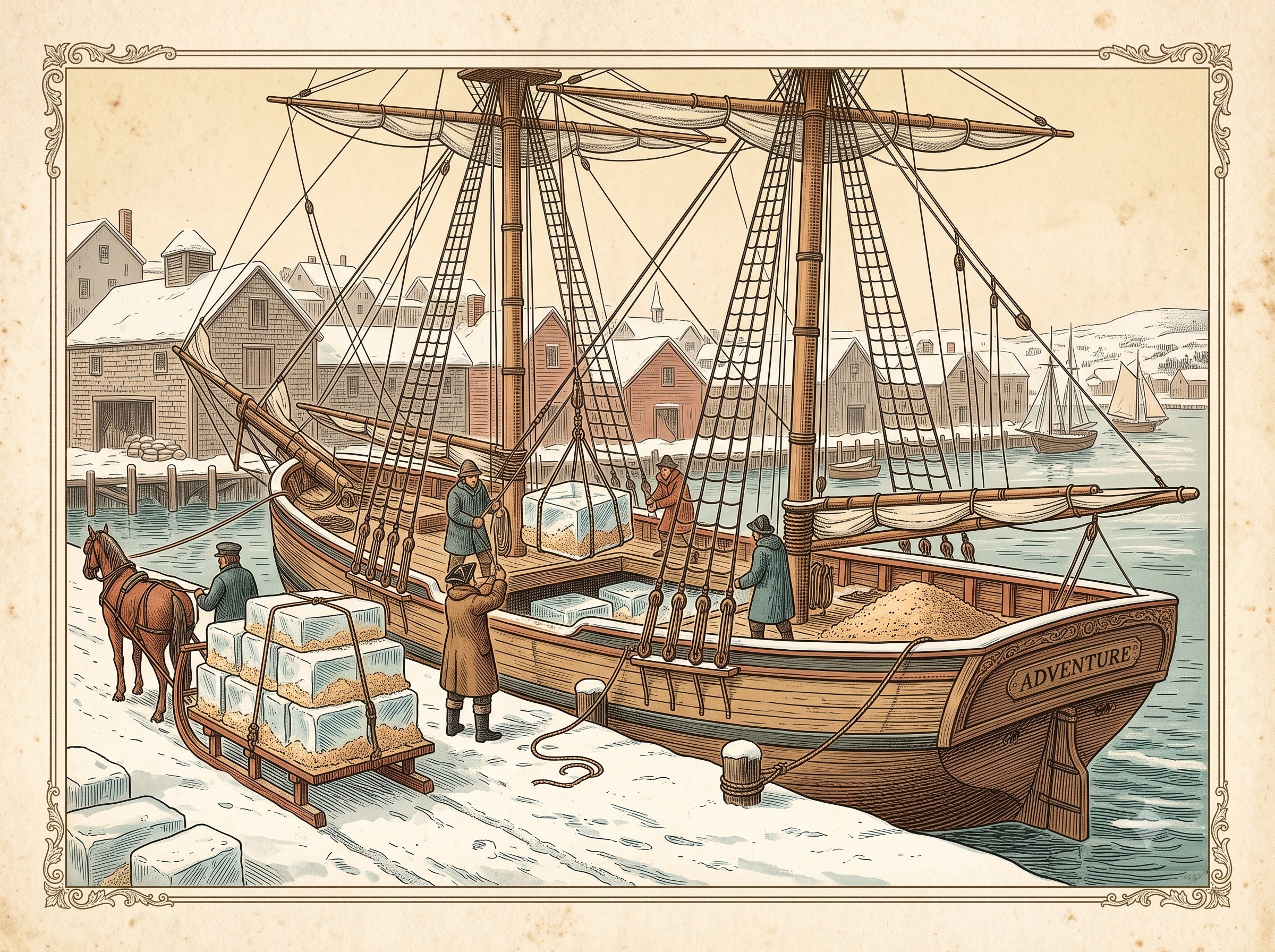
On 10 February 1806, a brig called the *Favorite* cleared Boston's Custom House carrying 130 tons of pond ice, bound for Martinique — a Caribbean island where most people had never seen the stuff. The *Boston Gazette* reported it with the flattest possible deadpan: "No joke. A vessel has cleared at the Custom House for Martinique with a cargo of ice. We hope this will not prove a slippery speculation."
By the Curiosities Desk · · 5 min read · Filed under Engineering · Today’s round
What happened?
The man behind the cargo was Frederic Tudor, 22 years old, the third son of a wealthy Boston lawyer. He had skipped Harvard to go into business, visited the Caribbean, noticed how badly people there wanted to be cool, and concluded that New England had a surplus of exactly the thing they lacked. The ice came off his family’s farm pond in Saugus. He sent his brother William and his cousin James Savage ahead to the islands to try to secure exclusive selling rights from the local governments, which tells you he expected competitors. He did not have any.
He also, it turned out, did not have any customers. A surprising amount of the ice survived the roughly three-week voyage. What it did not survive was arrival: there was no icehouse waiting, no cold-storage habit, no local sense of what a person was supposed to do with a hundred-pound block of frozen pond. Tudor sold what he could and came home down about $4,500 — roughly $90,000 today. The following year he lost more on three shipments to Havana. He spent part of 1812 and 1813 in debtor’s prison. In November 1815, by his own account, he was pursued by sheriffs to the wharf as he sailed for Havana again.
What eventually rescued the business was not better ice. It was better logistics and manufactured demand. Ice was free apart from the labor of cutting it. Sawdust was free too — a waste product of the lumber mills — and it turned out to be superb insulation. Ships were cheap to hire because many left Boston empty anyway, heading south to pick up cargo. Tudor built double-walled icehouses in the tropics, then set about teaching bartenders and café owners to serve cold drinks, on the theory that a person who has had one iced drink will want another.
Then came the machine that made it scale. Around 1825, one of Tudor’s suppliers, Nathaniel Jarvis Wyeth, hitched horses to a bladed cutter that scored the pond into an even grid. Uniform blocks stacked like masonry, with less surface area exposed and far less hand-sawing, and harvesting costs collapsed.
The high-water mark came in 1833. On 12 May, the brig Tuscany left Boston for Calcutta with 180 tons of New England winter in her hold — a voyage of roughly 16,000 miles and four months. She arrived in September with 100 tons still frozen. Over the next two decades Calcutta became Tudor’s most profitable destination.
Why was it strange?
Almost every other business sells something that sits still. Tudor’s product was actively destroying itself, every hour, in transit, at a rate nobody could precisely predict. His entire operation was a bet that he could lose the cargo more slowly than his competitors could — except he had no competitors, because nobody else thought there was a business here at all.
And the strangest part is the direction of the trade. Ice was not valuable in Massachusetts. It was an inconvenience. Tudor’s insight was that a nuisance in one place is a luxury 1,500 miles away, and that the whole enterprise turned on the unglamorous work of slowing something down.
Another thread pulled across centuries: From Plato’s Night Clock to Pea Shooters at the Window: A Short History of the Alarm Clock.
What did scientists learn?
The physics that made Tudor’s cargo survive at all had been worked out decades earlier by the Scottish chemist Joseph Black. In the 1750s and 1760s Black showed that ice sitting at its melting point soaks up a large amount of heat while its temperature stubbornly refuses to rise. That absorbed heat — the latent heat of fusion, meaning heat that goes into changing a substance’s state rather than its temperature — is what makes a block of ice such a durable traveler. It defends itself. Insulation only has to slow the leak; the ice does the rest.
Turn that idea around and you get refrigeration. If changing state absorbs heat, then a fluid you can force through that change on demand becomes a heat pump — and you no longer need winter. A physician in Apalachicola, Florida, named John Gorrie got there first in a practical form. Trying to cool the rooms of fever patients, he built a machine that compressed air, then let it expand to chill and freeze water, and received U.S. Patent No. 8080 on 6 May 1851 — the first American patent for mechanical refrigeration. His patent model is now in the Smithsonian. He never made money from it.
It is worth being precise about what these machines do: nothing “makes cold.” A refrigerator moves heat from inside the box to the room, which is why the back of your fridge is warm.
Another idea followed the long way: From Starving Horses to ‘Bicycle Face’: A Short History of the Bicycle.
How does it affect us today?
The natural ice trade died less of a better idea than of bad weather. Two mild winters in a row, in 1888–89 and 1889–90, produced the “ice famine” of 1890: northern cities that had never bothered with machines suddenly had nothing to cut, while southern cities, which had built ice plants precisely because they had no ponds, were fine. Within a generation, manufactured ice had overtaken the harvest.
The habit Tudor invented, though, outlived his industry. He spent decades convincing people that cold drinks and cold food were normal rather than exotic — and once that expectation existed, electric refrigerators, refrigerated railcars, frozen food, and the vaccine cold chain all had a market waiting. Even the vocabulary survives: plenty of people still call the fridge an “icebox,” which is precisely what the Wenham Lake Ice Company sold Londoners in 1845 — a metal-lined wooden cabinet restocked twice a day with a delivered block.
A close cousin: From the Everlasting Staircase to the Home Gym: A Short History of the Treadmill.
Fun fact
In the winter of 1846–47, a crew of about a hundred men spent sixteen days cutting Walden Pond while Henry David Thoreau watched from his window. Knowing where the blocks were headed, he wrote: “Thus it appears that the sweltering inhabitants of Charleston and New Orleans, of Madras and Bombay and Calcutta, drink at my well.”
The punchline comes a few lines later. Most of that ice never got to market. The stack — some ten thousand tons, piled thirty-five feet high — sat under hay and boards through the following summer and the winter after that, and was not fully melted until September 1848. “Thus,” Thoreau noted, “the pond recovered the greater part.”
Sources
- Henry David Thoreau, Walden; or, Life in the Woods (1854), “The Pond in Winter” — full text, Lit2Go, University of South Florida
- John Gorrie, U.S. Patent No. 8,080, “Improved Process for the Artificial Production of Ice” (6 May 1851) — the original patent text
- Gorrie Ice Machine, Patent Model — Smithsonian National Museum of American History
- Stawell Heard, “The ice trade: a cold business” — Royal Museums Greenwich, drawing on the Illustrated London News (17 May 1845) and the Caird Library archive
- Philip Chadwick Foster Smith, “Crystal Blocks of Yankee Coldness: The Development of the Massachusetts Ice Trade from Frederic Tudor to Wenham Lake, 1806–1886” — originally published in The Essex Institute Historical Collections (1961), based on Tudor’s own ice diaries