Science Through Time · Engineering
From Starving Horses to 'Bicycle Face': A Short History of the Bicycle
On a June afternoon in 1817, a German baron pushed a wooden beam on two in-line wheels out of Mannheim, straddled it, and shoved himself down the road with his feet like a grown man on a toddler's scooter. He looked ridiculous. He was also solving an energy crisis — because two years earlier, a volcano on the other side of the world had started killing the horses.
By the Curiosities Desk · · 5 read · Filed under Engineering · Today’s round
What happened?
In April 1815, Mount Tambora in Indonesia erupted in one of the largest volcanic explosions in recorded history. The ash and sulfur it threw into the stratosphere dimmed sunlight across the Northern Hemisphere, and 1816 went down as the “year without a summer”: snow in June, frost in July, failed harvests across Europe and New England, bread prices that put families under.
Oats failed with everything else, and oats were fuel. A horse that couldn’t be fed was a horse to be sold, slaughtered, or eaten, and across Baden and much of Germany the working animal population thinned badly through 1816 and into 1817. Transport got expensive at exactly the moment everyone needed it.
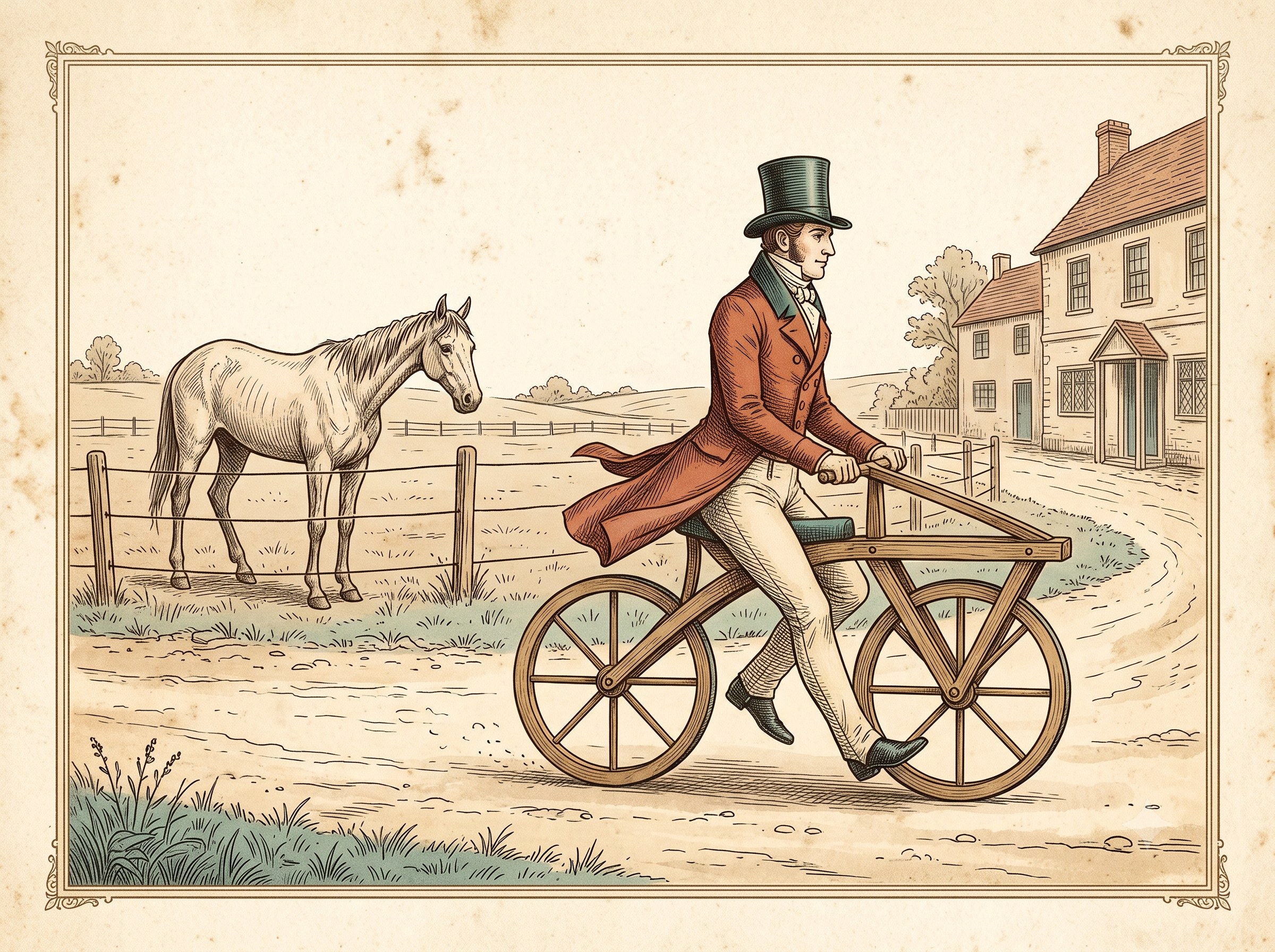
Karl Freiherr von Drais was a forestry official in Baden with a habit of inventing things nobody had asked for — a meat grinder, a shorthand machine, a four-wheeled human-powered carriage that went nowhere. In 1817 he tried again. Two wooden wheels, one behind the other, a padded saddle on a beam between them, a steerable front wheel. No pedals. You ran.
On 12 June 1817 he rode it out of Mannheim, roughly seven kilometres to a coaching inn on the Schwetzingen road, and back — a little over an hour for a round trip that would have taken more than twice as long on foot. He called it the Laufmaschine, the running machine. It weighed around 22 kilograms, and buried inside it was the insight nobody expected: a two-wheeled vehicle stays upright while it’s moving, and the rider steers to keep it that way.
The thing became a brief craze — in London, coachmaker Denis Johnson sold a version that earned the nicknames “dandy horse” and “hobby horse” — and then collapsed. Riders tore up the pavement meant for pedestrians, cities including Mannheim banned the machines from sidewalks, and without decent roads there was nowhere left to ride. Drais spent the rest of his life broke. He renounced his noble title during the revolutions of 1848–49 and went by “Citizen Karl Drais,” after which the Prussian authorities who crushed the uprising in Baden seized his pension to help pay the “costs of the revolution.” He died in Karlsruhe in December 1851, penniless.
It took another forty-odd years to finish the idea. In 1860s Paris, pedals and cranks were bolted directly to the front wheel — Pierre Michaux’s workshop gets the credit, though his employee Pierre Lallement claimed it too, in a dispute never settled. The result was heavy, iron-tired, and nicknamed the “boneshaker.” Because the pedals turned the front wheel directly, one push of the legs equaled one rotation, so to go faster makers simply grew the wheel — ending with the enormous penny-farthing and its rider perched five feet up, directly over the axle. Hit a rut and you were launched over the handlebars in a maneuver so routine that cyclists still call it “taking a header.”
The fix arrived in 1885 with John Kemp Starley’s Rover: two wheels of equal, modest size, the rider seated low and well back, and a chain driving the rear wheel, so gearing rather than wheel size supplied the speed. It was called the “safety bicycle” for the obvious reason. Dunlop’s pneumatic tire in 1888 made it comfortable, and by 1893 nobody was building high-wheelers anymore.
Why was it strange?
The bicycle is one of the few major machines that arrived because of the weather. It wasn’t the end of a research program — it was an improvisation during a fuel shortage, where the fuel was hay and the engine had four legs. Drais’s biographer Hans-Erhard Lessing made the connection, noting that Drais’s attempts at human-powered vehicles line up precisely with the worst crop failures around Baden, and that contemporaries described the machines as meant “to lower the price of oats and hay.” That’s an argument from circumstance rather than a statement of motive from Drais — the leading explanation, not a settled one.
Stranger still: the pieces had been available for centuries. Wheels, wood, iron, leather, a road. What was missing wasn’t materials — it was the idea that a person could balance on two wheels at all.
Another idea followed the long way: From Plato’s Night Clock to Pea Shooters at the Window: A Short History of the Alarm Clock.
What did scientists learn?
Mostly, that they didn’t understand their own invention. A moving bicycle stays up because steering corrections keep sliding the wheels back under the falling mass, and for a century physicists credited that self-correction to two things: gyroscopic force from the spinning wheels, and “trail,” the caster-like geometry that puts the front wheel’s contact point behind its steering axis. In 2011 a team publishing in Science built a deliberately perverse bicycle that canceled both — counter-rotating wheels, negative trail — and it still righted itself when rolling. Neither factor is necessary. Stability comes from mass distribution and steering geometry working together, and can be achieved several different ways.
Another thread pulled across centuries: From the Everlasting Staircase to the Home Gym: A Short History of the Treadmill.
How does it affect us today?
The safety bicycle’s 1885 geometry — two equal wheels, diamond frame, rear chain drive — is essentially the bicycle you can buy today, one of the most durable designs in engineering history. The 1890s bike boom pushed hard for paved roads, and the trade’s expertise in ball bearings, chain drives, and thin steel tubing fed straight into the automobile and the airplane. It is not a coincidence that Orville and Wilbur Wright ran a bicycle shop.
The social effect was bigger than the mechanical one. Bicycles gave women unchaperoned, self-directed mobility, and the backlash was immediate. Some physicians warned of “bicycle face” — a supposedly permanent look of drawn lips, shadowed eyes, and exhaustion brought on by the strain of riding. The term is usually credited to British doctor Arthur Shadwell in 1897; a version ran in the Literary Digest in 1895. It was never a real diagnosis, and other doctors said so at the time. Women kept riding. Susan B. Anthony, interviewed by Nellie Bly for the New York World in February 1896, said cycling “has done more to emancipate women than anything else in the world.”
A close cousin: The Self-Taught Carpenter Who Solved the Deadliest Problem in Ocean Navigation.
Fun fact
The design never really died. Strip the pedals off a modern child’s balance bike and you have, functionally, an 1817 Laufmaschine in plastic — the oldest bicycle layout in existence, now sold mainly to four-year-olds.
Sources
- Cycling UK, “200 years since the father of the bicycle Baron Karl von Drais invented the ‘running machine’”
- City of Mannheim, official Karl Drais biography (PDF), prepared by Drais biographer Hans-Erhard Lessing
- Smithsonian National Museum of American History, “The Development of the Velocipede”
- J. D. G. Kooijman, J. P. Meijaard, J. M. Papadopoulos, A. Ruina, A. L. Schwab, “A Bicycle Can Be Self-Stable Without Gyroscopic or Caster Effects,” Science 332 (2011): 339–342
- Sheila Hanlon, “Bicycle Face: A guide to Victorian cycling diseases”, citing Arthur Shadwell (1897) and the Literary Digest (1895)