Science Through Time · Engineering
From Plato's Night Clock to Pea Shooters at the Window: A Short History of the Alarm Clock
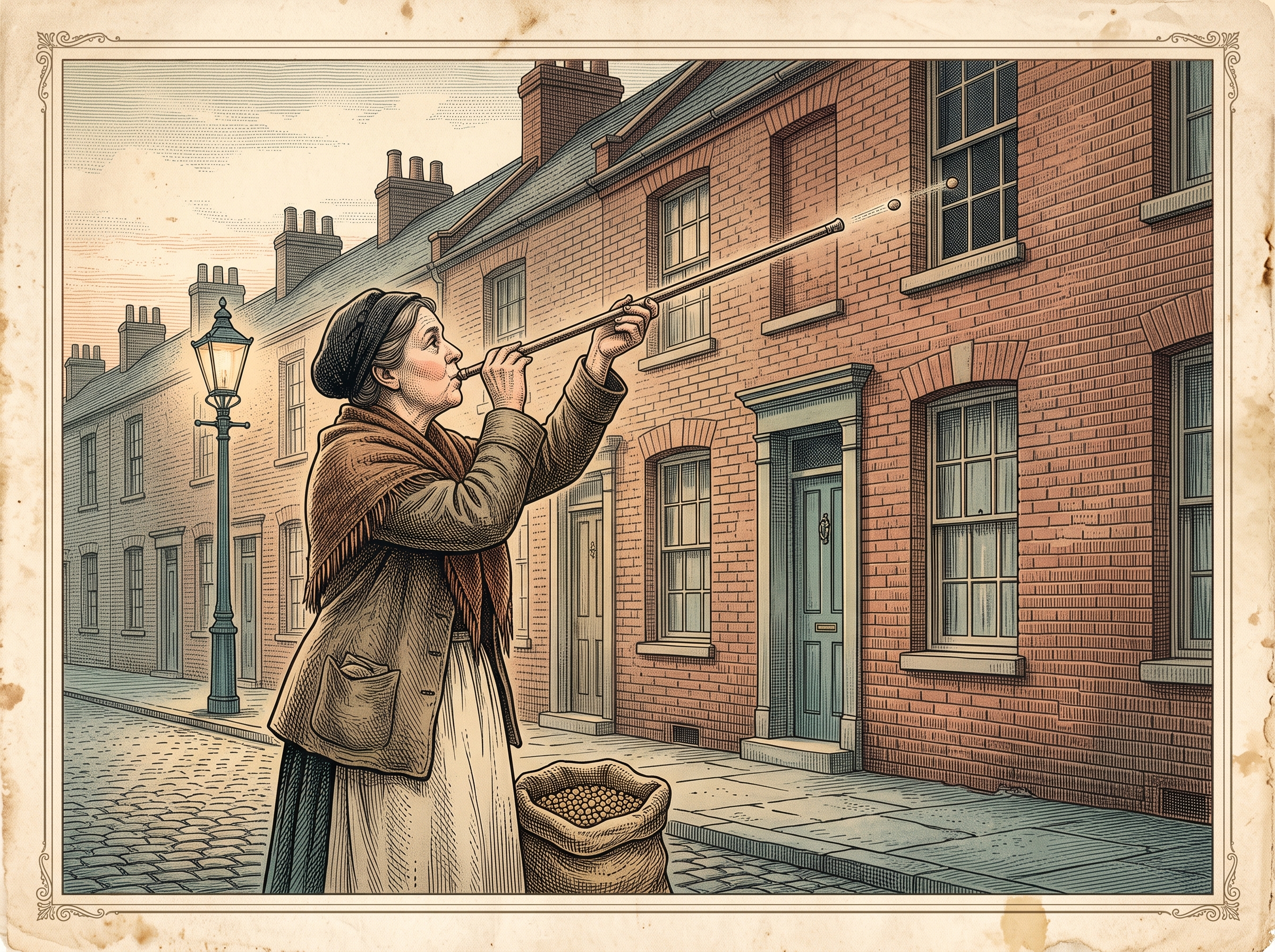
Around 1931, on a dark street in London's East End, a woman lifted a pea shooter to her lips and fired a dried pea at a second-floor window. Then another. Then another, until a sleepy face appeared behind the glass. Her name was Mary Smith, and she was the alarm clock. Her customers paid her sixpence a week.
By the Curiosities Desk · · 5 read · Filed under Engineering · Today’s round
What happened?
People have wanted to wake up on time for as long as they have had somewhere to be. The trouble is that the human body is a poor judge of the hour in the dark, so for most of history, getting up early meant borrowing help from water, fire, gears, or other people.
The story usually starts with Plato in Athens, in the 4th century BCE. The evidence for it is thin but intriguing. Writing roughly 500 years later, the Greek author Athenaeus passed along a claim that Plato had built a “night clock” that resembled a water organ, a kind of very large water clock. Modern writers often describe it as an alarm that whistled to call students to dawn lectures, and museums have built working reconstructions on that idea. But the ancient text doesn’t explain how it worked, or even say plainly that it woke anyone. Treat Plato’s alarm as a tantalizing maybe.
On firmer ground, later engineers made timekeepers that did announce the hour. In China, the monk Yi Xing in the 8th century and the official Su Song in the 11th built great water-driven astronomical clocks with mechanisms that struck bells and drums. By the 15th century, European clockmakers were making mechanical clocks with a settable alarm: you pushed a pin into a hole on the dial, and when the hand reached it, a bell rang.
Fast-forward to 1787 in Concord, New Hampshire. A 26-year-old clockmaker named Levi Hutchins wanted to be up before dawn every day. So he built himself a clock in a pine cabinet about 29 inches tall, with an extra gear that rang a bell at one time and one time only: 4 a.m. It couldn’t be set to anything else. Hutchins never patented it or sold copies. It was a tool for one early riser. His clock is often called the first alarm clock, but that isn’t quite right. European alarm clocks were centuries older. It is better described as an early American one.
The first adjustable mechanical alarm clock to be patented came in 1847, from the French clockmaker Antoine Redier. In 1876, the Seth Thomas Clock Company in Connecticut patented a small bedside alarm clock, and by the early 1900s factories were turning them out cheaply enough for ordinary households.
That timing matters, because for the century before, factories had been creating a problem they couldn’t yet fix. In Britain’s mill towns, shifts started at fixed hours, and a worker who overslept could lose pay or a job. Clocks were expensive. So towns developed a human alarm service: the knocker-up. Knocker-ups walked the streets before dawn, rapping on doors and upstairs windows with long poles, sometimes tipped with wire, for a few pence per customer each week. Mary Smith, who lived in London’s Limehouse district and retired in 1934, became famous because her tool of choice was a pea shooter. A 1931 photograph of her in action made the newspapers, and it is still the most famous image of the trade.
Why was it strange?
Because the problem the alarm clock solves is newer than it looks. For most of human history, people woke with the light, with the rooster, or with a full bladder, and nobody minded much if “morning” meant a different minute each day. Exact wake-up times became a crisis only when work started running on the clock instead of the sun.
And the solutions were wonderfully lopsided. A philosopher may have used plumbing. A clockmaker built a machine that could only say one thing. A whole profession sprang up around shooting peas at glass. The obvious question, “who woke up the knocker-up?”, has no single answer, though many of them simply worked through the night and slept during the day.
The same thread — Timekeeping — continues in The September That Jumped From the 2nd to the 14th.
What did scientists learn?
The alarm clock is a lesson in a basic engineering idea: a trigger. Any alarm needs two parts. The first is a steady timekeeper, like dripping water or a swinging balance wheel. The second is a stored burst of energy, like a wound spring or a weight, held back by a catch. When the timekeeper reaches a set point, it releases the catch, and the stored energy rings the bell.
Hutchins’s clock had the timekeeper and the trigger, but the trigger was fixed to one spot. Redier’s improvement was to make the trigger point movable, so the same machine could serve a baker at 3 a.m. and a clerk at 7. That small change turned a personal gadget into a product anyone could use.
Another thread pulled across centuries: The Self-Taught Carpenter Who Solved the Deadliest Problem in Ocean Navigation.
How does it affect us today?
Alarm clocks became so central to working life that their absence became a wartime emergency. In 1942, American clock factories stopped making civilian clocks to build war materials. By 1943, under a War Production Board program, Westclox was selling a “Waralarm” in a case of molded wood fiber, using just 7 pounds of brass per 1,000 clocks instead of the usual 300.
The next big change was a gift to the sleepy. In 1956, General Electric-Telechron released the “Snooz-Alarm,” one of the first clocks with a snooze button. Today, the alarm clock lives inside most people’s phones. It costs nothing, plays any sound we like, and can ring at any minute of the day, which is a long way from 4 a.m. or nothing.
Another idea followed the long way: From a Cargo of Melting Ice to the Kitchen Fridge: A Short History of Refrigeration.
Fun fact
The snooze on many alarm clocks lasts nine minutes, not ten. The most common explanation is that the gears in early snooze mechanisms couldn’t easily be made to count exactly ten minutes, so designers settled on nine, a tradition many digital clocks kept. It is a popular story, though, not a well-documented one.