The Scientist Behind It · Physics
The Scientist Who Weighed the Earth but Couldn't Speak to His Housekeeper
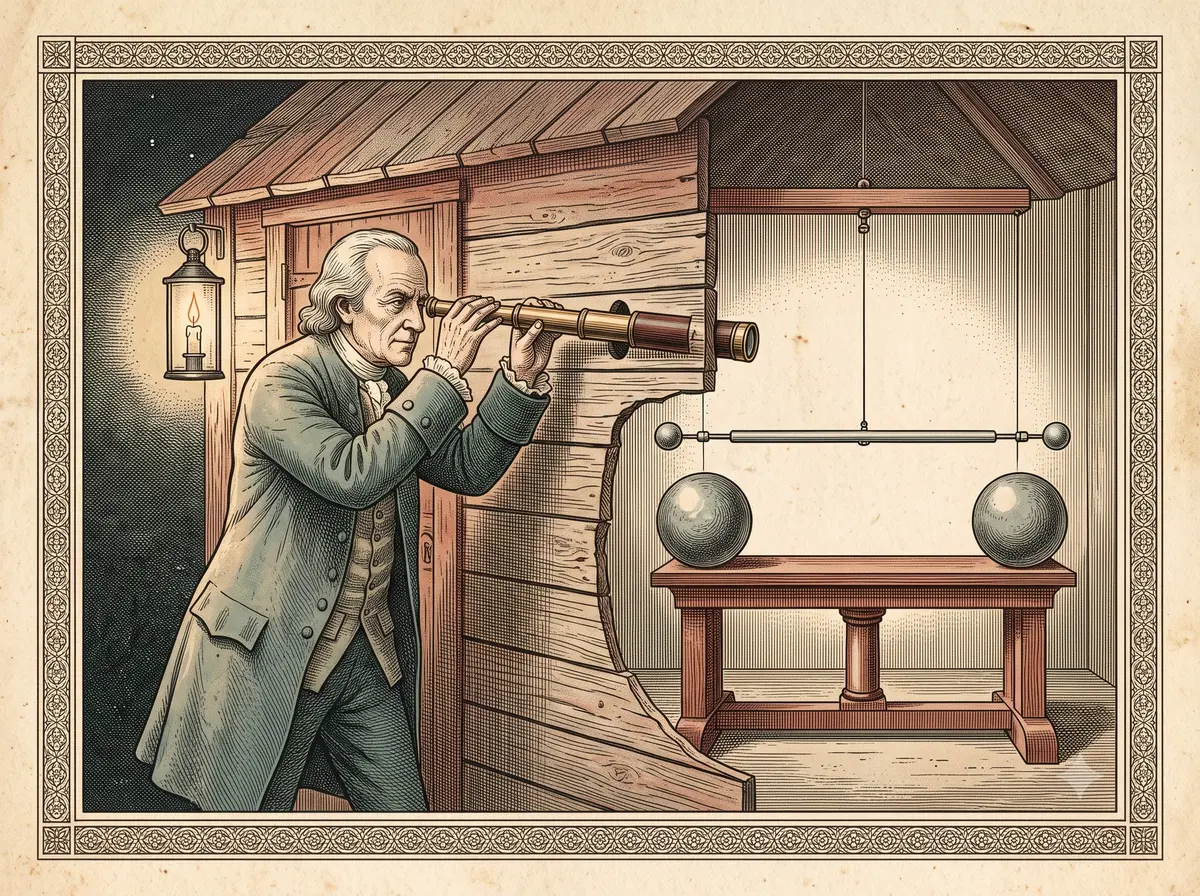
In a sealed shed in a London suburb in 1798, a 67-year-old man peered through a telescope poked through a hole in the wall, watching two small lead balls twist toward two big ones by less than the width of a grain of rice. He was weighing the entire planet. He would also, that same week, order his dinner the only way he ever did: by leaving a note on the hall table, because speaking to his housekeeper was more than he could bear.
By the Curiosities Desk · · 5 min read · Filed under Physics · Today’s round
Part of The Person Who Would Not Drop It
What happened: The Scientist Who Weighed the Earth but Couldn't Speak to His Housekeeper
Henry Cavendish was born in 1731 into one of the grandest families in England — both of his grandfathers were dukes — and he inherited a fortune that made him one of the richest men in the country. A line often attributed to the French physicist Jean-Baptiste Biot summed him up as “the richest of all the learned, and the most learned of all the rich.” He spent almost none of it on anything except books and scientific instruments.
He was also, by every surviving account, almost pathologically shy. He communicated with his female servants entirely by written notes. According to his 19th-century biographer George Wilson, after Cavendish once ran into a housemaid on the stairs, he had a separate back staircase built so it would never happen again. At the Royal Society’s weekly dinners — nearly his only social outing for fifty years — fellow scientists learned a trick for extracting his opinions: wander near him and speak “as it were into vacancy.” If the question was scientifically interesting, a mumbled answer might come back. If not, he might simply flee the room.
Yet inside that silence sat one of the greatest experimental minds of his century. In 1766 he isolated and described “inflammable air” — the gas we now call hydrogen — and in the 1780s his experiments showed that burning it in ordinary air produced pure water, a shocking result at a time when water was still considered a basic element.
His masterpiece came late. His friend John Michell, a country clergyman and geologist, had designed an apparatus to measure the gravitational pull between lead balls, but died in 1793 before he could use it. The equipment eventually passed to Cavendish, who rebuilt it and, in 1797–98, ran the experiment at his house at Clapham Common. A six-foot wooden rod hung from a slender wire, a two-inch lead ball at each end. Two 348-pound lead spheres were positioned nearby. Gravity — the mutual attraction of metal for metal — slowly twisted the rod toward them.
The force involved was absurdly small: about one fifty-millionth of the weight of the small balls. A draft, a footstep, even the warmth of a human body would have swamped it. So Cavendish sealed the whole apparatus inside a closed shed, stayed outside, and read the rod’s movement through telescopes aimed through holes in the walls. From the tiny deflection and the wire’s stiffness, he calculated that the Earth is, on average, 5.448 times denser than water — within about one percent of the modern value. He described the project in a letter with uncharacteristic flair: he was “weighing the world.”
Why it was strange: The Scientist Who Weighed the Earth but Couldn't Speak to His Housekeeper
Every part of the picture is upside down. The man who could not manage small talk with his own staff performed what was arguably the most delicate measurement of the entire 18th century. The planet beneath everyone’s feet — the one thing too big for any scale — was weighed with two lead balls in a garden shed, by a millionaire in a fifty-year-old faded coat. And nobody could ask him about it at dinner, because approaching him directly made him bolt.
His shyness had scientific costs, too. When James Clerk Maxwell finally published Cavendish’s private manuscripts in 1879, he found that Cavendish had quietly discovered, decades early, results later credited to others — including the law we call Ohm’s law. Lacking meters, Cavendish had gauged electric current by shocking himself and rating the pain. He simply never told anyone.
Another scientist, told from the human side: The Abbé Who Shocked 200 Monks in a Line a Mile Long to Time the Speed of Electricity.
What scientists learned: The Scientist Who Weighed the Earth but Couldn't Speak to His Housekeeper
Cavendish’s number did two big things. First, it revealed the Earth’s interior: 5.4 times the density of water is far denser than surface rock, which supported the idea that the planet hides a massive metallic core — a cornerstone of modern geology. Second, his measurement contained, in embryo, the gravitational constant G, the number in Newton’s law that sets the strength of gravity everywhere in the universe. Physicists later reworked his data into modern units and got a value within about one percent of today’s. His paper even carried a small arithmetic slip — 5.48 instead of 5.448 — that nobody caught until 1821, a comforting reminder that even the century’s most careful man could fumble a digit. No one measurably improved on his precision until 1895.
Another person who would not drop the question: The Physicist Who Cleaned His 40-Foot Spectrograph by Sending the Family Cat Through It.
How it reaches us today: The Scientist Who Weighed the Earth but Couldn't Speak to His Housekeeper
Every satellite launch, Mars landing, and GPS fix depends on knowing the mass of the Earth, and the torsion-balance method Michell and Cavendish pioneered is still, with refinements, how physicists measure G today. Cambridge University’s famous Cavendish Laboratory — birthplace of the electron’s discovery and the DNA double-helix model — carries the family name, a monument to a man who would likely have been too embarrassed to attend the opening.
A close cousin: The Physicist Who Levitated a Frog — and Then Won a Real Nobel Prize.
Fun fact: The Scientist Who Weighed the Earth but Couldn't Speak to His Housekeeper
Cavendish’s dinner-ordering system had a signature dish: when guests were expected, the note on the hall table nearly always specified the same meal — a leg of mutton. One story, likely polished in the retelling, says that when told a single leg wouldn’t feed his guests, he replied, “Well then, get two.”
Sources: The Scientist Who Weighed the Earth but Couldn't Speak to His Housekeeper
- Henry Cavendish, “Experiments to Determine the Density of the Earth,” Philosophical Transactions of the Royal Society, 1798 — the original paper
- American Physical Society: “June 1798: Cavendish weighs the world”
- George Wilson, The Life of the Honourable Henry Cavendish (1851) — the first full biography, source of the servant and staircase anecdotes
- Encyclopaedia Britannica: Henry Cavendish
- Science Museum Group: Model of Cavendish’s torsion balance apparatus, 1798
Related stories: The Scientist Who Weighed the Earth but Couldn't Speak to His Housekeeper
- The Astronomer With a Metal Nose and a Beer-Drinking Elk — A gold nose, a private island, and a beer-drinking elk
- The Geologist Who Tried to Eat His Way Through the Entire Animal Kingdom — A geologist who tried to taste his way through the animal kingdom
- Nikola Tesla and the Pigeon He Loved — The inventor of AC power fell in love with a pigeon