Science Through Time · Archaeology
From a Sponge on a Stick to the Flush Toilet: A Short History of the Toilet
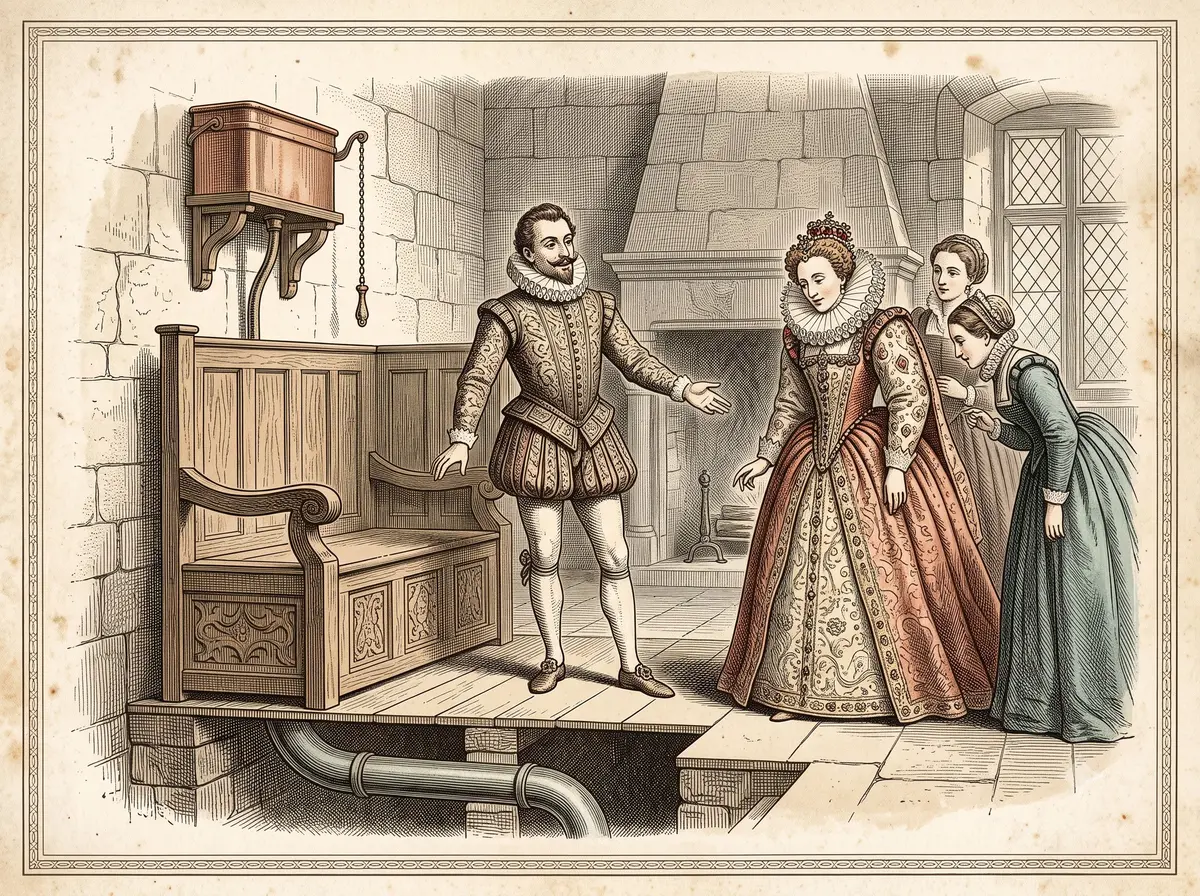
In 1596, an English courtier published a book explaining how to build a working flush toilet. It described a cistern, a valve, a seat, and a pan that emptied at the pull of a handle. It also had so many jokes about excrement that Queen Elizabeth I, who happened to be the author's godmother, banished him from court. The invention went back on the shelf for nearly two hundred years.
By the Curiosities Desk · · 5 min read · Filed under Archaeology · Today’s round
What happened: The Flush Toilet
The story starts far earlier, and in better shape than you’d expect.
Around 2600 BCE, the Indus Valley cities of Mohenjo-daro and Harappa, in present-day Pakistan, were built with sanitation designed in from the start. Houses had bathing platforms and dedicated waste holes. Standardized baked bricks carried the runoff into covered street drains, which fed a trunk sewer roughly a metre and a half deep and out to soak pits. There was no automatic flush; a resident poured a jar of well water down the hole. But the principle — waste out of the house, out of the street, and away — was fully worked out 4,600 years ago.
Rome scaled it up and made it social. Public latrines were long stone benches with keyhole-shaped openings cut into them, a dozen or more seats to a room, no partitions, and a channel of running water at your feet. For cleaning up, archaeologists keep finding pessoi: discs of broken pottery, roughly 3 to 10 centimetres across, recut so the edges were smooth — reusable ceramic toilet paper.
Rome also gives us the item this article is named for. The xylospongium, or tersorium, was a sea sponge on the end of a wooden stick, kept in a bucket of water or vinegar in the latrine. Its clearest ancient mention is a grim one: Seneca, in the seventieth of his letters to Lucilius, describes a German gladiator who used one to take his own life rather than die in the arena. That passage is why we know the object existed — and also why we’re unsure what it was for. Traditionally it’s read as a communal bottom-wiper, the version that made it famous; more recent scholarship argues it was a brush for cleaning the latrine itself. The question is still open.
Then Roman plumbing fell apart, and Europe spent a millennium with chamber pots, cesspits, and castle garderobes emptying into moats.
Which brings us to Sir John Harington, poet, wit, and Elizabeth I’s “saucy godson.” Around 1592 he built a flushing lavatory — a seat over a pan, a cistern above it, a handle that swept the contents into a cesspool below — and installed one for the Queen at Richmond Palace. In 1596 he wrote it up in A New Discourse of a Stale Subject, Called the Metamorphosis of Ajax. “Ajax” was a pun on “a jakes,” period slang for a privy. The book was three-quarters satire of English society and one-quarter engineering manual, and the satire got him thrown out of court. Almost nobody built the toilet.
The idea was revived in 1775, when the Scottish watchmaker Alexander Cumming patented a water closet with one crucial addition: an S-shaped bend in the outflow pipe. Joseph Bramah improved it in 1778 with a hinged valve less prone to freezing. Flush toilets began spreading through British cities — and immediately created a much larger problem, because all that water now had somewhere to go.
By 1858 London held more than two and a half million people, and the Metropolitan Sewers Act of 1848 had directed household waste into the Thames. That summer was hot. The river became an open sewer, and the smell — remembered as the Great Stink — reached the windows of Parliament. Curtains were soaked in chloride of lime; lime was tipped into the river. Neither worked. A bill to fund a proper sewer network, championed by Benjamin Disraeli, passed in eighteen days. Joseph Bazalgette’s intercepting tunnels and pumping stations were finished in 1875 and are still in use.
One footnote, since everyone asks: Thomas Crapper was real, was a successful sanitary engineer, and did not invent the toilet. He held nine patents, three for water-closet improvements. His ads for a “Valveless Water Waste Preventer” cited patent 4,990 — which belonged to Albert Giblin, in 1898.
Why it was strange: The Flush Toilet
The strange part isn’t that the toilet took so long to arrive. It’s that it kept arriving and then leaving. A working urban sanitation system existed in 2600 BCE. Rome ran another. Harington built a flush toilet in Tudor England and it was received as a dirty joke. Sanitation is one of the few technologies humanity has managed to invent, lose, and reinvent more than once — not because the engineering was hard, but because the subject was unspeakable.
The same thread — Ancient Rome — continues in From Crushed Oyster Shells to Nylon: A Short History of the Toothbrush.
What scientists learned: The Flush Toilet
Two things, one mechanical and one biological.
The mechanical one is the water seal. Cumming’s S-bend holds a small permanent puddle in the pipe, and that puddle is a physical plug: waste passes through, sewer gas cannot come back up. No moving parts, no power, no maintenance — which is why it is still in your bathroom, essentially unchanged since 1775.
The biological one took longer. In 1854 the physician John Snow traced a cholera outbreak to one contaminated pump on London’s Broad Street — evidence that the disease travelled in water, not foul air. Official London wasn’t convinced. Parliament funded Bazalgette’s sewers because the Thames smelled, under the reigning “miasma” theory that bad air itself caused disease. The sewers cut cholera anyway, because what they actually did was separate sewage from drinking water. London’s last major cholera epidemic, in 1866, struck an East End district not yet connected to the new system. Right answer, wrong reasoning — and the evidence caught up later.
Another thread pulled across centuries: From Baltimore Sewer Gas to the Shroud of Turin: A Short History of Radiocarbon Dating.
How it reaches us today: The Flush Toilet
Every flush you take runs Cumming’s 1775 patent through Bazalgette’s 1870s logic. The unfinished part is distribution. The WHO/UNICEF Joint Monitoring Programme reported that as of 2024, 3.4 billion people still lacked safely managed sanitation and 354 million still practised open defecation — alongside the fastest progress on record, with 1.2 billion people gaining safely managed services between 2015 and 2024 and coverage rising from 48% to 58%. The technology has been solved for centuries. The plumbing hasn’t.
Another idea followed the long way: The 3,900-Year-Old Fart Joke Scribes Copied in School.
Fun fact: The Flush Toilet
Athenians voted to exile a citizen by scratching his name onto ostraka — shards of broken pottery, roughly the same size and material as the pessoi Greeks used to wipe. Researchers writing in the BMJ in 2012 noted a suggestion that the two uses overlapped: banish your enemy, then put his name to more personal work. It’s a plausible idea rather than a proven one — but the pottery fits.
A note: this article mentions a suicide recorded in an ancient Roman source. If that’s a difficult subject for you right now, support is available — a doctor, a crisis line, or someone you trust is a good place to start.
Sources: The Flush Toilet
- Sir John Harington, The Metamorphosis of Ajax (1596; digitized edition, Internet Archive)
- Charlier P, Brun L, Prêtre C, Huynh-Charlier I. “Toilet hygiene in the classical era.” BMJ 2012;345:e8287
- De Feo G, et al. “The Historical Development of Sewers Worldwide.” Sustainability 2014;6(6):3936–3974
- London Museum — “The Great Stink of 1858”
- WHO/UNICEF Joint Monitoring Programme — Progress on household drinking water, sanitation and hygiene 2000–2024 (2025)
Related stories: The Flush Toilet
- The Doctor Who Discovered Handwashing — and Was Locked Away for It — He proved handwashing saved mothers and was destroyed for it
- From the Everlasting Staircase to the Home Gym: A Short History of the Treadmill — A prison punishment device that became gym equipment
- The Canned Food That Arrived 48 Years Before the Can Opener — Tinned food shipped 48 years before anyone invented the opener