Science Through Time · Archaeology
From Sheep's Ankle Bones to the Rule of Seven: A Short History of Dice
In 2022, 23 psychology students at Drew University in New Jersey were handed little clay dice, some nearly cubic and some stretched out of shape, and asked to press in the pips. Nobody told them what the study was about. Again and again, they put the 6 on one of the biggest faces — just as Roman dice makers in the Netherlands had tended to do nearly 2,000 years earlier. The students weren't cheating, and the researchers came to suspect the Romans probably weren't either.
By the Curiosities Desk · · 5 min read · Filed under Archaeology · Today’s round
What happened: From Sheep's Ankle Bones to the Rule of Seven: A Short History of Dice
Long before anyone carved a cube, people threw bones. The astragalus — the small ankle bone of a sheep or goat, often called a knucklebone — lands on one of four sides. Greeks and Romans gave those sides the values 1, 3, 4, and 6 and threw four bones at a time. The worst throw, four 1s, was called “the dog.” The best Roman throw, in which every bone showed a different face, was called “Venus.”
Cubic dice are also old. Excavators at Mohenjo-daro, a city of the Indus Valley civilization in what is now Pakistan, found many baked-clay dice more than 4,000 years old. Their numbering was not ours: 1 sat opposite 2, 3 opposite 4, and 5 opposite 6. Archaeologists call that layout “primes.” Today’s standard, where opposite faces add up to seven, is called “sevens.”
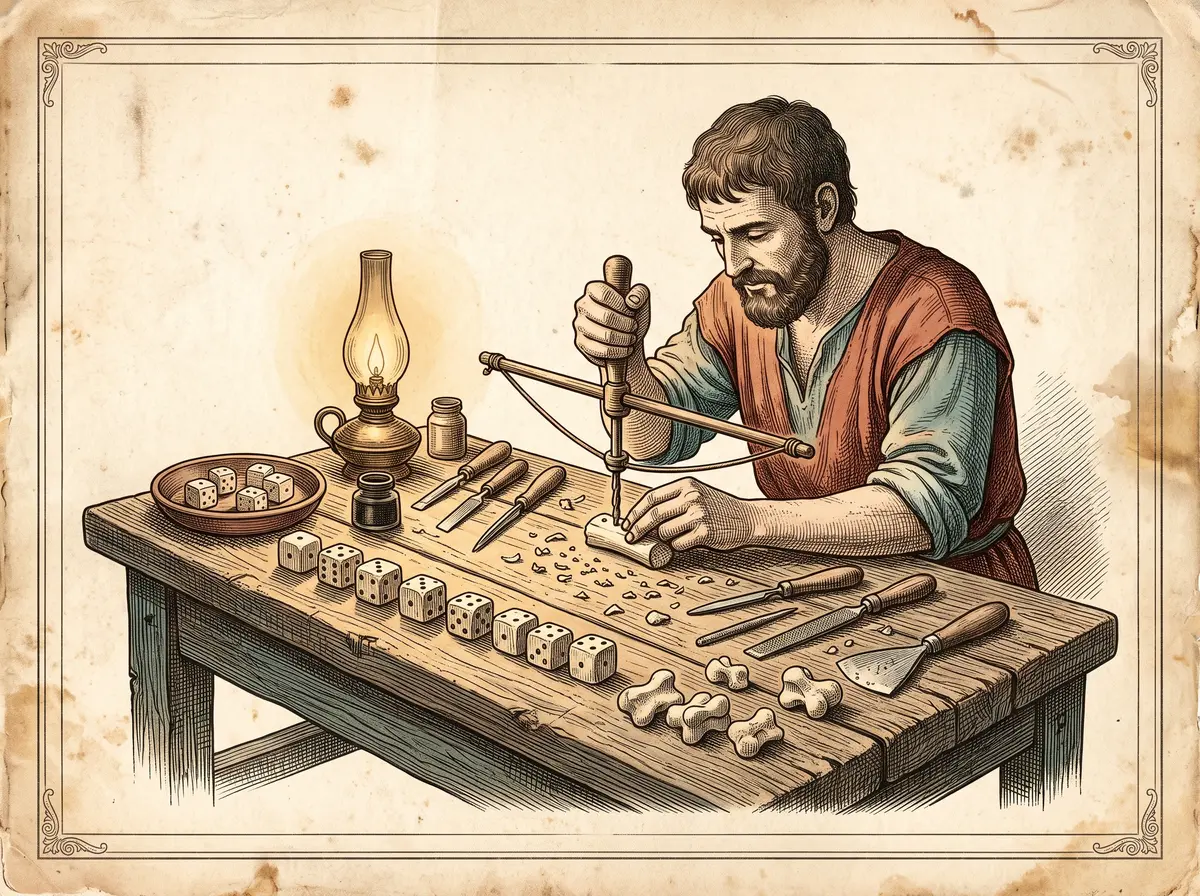
Dice usually get only a passing mention in excavation reports. Then the anthropologist Jelmer Eerkens of the University of California, Davis, and Alex de Voogt, who studies the history of board games, went looking for patterns. They visited dozens of museums and archaeological storerooms across the Netherlands and built a database of 110 well-dated cubic dice, published in Acta Archaeologica in 2017.
The dice told a story in three acts. Dice from before about 650 CE varied wildly in size, shape, and numbering, and many were visibly lopsided. Between about 400 and 1100, dice became rare. When they returned in large numbers around 1100, they were small, standardized, and mostly numbered in the old “primes” layout. Then, around 1450, the sevens layout took over, and dice became much more consistently cube-shaped.
A second study, published in Archaeological and Anthropological Sciences in 2022, zoomed in on the oddest group: 28 Roman-period dice, 24 of which were asymmetrical. Many were stretched along one axis, like a short brick. Of 17 flattened dice, 10 had the 1 and the 6 on the two largest faces, opposite each other. The authors calculated that this would happen by random chance only about 0.6 percent of the time. That is where the clay-and-pencil experiment came in.
Why it was strange: From Sheep's Ankle Bones to the Rule of Seven: A Short History of Dice
A lopsided die is not fair. A flatter shape is more likely to come to rest on one of its big faces, the way a book lands on its cover rather than its spine. For the most stretched Roman die in the study, the researchers estimated about a 43 percent chance of rolling a 1 or a 6, compared with about 33 percent on a true cube.
So were Roman gamblers loading their dice? The students suggest a gentler explanation. Six pips simply fit more easily on a big face, and if you start with the 1 on a big face, the 6 lands opposite it. In the sevens condition, 63 of the 72 dice the students made put the 6 on one of the two largest sides. Eerkens and de Voogt argue that the Roman pattern looks like a habit of the hands, not a scheme.
The bigger surprise is that people tolerated uneven dice for centuries. The authors suggest many players saw a throw as the decision of fate or the gods, not as a matter of odds. If the outcome was destined, the exact shape of the die hardly mattered.
Rome left behind other small, delightfully odd personal objects too: The Roman Pocket Sundial Shaped Like a Ham.
What scientists learned: From Sheep's Ankle Bones to the Rule of Seven: A Short History of Dice
The change around 1450 lines up with a change in how Europeans thought about chance. In the 1500s, the Italian physician and gambler Gerolamo Cardano wrote Liber de ludo aleae (“The Book on Games of Chance”), a short manual that worked out early rules of probability, the mathematics of how likely things are. It was not published until 1663, long after his death. In 1654, a gambler known as the Chevalier de Méré brought dice and betting puzzles to Blaise Pascal, whose letters with Pierre de Fermat that year are often treated as the founding of probability theory.
Eerkens and de Voogt think the dice reflect that shift. Standard shapes and a single numbering scheme made it harder for anyone to tamper with a die unnoticed. Their article concludes that gamblers “may have seen dice throws as no longer determined by fate, but instead as randomizing objects governed by chance.” The authors are careful to call this an interpretation of the pattern, not proof of what any individual player believed.
Writing that outlasted its writers is a theme in archaeology: The Angry Customer Complaint That Survived 3,750 Years.
How it reaches us today: From Sheep's Ankle Bones to the Rule of Seven: A Short History of Dice
The sevens die on your game shelf is the descendant of that late-medieval standard. More importantly, the math that grew out of gamblers’ questions now runs much of modern life, from insurance premiums and medical trials to weather forecasts that give a “40 percent chance of rain.”
Dice have also become a tool for archaeologists. Because their shape and numbering changed in datable ways, Eerkens has suggested that a die found in a dig could help date the layer of soil it came from.
Roman Netherlands has surprised archaeologists before, as this story shows: The Lost Hammer That Led to 14,865 Roman Coins — and Got Its Own Museum Number.
From ankle bones to the rule of seven, dice belong with the other long histories in From the First Spark to the Thing You Still Use.
Fun fact: From Sheep's Ankle Bones to the Rule of Seven: A Short History of Dice
The Roman emperor Claudius loved dice so much that, according to the historian Suetonius, he wrote a book on the game (now lost) and played while traveling, with a board fitted to his carriage so the bumps wouldn’t disturb his game.
Sources: From Sheep's Ankle Bones to the Rule of Seven: A Short History of Dice
- Eerkens, J. W., & de Voogt, A. (2017). “The Evolution of Cubic Dice.” Acta Archaeologica 88(1): 163–173 (eScholarship)
- Eerkens, J. W., & de Voogt, A. (2022). “Why are Roman-period dice asymmetrical? An experimental and quantitative approach.” Archaeological and Anthropological Sciences 14: 134
- “It’s Not How You Play the Game, but How the Dice Were Made” — UC Davis News
- Ancient Indus dice from Mohenjo-daro and Harappa — Harappa.com
- Suetonius, The Life of Claudius, 33 — Lexundria