Weird Medical History · Physics
The 'Life Energy' Box Einstein Tested for Ten Days — and the Warm Ceiling That Explained It
In early February 1941, Albert Einstein spent about ten days doing something unexpected for the father of relativity: checking thermometers around a small box lined with metal. Its builder, the psychoanalyst Wilhelm Reich, said the box soaked up a newly discovered energy of life, and that the proof was a thermometer above it that read warmer than the air in the room. Einstein saw the extra warmth too. Then one of his assistants noticed something about the room itself.
By the Curiosities Desk · · 5 min read · Filed under Physics · Today’s round
What happened?
Wilhelm Reich, born in 1897 in what is now Ukraine, had been a rising figure in Vienna’s psychoanalytic world before fleeing Europe. After he arrived in New York in 1939, he began saying he had discovered a biological, even cosmic, energy that he called “orgone.” A shortage of it, he argued, lay behind both mental and physical illness.
To gather this energy, Reich built what he called orgone energy accumulators. In effect they were modified Faraday cages, metal enclosures of the kind physicists use to block outside electric fields, wrapped in layers of organic material. The first one big enough for a person, finished in December 1940, stood about five feet tall: a plywood cabinet lined with rock wool and sheet iron, with a chair inside and a small window. Patients sat in it, and Reich came to believe the boxes could help with many illnesses, including cancer.
Reich also thought he had found a measurement that physics couldn’t explain. A thermometer placed above or inside an accumulator, he reported, read slightly warmer than the surrounding air, even though the box had no heat source.
On December 30, 1940, he wrote to Einstein in Princeton asking to discuss a “specific biologically effective energy.” Einstein agreed to meet, and on the afternoon of January 13, 1941, the two men talked for roughly four to five hours. Einstein was intrigued enough by the temperature claim to offer to check it himself.
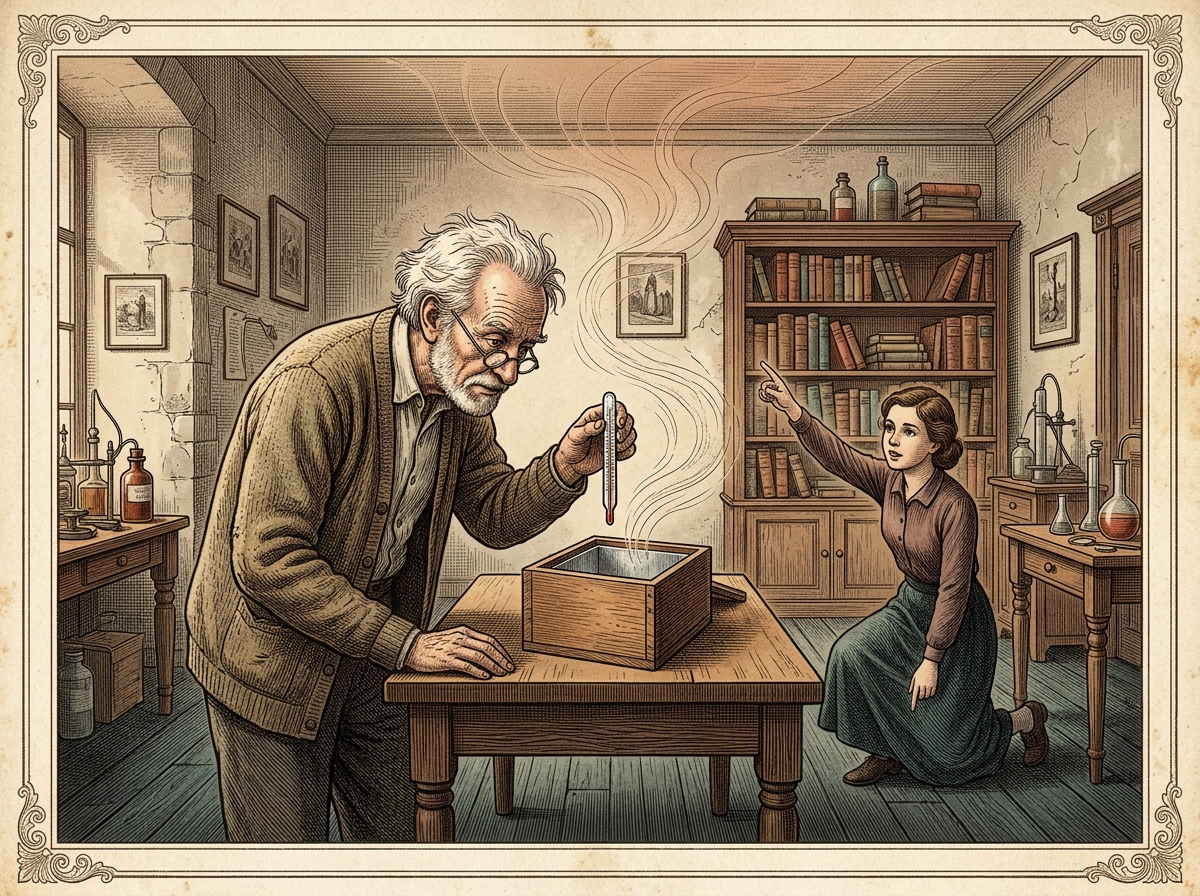
Reich spent about two weeks building a small accumulator for the test and delivered it on February 1. The two studied it together, and Einstein asked to keep it for a couple of weeks. Over roughly ten days, he took readings above it, inside it, and nearby. He even stripped the device down to its bare metal cage to see if the effect survived.
It did, in a sense: Einstein recorded the temperature rise. But one of his assistants pointed out that the floor of the room was cooler than the ceiling. Ordinary air in an ordinary room is layered by temperature, and that layering, Einstein concluded, was enough to account for the readings. In a letter dated February 7, 1941, he told Reich he regarded the matter as “completely solved.”
Reich answered with a letter about 25 pages long, describing every countermeasure he had tried against drafts and air layers: a horizontal plate over the box, a blanket, hanging it, burying it, and moving it outdoors. The difference, he said, persisted every time. Einstein never answered that letter or Reich’s later reports. Three years on, when Reich raised the idea of publishing their exchange, Einstein replied that he could not give the matter more time and asked that his name not be used for advertising. Reich published the correspondence anyway in 1953, as The Einstein Affair.
By then the accumulators were drawing a very different kind of attention. The U.S. Food and Drug Administration began investigating in 1947, and in March 1954 a federal court barred shipping the devices and related literature across state lines. In 1956, after an associate sent accumulator parts to another state, Reich was convicted of contempt of court and sentenced to two years in prison. Accumulators at his Maine estate were chopped apart under federal supervision, and tons of his books and papers were burned. Reich died of heart failure in Lewisburg federal prison on November 3, 1957, at the age of 60.
Why was it strange?
The test itself was the odd part. The world’s most famous physicist didn’t wave the claim away; he set up the experiment, watched the thermometers, and confirmed the reading. The number on the thermometer was real. What failed was the explanation for it.
That gap between a real measurement and a mistaken meaning is a recurring trap in science, and smart, sincere people fall into it. Reich was convinced he was seeing a new energy, and every extra control he added only deepened his conviction. The same pattern undid a whole community of physicists in The Rays 300 Scientists Saw That Were Never There.
What did scientists learn?
The physics behind Einstein’s verdict is something you can feel on a stepladder. Warm air is less dense than cool air, so it rises, and a still room settles into layers, cooler near the floor and warmer near the ceiling. This is called thermal stratification. A difference of a degree or two between a tabletop and the air around it is normal, and a box, a table, or a thermometer’s position can all trap or shield pockets of slightly different air.
That’s why Einstein’s real lesson was about controls, meaning comparisons that change only one thing at a time. A small temperature difference only becomes interesting once every mundane cause, from air layers to sunlight to the warmth of the person reading the thermometer, has been ruled out with an identical setup that lacks the supposed ingredient. No later research found support for orgone in medicine or physics. A light-filled cure cabinet from the same era makes an instructive comparison: The Box of Light Bulbs the Corn Flakes Doctor Said Cured a King.
How does it affect us today?
Orgone accumulators are still built and sold today, and the claims around them still don’t hold up. But the story also lingers for a second reason. Many historians and writers who reject orgone entirely still see the court-ordered destruction of Reich’s books as a troubling episode of censorship in American history, a reminder that how a society handles bad science matters too.
The quieter legacy is in laboratories. Precision measurements, from mass standards to telescope mirrors, are done in rooms with tightly controlled temperature and air flow precisely because a stray degree can impersonate a discovery. Questionable bedroom devices have a long history of their own, as in The £50-a-Night Electric Bed That Promised Couples a Baby.
Fun fact
Kate Bush’s 1985 song “Cloudbusting” tells part of Reich’s story through the eyes of his son, Peter, whose memoir A Book of Dreams inspired it.
A note: if you or someone you love is facing a serious illness like cancer, a trusted doctor is the best place to weigh any treatment, including ones promoted as natural or energy-based.
Sources
- The Wilhelm Reich Museum, “The Einstein Affair” — the December 30, 1940 letter, the January 13 and February 1, 1941 meetings, and the published correspondence.
- Encyclopaedia Britannica, “Wilhelm Reich” — biography, the orgone box, the FDA injunction, conviction, and death.
- Encyclopaedia Britannica, “Orgone box” — what the accumulator was claimed to do.
- Pacific Standard, “One Man’s Search for an Orgasmic Life Force” — the accumulator’s construction, the Einstein test, Reich’s 25-page reply, and the FDA case.
- “Wilhelm Reich”, Wikipedia — used as a guide to Myron Sharaf’s Fury on Earth (1983) and Christopher Turner’s Adventures in the Orgasmatron (2011) for the February 7, 1941 letter and the 1956 destruction of books.