Weird Medical History · Archaeology
The 3,000-Year-Old Wooden Toe Scientists Test-Drove in Replica Egyptian Sandals
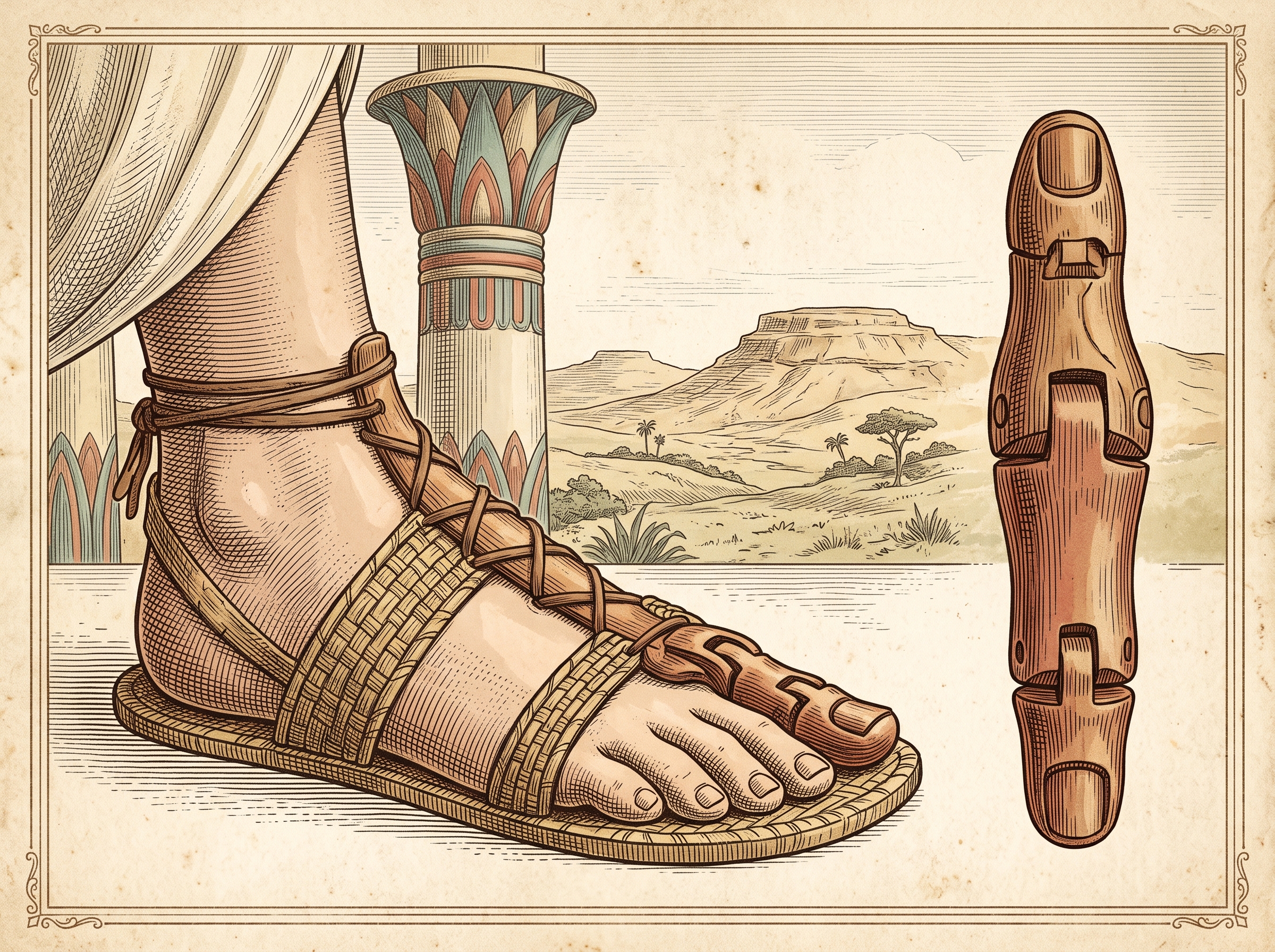
In a gait lab at Salford University in England, two men stepped onto a 10-metre walkway while ten cameras tracked every movement and a pressure mat recorded each footfall. Both were missing their right big toe. Strapped in its place was a replica of a prosthetic toe made in Egypt nearly 3,000 years ago, and on their feet were replica leather Egyptian sandals. The question they were helping to answer sounds like a riddle: was this ancient toe for show, or could you actually walk on it?
By the Curiosities Desk · · 5 read · Filed under Archaeology · Today’s round
What happened?
The toe at the center of the story was found in 1997, still attached to the foot of a mummified woman. She was buried in a rock-cut tomb (catalogued as Theban Tomb 95) at Sheikh 'Abd el-Qurna, a hillside cemetery in western Thebes, near modern Luxor. Researchers describe her as the daughter of a high-status priest, and some accounts name her Tabaketenmut, though the archaeological team has been cautious about formally identifying her. Studies estimate she died somewhere between about 50 and 60, and that she had lost the toe long before her death — the wound had fully healed.
The prosthesis itself is a small marvel: a carved wooden toe joined to a wooden plate, held on with leather and lacing, and made in three parts. It dates to roughly 950–710 BCE. Today it is held at the Egyptian Museum in Cairo, which is why it is often called the “Cairo toe.”
It has a lesser-known cousin. In 1881 the British Museum bought a false big toe from the Reverend Greville John Chester, a collector of Egyptian antiquities. This one is made of cartonnage — layers of linen glued together and coated with plaster, a sort of ancient papier-mâché — and it once had an inlaid toenail. The museum dates it to before about 600 BCE.
Both toes show wear, but wear alone doesn’t prove much. Egyptian embalmers sometimes added replacement body parts after death so the deceased would enter the afterlife complete. So Dr. Jacky Finch, a researcher at the University of Manchester’s KNH Centre for Biomedical Egyptology, decided to test the toes the most direct way possible: by having people walk on them.
She found two volunteers who were each missing their right big toe. Replicas of both ancient designs were made to fit each man, along with copies of Egyptian sandals. At Salford University’s gait laboratory, the volunteers walked the 10-metre course barefoot, in their own shoes, and in the replicas with and without the sandals. Their normal left foot served as the comparison.
The results, published in the Journal of Prosthetics and Orthotics in 2012, were encouraging. For one volunteer wearing sandals, the cartonnage replica reached 87 percent of the bending of his healthy left big toe, and the wood-and-leather design reached nearly 78 percent. Neither replica created dangerous pressure points. Without any false toe, though, sandals made the pressure under the foot rise sharply.
Comfort was another matter. The volunteers rated the stiff cartonnage toe poorly — an excellent cosmetic replacement, but not something you’d want to wear all day. The jointed wooden toe, on the other hand, was described as very comfortable, and one volunteer said he could get used to it.
In 2017, a team from the University of Basel, working with the Egyptian Museum and the University of Zurich, examined the Cairo toe again using microscopy, X-rays, and computed tomography (CT, a scan that builds a 3D picture from many X-ray slices). They found it had been reworked and refitted to the woman’s foot several times.
Why was it strange?
We tend to picture ancient artificial body parts as decorative stand-ins, like a statue’s missing nose glued back on. The Cairo toe suggests something more personal. Someone took measurements, made adjustments, and kept coming back to improve the fit for one specific woman — the same cycle of fitting and refitting that modern prosthetics clinics go through.
It also shows how much a big toe matters. In flat sandals with a thong between the toes, the big toe helps grip the sandal and push off. Finch noted that an Egyptian missing one would have found it very difficult to walk normally in traditional footwear.
The same thread — Egyptology — continues in The Ancient Egyptian Pregnancy Test That Asked Women to Pee on Grain — and Sort of Worked.
What did scientists learn?
Biomechanics — the study of how bodies move and bear loads — gave the archaeologists a way to turn a museum object into an experiment. The gait tests showed that both designs could function, with the wood-and-leather toe being the one a person might plausibly wear every day.
The Basel team added that the toe’s maker was probably not a “prosthetics specialist.” Egyptologist Susanne Bickel suggested an artisan who knew how to combine wood with other materials, perhaps drawing on furniture-making skills. She also suggested balance was a key reason to wear it, with appearance playing a role too, given the Egyptian ideal of a complete body.
Some questions remain open. The British Museum’s own curator notes the cartonnage toe could have been used in life and later buried with its owner — or added to repair damage just before death or during mummification. And while Finch has speculated that the Cairo toe’s owner may have lost her toe to gangrene caused by diabetes, the cause of the amputation hasn’t been established.
Another treatment that history kept the receipt for: The 5,300-Year-Old Iceman Whose Tattoos May Have Been Medicine.
How does it affect us today?
These two toes rewrote the timeline of prosthetic medicine. Before them, the oldest known practical prosthesis was a bronze-and-wood leg from a Roman burial at Capua, in southern Italy, dated to about 300 BCE. The Cairo toe beats it by roughly 400 years.
They’re also a reminder that modern prosthetics balance the same goals ancient Egyptians did: function, comfort, and looking like part of you. Today’s devices use carbon fiber and microprocessors, but a good fit, tested on a real person’s walk, is still the measure of success.
Another odd chapter in medicine: The Stone Age Skull Surgery With a Higher Survival Rate Than the Civil War’s.
Fun fact
The Capua leg — the record holder the Egyptian toes dethroned — no longer exists. The original was destroyed in a World War II bombing raid on London, and only a replica survives.
If you or someone you love is living with limb loss, the Amputee Coalition (amputee-coalition.org) offers free information and peer support.
Sources
- University of Manchester, “Egyptian toes likely to be the world’s oldest prosthetics” (2012): https://www.manchester.ac.uk/discover/news/egyptian-toes-likely-to-be-the-worlds-oldest-prosthetics/
- The British Museum, Collection object EA29996 (cartonnage prosthetic big toe): https://www.britishmuseum.org/collection/object/Y_EA29996
- Smithsonian Magazine, “Study Reveals the Secrets of the Ancient ‘Cairo Toe’” (2017): https://www.smithsonianmag.com/smart-news/study-reveals-secrets-ancient-cairo-toe-180963783/
- Swissinfo, “Swiss examine ‘extraordinary’ Egyptian faux toe” (2017), on the University of Basel study: https://www.swissinfo.ch/eng/culture/archaeology_swiss-examine-extraordinary-egyptian-faux-toe/43274046
- Hyperallergic, “The Sophisticated Design of a 3,000-Year-Old Wooden Toe” (2017): https://hyperallergic.com/387047/the-sophisticated-design-of-a-3000-year-old-wooden-toe/