Weird Medical History · Archaeology
The 5,300-Year-Old Iceman Whose Tattoos May Have Been Medicine
In September 1991, two hikers crossing a melting glacier high in the Alps spotted a brown, leathery shape sticking out of the ice. They thought it was an unlucky mountaineer. It was — just not a recent one. The man had died around 3300 BCE, and the cold had kept him so intact that researchers would eventually map his last meal, the parasites in his gut, the diseases in his blood, and the arrowhead that killed him. He arrived in the 20th century, in effect, with a complete medical file.
By the Curiosities Desk · · 6 min read · Filed under Archaeology · Today’s round
Part of Medicine, Before It Was Sure
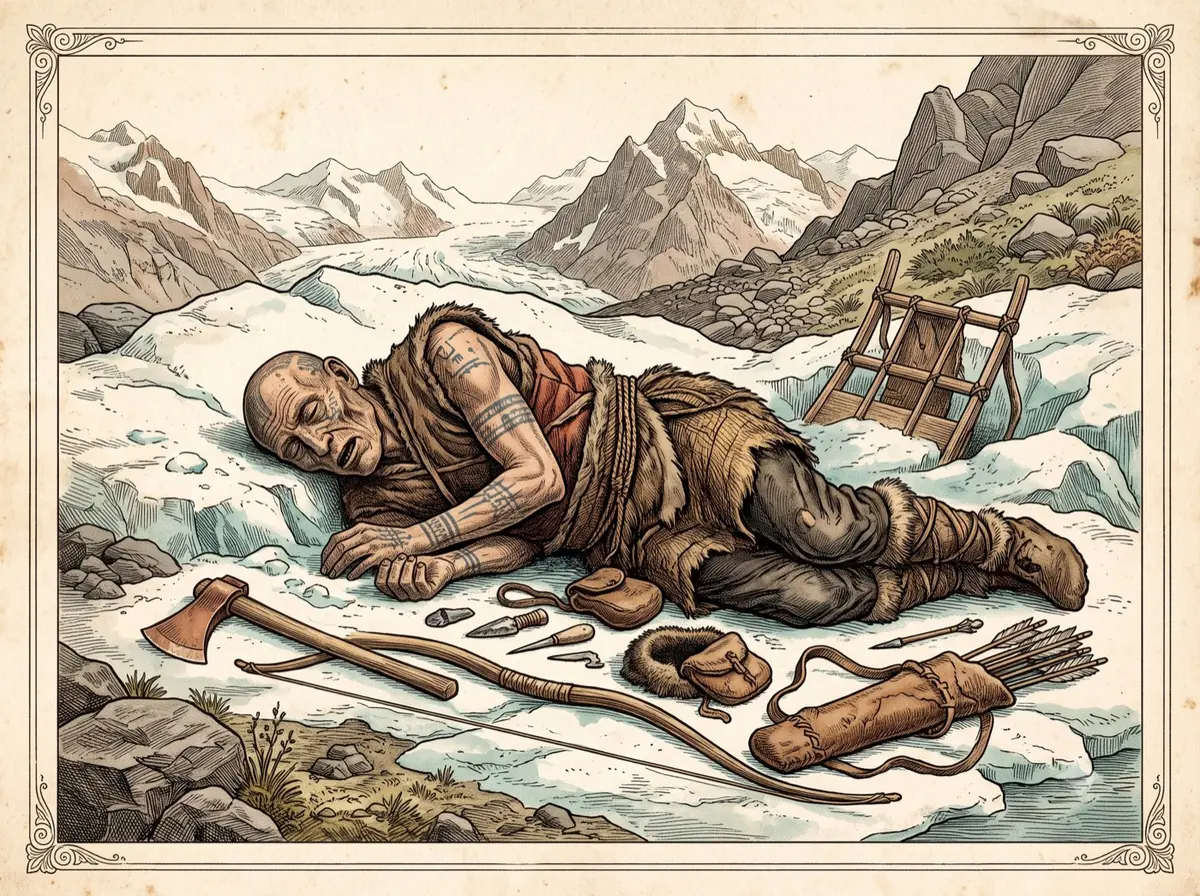
What happened: Ötzi the Iceman
On September 19, 1991, German tourists Helmut and Erika Simon were descending from a peak in the Ötztal Alps, on the border between Austria and Italy, when they found a body emerging from the ice at the Tisenjoch pass, around 3,200 meters up. Authorities first treated it as a routine alpine death and recovered the corpse with a jackhammer and ice axes, damaging it before anyone realized how old it was. Only when the equipment found nearby — a copper axe, leather clothing, a wooden-framed backpack — was examined did the truth emerge. Radiocarbon dating put the man’s death at roughly 5,300 years ago, in the Copper Age.
The press nicknamed him “Ötzi,” after the Ötztal valley. A later survey settled a brief Austrian–Italian tug-of-war by establishing that he had been found about 92 meters inside Italian territory, so today he resides in the South Tyrol Museum of Archaeology in Bolzano, Italy, kept in a custom cold cell at around –6°C to mimic the glacier.
What made Ötzi extraordinary was not just his age but his completeness. Most ancient human remains are bones. Ötzi was a natural mummy: skin, organs, hair, fingernails, and stomach all freeze-dried and preserved. He was roughly 45 years old, about 1.6 meters tall, and carried a full kit — an unfinished longbow, a quiver of arrows, a flint dagger, birch-bark containers, and that copper-bladed axe. Decades of study turned him into one of the most thoroughly examined human beings who ever lived.
For years his cause of death was a mystery. Then in 2001, radiologist Paul Gostner spotted something on a CT scan that earlier examinations had missed: a flint arrowhead lodged in Ötzi’s left shoulder. It had torn a major artery. Combined with evidence of a blow to the head, the finding rewrote the story. Ötzi had not simply frozen to death. He had been ambushed and killed — one of the oldest murder cases ever investigated.
Why it was strange: Ötzi the Iceman
The strangeness is that an ordinary man from the Copper Age, with no tomb and no monument, turned out to carry more recoverable medical information than most people who died a century ago. A frozen body is a kind of time capsule that bone alone can never be. Where archaeologists usually infer ancient health from skeletons and grave goods, Ötzi let them read soft tissue directly — and what they read was a startlingly detailed case history of a single human life and its abrupt, violent end.
Stranger still were his tattoos. Ötzi’s skin carries 61 of them, mostly small groups of lines and crosses on his lower back, knees, ankles, and wrist. These are not decorative images; they were made by rubbing soot or charcoal into fine cuts. Crucially, many sit over joints and along the spine — exactly the places where CT scans show he suffered worn cartilage and degeneration. That has led many researchers to suspect the marks were therapeutic, a Copper Age attempt to treat pain at the site of the ache, rather than ornamental.
Another treatment that history kept the receipt for: The 3,000-Year-Old Wooden Toe Scientists Test-Drove in Replica Egyptian Sandals.
What scientists learned: Ötzi the Iceman
Ötzi became a one-man encyclopedia of prehistoric health, and the verdict is that life in 3300 BCE was hard on the body. CT imaging revealed worn joints, hardened arteries, and gallstones. DNA work added more: he had brown eyes, type O blood, was lactose intolerant, and carried a genetic predisposition to cardiovascular disease. His gut held the eggs of whipworm, an intestinal parasite, and in 2016 a team led by microbiologist Frank Maixner recovered the stomach bacterium Helicobacter pylori — the same microbe behind many modern ulcers — making Ötzi the oldest known case of the infection. Researchers have also reported DNA evidence consistent with the bacterium that causes Lyme disease.
His final hours came into focus too. After his stomach was relocated on a scan in 2009 (it had been pushed up under his ribcage), analysis of its contents showed a fatty last meal of ibex and red deer meat with einkorn wheat, eaten not long before he died. The tattoos, meanwhile, are often described as the oldest preserved on any human body, though figural tattoos on roughly contemporaneous Egyptian mummies make “among the oldest” the safer claim. Either way, they remain the best evidence that people were marking skin for possibly medical reasons more than five thousand years ago.
Another odd chapter in medicine: The Ancient Egyptian Pregnancy Test That Asked Women to Pee on Grain — and Sort of Worked.
How it reaches us today: Ötzi the Iceman
Ötzi reshaped how we study the deep past. He helped launch modern “mummy science,” in which CT scanners, DNA sequencing, isotope analysis, and forensic pathology are turned on ancient remains to reconstruct individual lives in granular detail. His copper axe, traced by isotopes to ore from central Italy, forced a rethink of how far Copper Age goods and knowledge traveled. His H. pylori strain is now used to trace ancient human migrations, because the bacterium spreads within families and tracks the movements of the people it infects. And the therapeutic-tattoo hypothesis has fed real debate among medical historians about how old the impulse to treat pain at its source — including practices resembling acupuncture — might actually be.
A close cousin: The Stone Age Skull Surgery With a Higher Survival Rate Than the Civil War’s.
Fun fact: Ötzi the Iceman
Ötzi was carrying two lumps of birch polypore, a woody fungus with antibacterial and antiparasitic properties. Since he was also infected with whipworm, some researchers think he may have been packing it as medicine — a 5,300-year-old traveler with parasites in his gut and, quite possibly, a remedy for them in his pouch.
Sources: Ötzi the Iceman
- South Tyrol Museum of Archaeology — official Iceman site: https://www.iceman.it/en/
- Smithsonian Magazine, “Iceman” coverage: https://www.smithsonianmag.com/science-nature/iceman-autopsy-130865388/
- Maixner, F. et al., “The 5300-year-old Helicobacter pylori genome of the Iceman,” Science (2016): https://www.science.org/doi/10.1126/science.aad2545
- Keller, A. et al., “New insights into the Tyrolean Iceman’s origin and phenotype,” Nature Communications (2012): https://www.nature.com/articles/ncomms1701
- Encyclopædia Britannica, “Ötzi the Iceman”: https://www.britannica.com/topic/Otzi
Related stories: Ötzi the Iceman
- The 5,700-Year-Old Chewing Gum That Held an Entire Human Genome — Birch tar chewed 5,700 years ago preserved an entire human genome
- The Stone Age Skull Surgery With a Higher Survival Rate Than the Civil War’s — Neolithic skull surgery with better survival odds than Civil War hospitals
- The Runaway Goat That Led to the Dead Sea Scrolls — A goat wandered into a cave and led to the Dead Sea Scrolls