Weird Medical History · Archaeology
The Stone Age Skull Surgery With a Higher Survival Rate Than the Civil War's
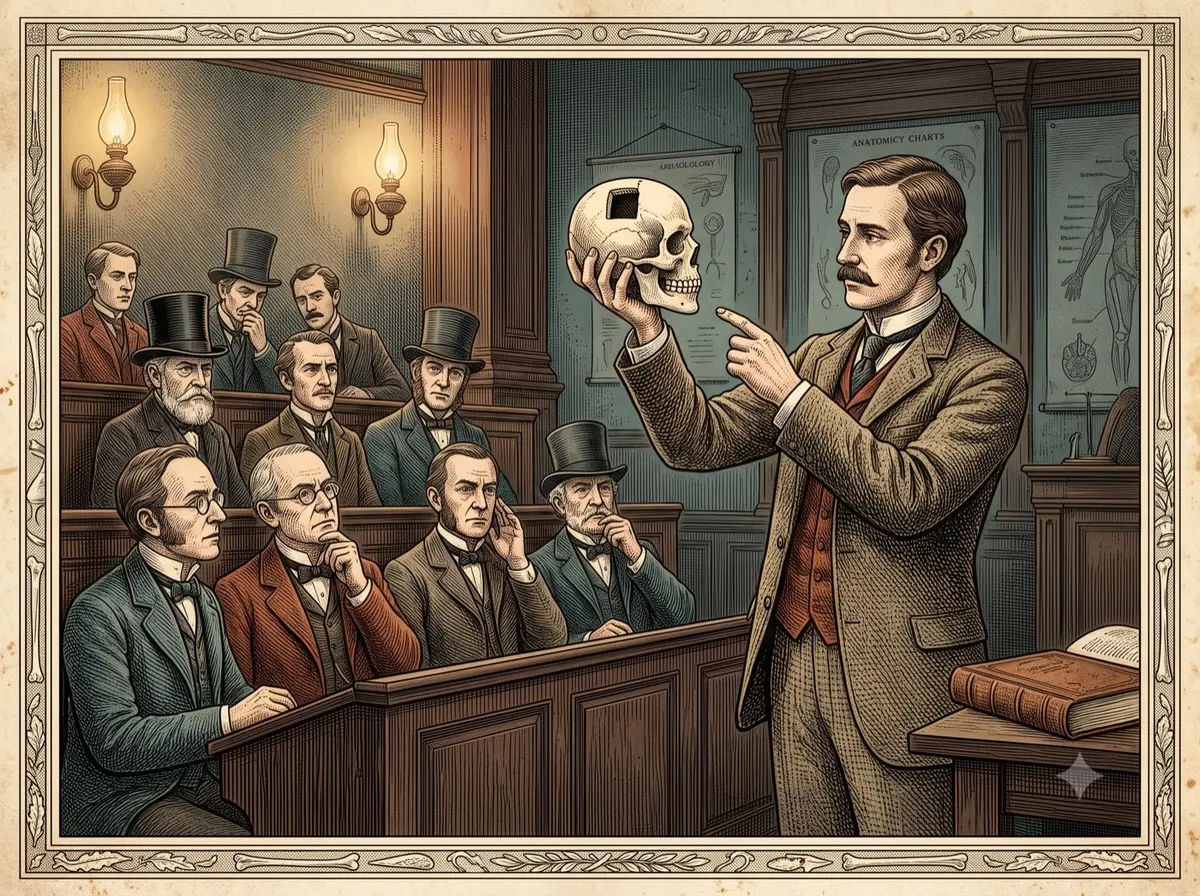
In 1865, an American archaeologist named Ephraim George Squier stood before the New York Academy of Medicine holding a human skull from Peru with a neat, deliberate hole cut into it. He told the assembled doctors that the hole hadn't killed its owner — it had been carved out on purpose, by a surgeon, and the patient had lived. The room did not believe him. Surviving a hole bored into your skull, without anesthesia, without germ theory, using a blade of volcanic glass? In the best hospitals of the 1860s, survival odds for a comparable operation on the head barely cleared one in ten.
By the Curiosities Desk · · 7 min read · Filed under Archaeology · Today’s round
Part of Medicine, Before It Was Sure
What happened: The Stone Age Skull Surgery With a Higher Survival Rate Than the Civil War's
Squier’s skull, a gift from a Cuzco antiquities collector named Señora Zentino, showed a rectangular opening about half an inch across, its edges smoothed and rounded rather than sharp and raw. That rounding mattered: it meant the bone had spent months, maybe years, quietly regrowing around the wound after surgery — proof the patient had walked away from the procedure and kept living. Squier carried the skull to Paris and put it in front of Paul Broca, the anatomist who would later become famous for identifying the brain’s speech center. Broca examined it, consulted surgical colleagues, and in 1867 agreed: this was a real operation with a real survivor, performed by people the New York and Paris medical establishments had assumed were incapable of it.
The procedure is called trepanation (or trephination) — cutting, scraping, or drilling a hole through the skull to expose the tough membrane, called the dura mater, that wraps the brain. It’s the oldest surgical procedure archaeologists can document, with confirmed examples stretching back 7,000 to 10,000 years across Europe, Asia, Africa, and the Americas. A 6500 BCE burial site in France turned up 40 trepanned skulls out of 120. More than 1,500 trepanned Neolithic skulls have been catalogued worldwide.
Nowhere practiced it more than the Andes. Bioarchaeologists have recovered more than 800 trepanned skulls from Peru — more than the rest of the world’s known examples combined — spanning nearly 2,000 years, from around 400 BCE through the Inca Empire’s collapse in the 1500s. Early operators worked with blades knapped from obsidian, volcanic glass sharper than surgical steel; later surgeons switched to bronze and copper, favoring a curved ceremonial knife called a tumi. Warfare in the Andean highlands, fought with slings and war clubs aimed squarely at the head, supplied no shortage of patients with skull fractures needing exactly this kind of care. There are no written surgical manuals from Inca Peru, so exactly what surgeons used for pain relief is unconfirmed — coca leaf and fermented corn beer, chicha, are the leading guesses, based on their known use in the region.
Why it was strange: The Stone Age Skull Surgery With a Higher Survival Rate Than the Civil War's
The strangeness isn’t just that ancient people cut holes in living heads and some of them lived. It’s that they got measurably better at it than surgeons operating three centuries later with far more formal medical training. A 2018 study by physician David Kushner and bioarchaeologists John Verano and Anne Titelbaum compared healing rates across those 800-plus Peruvian skulls against documented cranial surgeries from the American Civil War. During the Inca period, roughly 75 to 83 percent of trepanation patients survived. Civil War soldiers who underwent similar skull surgery, performed by trained doctors in the 1860s, died at a rate of 46 to 56 percent — worse odds, despite two extra millennia of accumulated medical knowledge standing between the two groups.
Another treatment that history kept the receipt for: The 3,000-Year-Old Wooden Toe Scientists Test-Drove in Replica Egyptian Sandals.
What scientists learned: The Stone Age Skull Surgery With a Higher Survival Rate Than the Civil War's
Researchers read survival directly off the bone. A skull edge that’s sharp and unchanged means the patient died during or shortly after surgery; an edge that’s smoothed, rounded, and covered in new bone growth (a process called osteogenesis) means the wound healed, sometimes for years. Applying that method across centuries of Peruvian skulls, Kushner, Verano, and Titelbaum showed survival climbing steadily over time — from roughly 40 percent in the earliest samples to as high as 91 percent by the Inca era — as surgeons refined their technique. They learned to keep openings small, since larger holes killed more often. They learned to avoid the skull’s suture lines and the sagittal sinus, a major blood vessel running down the midline, and to stop short of piercing the dura mater itself — the same rule Hippocrates was independently writing down in Greece around the same centuries. What still puzzles researchers is infection control: Civil War surgeons, probing wounds with unwashed fingers and shared instruments, spread infection routinely. How ancient Peruvian surgeons, operating outdoors with stone and metal tools and no concept of germs, apparently avoided that fate as often as they did remains an open question.
Another odd chapter in medicine: The Ancient Egyptian Pregnancy Test That Asked Women to Pee on Grain — and Sort of Worked.
How it reaches us today: The Stone Age Skull Surgery With a Higher Survival Rate Than the Civil War's
Every modern neurosurgeon who performs a craniotomy — removing a section of skull to relieve pressure from bleeding, remove a tumor, or reach damaged tissue — is doing a direct descendant of trepanation. The difference isn’t the basic act of opening the skull; it’s everything now wrapped around it: anesthesia, sterile technique, imaging like CT and MRI scans that show surgeons exactly where to cut before they ever touch bone, and cranial drills engineered with safety stops so they can’t plunge into brain tissue. The core insight — that a skull can be opened and the person inside it can still be a person afterward — is one ancient surgeons on multiple continents arrived at independently, working it out one patient at a time, long before anyone could explain why it sometimes worked.
A close cousin: The Coffin That Waved a Flag If You Woke Up Buried — and Flunked Its Own Demonstration.
Fun fact: The Stone Age Skull Surgery With a Higher Survival Rate Than the Civil War's
The tumi, the curved bronze knife Peruvian surgeons used for trepanation, didn’t disappear with the Inca Empire. It’s now the official emblem of the Peruvian Academy of Surgery, and its silhouette shows up on everything from jewelry to tourism logos across Peru today — a surgical tool turned national symbol.
Sources: The Stone Age Skull Surgery With a Higher Survival Rate Than the Civil War's
- Kushner, D.S., Verano, J.W., and Titelbaum, A.R., “Trepanation Procedures/Outcomes: Comparison of Prehistoric Peru with Other Ancient, Medieval, and American Civil War Cranial Surgery,” World Neurosurgery, 2018
- University of Miami Miller School of Medicine, “Holes in the Head” (news coverage of the Kushner/Verano/Titelbaum study)
- Charles G. Gross, “A Hole in the Head: A History of Trepanation,” The MIT Press Reader
- Wikipedia, “Trepanning” (cross-referenced against its cited academic sources)
Related stories: The Stone Age Skull Surgery With a Higher Survival Rate Than the Civil War's
- The 5,300-Year-Old Iceman Whose Tattoos May Have Been Medicine — A 5,300-year-old murder victim whose tattoos may have been treatment
- The Man Who Took an Iron Rod Through His Brain and Lived — An iron rod through the skull, and the man who lived to change neuroscience
- The Surgeon So Fast He Supposedly Killed Three People With One Amputation — The surgeon so fast his amputation supposedly killed three people