Weird Medical History · Engineering
The Coffin That Waved a Flag If You Woke Up Buried — and Flunked Its Own Demonstration
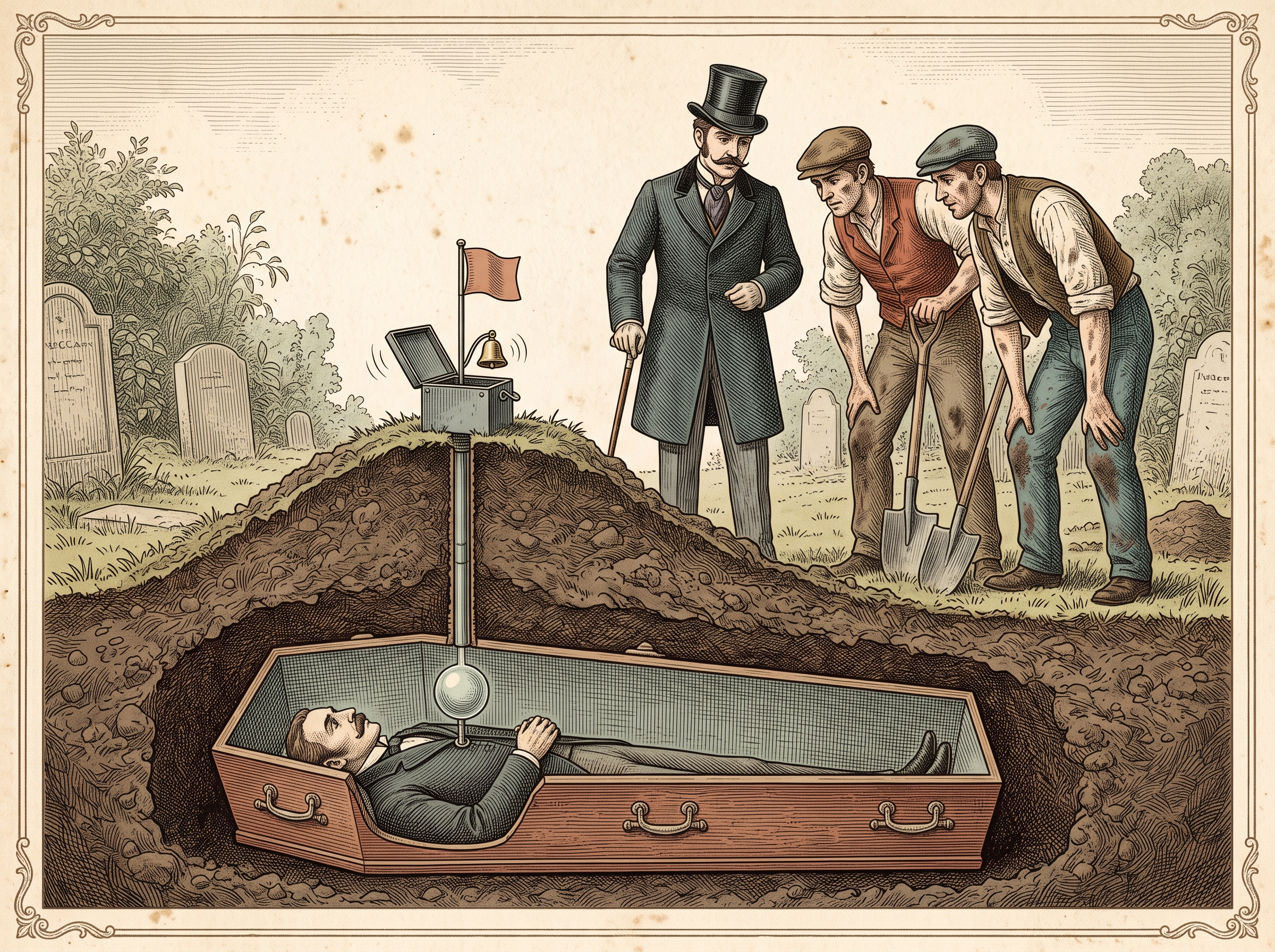
In 1896, Count Michel de Karnice-Karnicki received a U.S. patent for a coffin with a glass ball resting on the occupant's chest. If the "dead" person so much as took a breath, the ball would shift, a spring-loaded box on top of the grave would fly open, a bell would ring, and a little flag would pop up to tell the cemetery: *this one isn't finished yet.* It was a clever machine. According to the stories later told about it, it also failed the one public test that mattered.
By the Curiosities Desk · · 5 read · Filed under Engineering · Today’s round
What happened?
To understand why anyone would build a coffin with a doorbell, you have to understand a fear that gripped Europe and America for more than a century: taphophobia, the dread of being buried alive. Before modern medicine, declaring death was surprisingly uncertain. Doctors had no electrocardiograms, and a faint pulse or shallow breathing could be missed in a person in a deep coma or under heavy sedation. Newspapers loved lurid tales of scratched coffin lids, and Edgar Allan Poe’s 1844 story “The Premature Burial” gave the fear a literary voice.
Inventors answered with engineering. Duke Ferdinand of Brunswick, who died in 1792, is often credited with the first recorded safety coffin: it reportedly had a window, an air tube, and a locked lid instead of a nailed one, with the keys tucked into his shroud. German designers went further. In 1822, Dr. Adolf Gutsmuth of Seehausen demonstrated his own design by having himself buried alive for several hours, during which, according to the Australian Museum, he was served soup, beer, and sausages through the coffin’s feeding tube. In 1829, Dr. Johann Gottfried Taberger designed a system that tied strings to a body’s hands, feet, and head and ran them up to a bell in a little housing above ground, with mesh to keep out insects.
Karnice-Karnicki, a Russian chamberlain living in Warsaw, built the most elaborate version. His U.S. patent, No. 572,119, issued on December 1, 1896, is titled plainly: “Apparatus for Saving People Buried Alive.” A pipe ran from the coffin lid up to a box on the grave. Inside the pipe hung a rod ending in a hollow ball placed “close to the breast of the person buried.” The slightest movement would nudge the rod and release a spring catch. The box’s lid would snap open, letting air and light down the tube; a signal rod with a small flag would swing upright; and a spring-driven bell would sound. The patent even specified painting the inside white, so the reflected light could reach the person below.
The device, which he called “Le Karnice,” was presented in Paris in 1897 and later promoted in New York. Then came the demonstration. Historians who have written about it, including Jan Bondeson in his book Buried Alive, describe a test in which one of the count’s assistants was buried in the coffin and the flag and bell did not trigger as promised. The assistant was dug up unharmed, but the device’s reputation never recovered. The surviving accounts are thin on specifics, so the exact date, place, and sequence of that failed trial should be treated as uncertain.
Why was it strange?
The deepest irony is that safety coffins were built to solve a problem they could barely detect. Bodies move after death. As decomposition sets in, gases cause swelling and shifting, which can tug a string or nudge a ball. Critics at the time made exactly this point: a French physician, M. E. Vallin, reportedly warned that Le Karnice was too sensitive and could be set off by a swelling abdomen. A device designed to rescue the living could just as easily send gravediggers running to exhume the dead.
There is also no documented case of anyone ever being saved by a safety coffin. The Australian Museum notes that there is no clear evidence any of these devices worked as intended, and the one well-recorded “survivor” was Gutsmuth himself, who climbed out of his own staged demonstration, presumably full of sausage.
Another treatment that history kept the receipt for: The Box of Light Bulbs the Corn Flakes Doctor Said Cured a King.
What did scientists learn?
The real fix for premature burial was not a better bell. It was better medicine. Over the 19th and 20th centuries, doctors developed more reliable ways to confirm death: listening with the stethoscope for an extended period, checking the pupils’ response to light, and eventually measuring the heart’s electrical activity. Legal waiting periods before burial, death certificates signed by a physician, and widespread embalming all closed the gap that had terrified people.
Safety coffins also offer an engineering lesson about sensors. A detector is only as good as its ability to tell signal from noise, and Le Karnice’s glass ball could not tell a waking chest from a settling one. Modern engineers face the same trade-off in smoke alarms, medical monitors, and car crash sensors: too sensitive and you get false alarms; not sensitive enough and you miss the real thing.
Another odd chapter in medicine: The Dinner Party Where Three Doctors Sniffed Chloroform and Woke Up Under the Table.
How does it affect us today?
The fear left a lasting mark on language, though not the one most people think. Popular stories claim that “saved by the bell,” “dead ringer,” and “graveyard shift” come from coffin bells and night watchmen listening for them. Linguists disagree. The Oxford English Dictionary traces “saved by the bell” to boxing, with a 1909 newspaper describing a fighter who was saved from a knockout by the bell ending the round.
Even the most-quoted safety coffin may never have existed. Many websites describe “Bateson’s Belfry,” a bell device supposedly patented by a Victorian named George Bateson. Independent scholar Jeremy Stern traced that story back to Michael Crichton’s 1975 novel The Great Train Robbery and found no original records of Bateson at all, a reminder that a good story can be printed and reprinted long after anyone checks it.
Safety coffins themselves never fully vanished. In 1995, inventor Fabrizio Caselli patented a modern version complete with an alarm, an intercom, a flashlight, and a heart monitor.
A close cousin: The Everlasting Pill That Families Fished Out of the Chamber Pot and Passed Down.
Fun fact
The legend of “Bateson’s Belfry” says Queen Victoria rewarded its inventor with an OBE in 1859. The Order of the British Empire wasn’t created until 1917, 58 years later.
If thinking about death or loss is weighing on you, it can help to talk with someone you trust or a counselor.
Sources
- U.S. Patent No. 572,119: “Apparatus for Saving People Buried Alive,” Michael Karnicki (1896)
- Australian Museum: “Safety coffins”
- Jeremy Stern, “A Tale Worthy of Poe: The Myth of George Bateson,” History News Network
- AAP FactCheck: “Phrase origins linked to burials is dead wrong” (citing the Oxford English Dictionary)
- Mental Floss: “Le Karnice, the Victorian Coffin Designed to Save Lives”